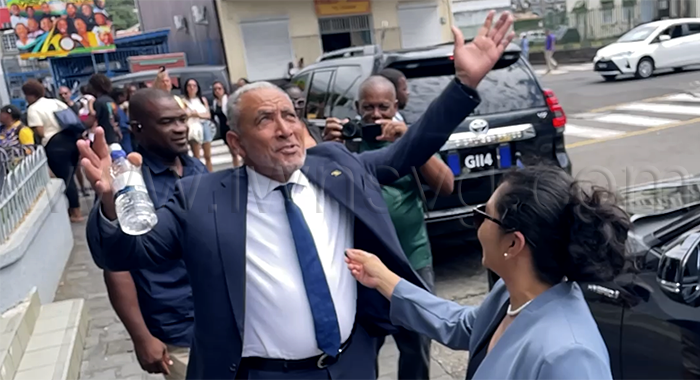
Prime Minister Godwin Friday displayed unwavering confidence as he departed the High Court in Kingstown following a crucial case management hearing on Thursday. The legal proceedings center on constitutional challenges brought by the opposition Unity Labour Party (ULP) questioning the eligibility of both Friday and his Foreign Affairs Minister Dwight Fitzgerald Bramble to hold parliamentary seats due to their Canadian citizenship status.
When pressed by journalists for commentary, Friday responded with notable composure: “Yeah. It’s a beautiful day.” Gesturing toward the sunny skies, he added, “It is a wonderful day. Look at the sunshine,” before deferring to his lead counsel, Anand Ramlogan S.C. of Trinidad and Tobago.
The constitutional dispute emerges despite Friday’s National Democratic Party (NDP) achieving a landmark electoral victory in November 2025, securing 14 of 15 parliamentary seats with a substantial margin of 10,055 votes over the ULP. This represents the most decisive electoral mandate since the NDP’s complete sweep in 1989.
Ramlogan characterized the hearing as “an interesting, if not amusing experience,” suggesting the petitions represent an attempt to subvert democratic processes rather than honor the electorate’s clear decision. He confirmed the court has established an accelerated timeline, with evidence submissions due before a scheduled trial from July 28-30.
Representing the ULP, former Trinidad and Tobago Prime Minister Stuart Young emphasized the case’s profound constitutional significance for Vincentian governance. “What is being determined by the court really is an interpretation of your constitutional provisions and the qualification, or the disqualification to stand as a candidate for elections,” Young stated, noting that while other Caribbean jurisprudence might inform proceedings, St. Vincent’s constitutional framework contains unique provisions.
The litigation specifically challenges the nomination acceptance processes undertaken by returning officers and the Supervisor of Elections. Both cases name the Attorney General as respondent, with representation teams comprising multiple Caribbean legal experts including non-national attorneys from Trinidad and England.