The assassination of Iran’s Supreme Leader Ayatollah Ali Khamenei in a joint U.S.-Israeli airstrike has triggered seismic geopolitical repercussions across the Middle East and beyond, unleashing both mourning and celebration while threatening regional stability.
International responses reflect deep ideological divisions. European Union foreign policy chief Kaja Kallas characterized the event as a historic turning point that could potentially open pathways toward greater Iranian freedoms, while simultaneously warning of persistent uncertainties. Russian President Vladimir Putin conveyed profound condolences to Khamenei’s family, condemning the operation as a cynical violation of international law and moral principles.
Middle Eastern powers demonstrated remarkable unity as Qatar, UAE, Bahrain, Kuwait and Saudi Arabia unanimously condemned Iranian missile attacks following the assassination, emphasizing their sovereign right to self-defense. Bahrain specifically denounced the assault on the U.S. Fifth Fleet as ‘treacherous.’
France’s President Emmanuel Macron urgently convened a UN Security Council meeting, highlighting escalation dangers and calling for renewed negotiations on Iran’s nuclear and ballistic programs. Sweden’s Foreign Minister Maria Stenergard cautiously acknowledged potential opportunities while warning against descending into violence spirals.
In Southeast Asia, Indonesia’s Ulema Council expressed deep sympathy and criticized U.S. involvement, urging withdrawal from the Board of Peace organization which they claim promotes unequal security policies. Pakistan’s Foreign Minister Ishaq Dar condemned the attacks while advocating immediate diplomatic de-escalation.
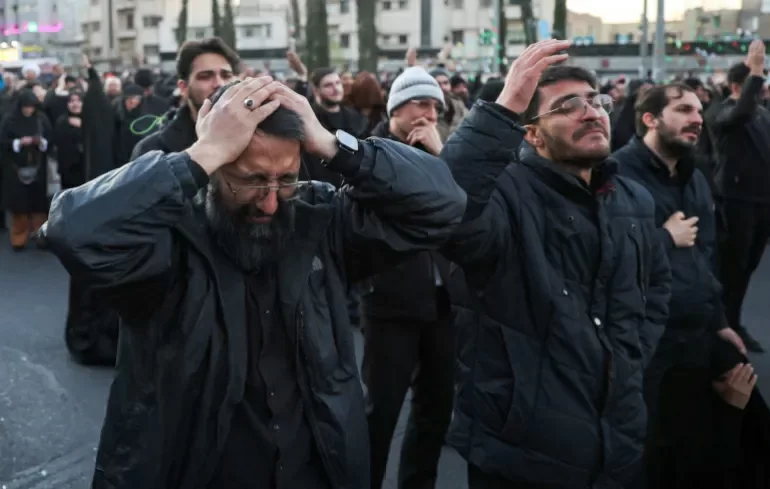
Domestically, Iran presented contrasting narratives. State television broadcast images of black-clad mourners gathering in Tehran’s Enghelab Square, while simultaneous celebrations erupted in Dehloran, Karaj and Izeh. In Galleh Dar, protesters toppled a monument of Islamic Republic founder Ayatollah Khomeini, with one celebrator exclaiming, ‘Hello new world!’ Educational professionals expressed concerns about potential Iraqi-style chaos engulfing the nation.
The assassination ignited violence across Shiite communities worldwide. Karachi witnessed deadly riots at the U.S. consulate claiming at least nine lives, while protesters set fire to a UN office in Skardu. Baghdad police deployed tear gas against pro-Iranian demonstrators near the U.S. embassy, where crowds chanted ‘Death to America’ and ‘Death to Israel.’ Western diplomatic missions and multinational corporations across Pakistan have significantly enhanced security protocols.
This watershed moment underscores profound global divisions, with the coming days likely determining not only Iran’s future trajectory but regional stability throughout the Middle East.