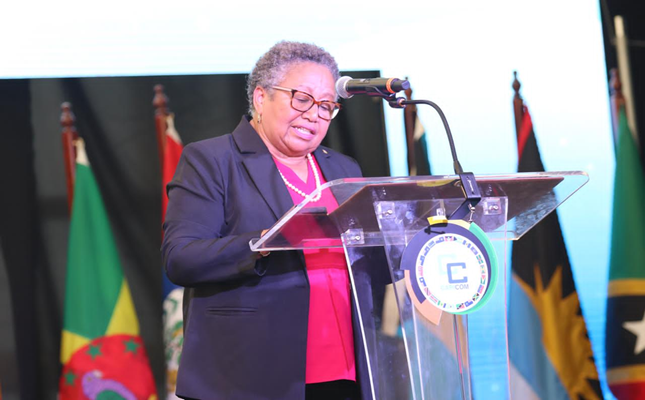
The Caribbean Community (CARICOM) commenced its landmark 50th Regular Meeting of the Conference of Heads of Government in St. Kitts and Nevis, with Secretary-General Dr. Carla Barnett presiding over the opening ceremony. The gathering marks a significant milestone for regional integration amidst complex global challenges.
Secretary-General Barnett extended formal acknowledgments to host nation leadership, including Governor-General Dame Marcella A. Liburd and Prime Minister Dr. Terrance Drew, who currently chairs the CARICOM leadership council. The Secretary-General praised St. Kitts and Nevis for demonstrating exceptional organizational capability despite being the smallest sovereign state within the community, having previously hosted two major CARICOM meetings in 2025.
Prime Minister Drew’s tenure as chairman, which began January 1, has already established a pattern of proactive engagement, commencing with emergency regional meetings during the year’s first weekend and continuing with extensive diplomatic visits throughout member states.
The address reflected on 2025 as one of the most challenging periods in CARICOM’s history, particularly highlighting Hurricane Melissa’s catastrophic impact across Haiti, The Bahamas, Bermuda, and Jamaica. The Category 5 system caused extensive devastation, with Jamaica experiencing particularly severe consequences. The community collectively acknowledged former Chairman Prime Minister Andrew Holness of Jamaica for his decisive leadership during the crisis response.
CARICOM’s institutional response mechanisms, including the Caribbean Disaster Emergency Management Agency and the Caribbean Public Health Agency, demonstrated remarkable coordination in providing immediate humanitarian assistance, technical damage assessments, and recovery support. This collective action exemplified the community’s resilience and mutual support principles.
The past year also witnessed significant democratic exercises across seven member states and four associate members, with several landmark electoral outcomes. Suriname inaugurated its first female president, Dr. Jennifer Geerlings-Simons, while multiple nations returned or elected new leadership through peaceful processes.
The current summit’s agenda addresses pressing regional priorities, with substantial time allocated for candid deliberations. Full representation at the head-of-government level despite domestic pressures underscores member states’ commitment to collective action.
Notable developments include four member states—Barbados, Belize, Dominica, and St. Vincent and the Grenadines—implementing full free movement provisions under the CARICOM Single Market and Economy framework since October 2025. This pioneering integration effort has already facilitated increased economic activity and people-to-people connections.
The evolving global landscape presents both challenges and opportunities, particularly in energy transition, digital infrastructure, climate resilience, and technological advancement. CARICOM’s coordinated foreign policy approach continues to attract international engagement, evidenced by high-level participation from Saudi Arabia, the United Arab Emirates, and the Commonwealth Secretariat.
The community is actively strengthening South-South partnerships, notably with the African Union through institutions like Afreximbank. The second CARICOM-Africa Summit in 2025 established frameworks for enhanced cooperation in finance, reparations advocacy, air connectivity, and cultural exchange.
As CARICOM celebrates five decades of regional integration, the organization continues to advance human development, foreign policy coordination, security cooperation, and economic progress. The current summit aims to translate commitments into concrete actions that ensure a sustainable and prosperous future for all Caribbean citizens.