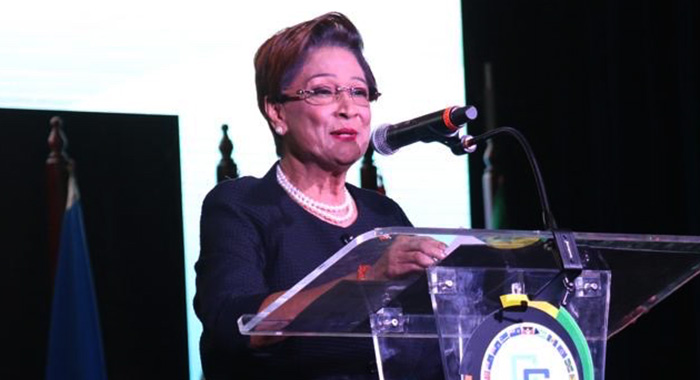
In a striking address at the 50th Regular Meeting of CARICOM Heads of Government in St. Kitts and Nevis, Trinidad and Tobago Prime Minister Kamla Persad-Bissessar delivered a robust defense of her nation’s security partnership with the United States while issuing sharp criticism of regional counterparts for their silence on Venezuelan aggression.
The Prime Minister articulated her government’s position with exceptional clarity, emphasizing that sovereign nations must determine their own foreign policy approaches based on national security requirements. She directly addressed what she termed ‘the elephant in the room’ – Trinidad’s cooperation with the Trump administration – framing it as an essential measure for combating transnational crime rather than a deviation from regional unity.
Persad-Bissessar presented compelling statistics to substantiate her position, revealing that Trinidad and Tobago, with a population of 1.4 million, had recorded 623 murders in 2024, with 40% directly linked to firearms and narcotics trafficking originating from Venezuela. She challenged the regional concept of a ‘zone of peace,’ arguing that such rhetoric becomes meaningless when member states face existential security threats.
The Prime Minister detailed how policy shifts in 2025 – including designating drug cartels as violent terrorist organizations and collaborating with US military operations – produced dramatic results: a 42% reduction in murder rates equating to 257 fewer deaths. She extended specific gratitude to President Trump, Secretary of State Marco Rubio, and US military forces for their assistance in combating narco-trafficking, arms smuggling, and illegal migration networks.
Persad-Bissessar contrasted her government’s approach with what she characterized as inadequate regional support, noting that many CARICOM members lack the military capacity to provide meaningful assistance. She acknowledged Jamaica’s success in reducing murder rates through specialized legislation while noting Trinidad’s parliamentary challenges in implementing similar measures.
The Prime Minister concluded with a firm declaration that partnership with the United States represents not a undermining of Caribbean unity but rather a defense of regional security interests, vowing to continue cooperation to eliminate destructive criminal forces from the hemisphere.