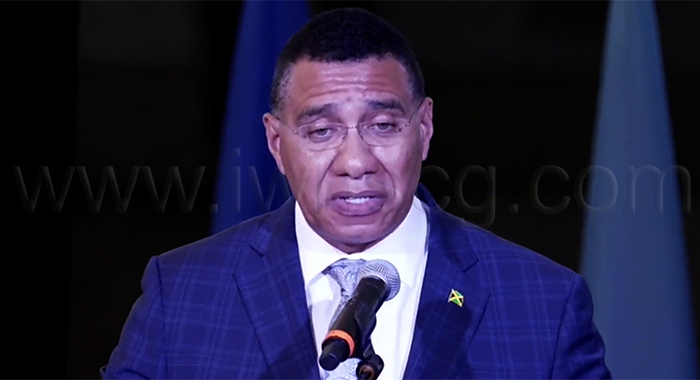
Jamaican Prime Minister Andrew Holness has delivered a paradigm-shifting address at the 50th CARICOM summit in Basseterre, fundamentally redefining the Caribbean Community’s operational philosophy. Contrary to popular perception, Holness emphasized that CARICOM constitutes an association of sovereign states rather than a political union, with no treaty obligations mandating unified foreign policies or supranational governance.
The Prime Minister articulated a compelling vision for regional cooperation amidst accelerating global disruptions. “Climate shocks arrive faster than our financing mechanisms, criminal networks adapt faster than our institutions, and technological disruption reshapes economies faster than our regulatory frameworks,” Holness observed, highlighting the urgent need for responsive governance structures.
Holness challenged conventional integration narratives, arguing that CARICOM’s strength lies not in uniformity but in its diversity of democratic expressions. “Variations in national perspectives are not a liability to be feared but a resource to be harnessed,” he asserted, framing member states’ differing risk assessments and priority sequences as natural expressions of sovereignty rather than institutional weakness.
The address positioned regional security as a binding imperative, citing sophisticated transnational criminal networks that increasingly challenge state authority. Referencing Jamaica’s developed security architecture—forged through persistent violence—Holness proposed knowledge-sharing as organic integration: “Our region’s variability is not an obstacle to integration. It is integration, practical, organic and rooted in shared learning.”
On geopolitical matters, Holness addressed Cuba’s escalating crisis with unprecedented candor, warning that economic hardship and energy shortages could trigger regional destabilization through migration and security spillovers. While affirming Jamaica’s commitment to democratic principles and market economies, he advocated for pragmatic U.S.-Cuba dialogue focused on humanitarian relief and de-escalation.
The Prime Minister also delineated digital sovereignty as critical for Caribbean nations, noting that control over information platforms and algorithms now influences economic power as profoundly as physical resources historically did. He positioned the Caribbean Single Market and Economy (CSME) as the primary vehicle for building scalable digital infrastructure and economic resilience through flexible integration models.
Holness concluded by framing CARICOM’s role as a community of democratic states offering cooperation rather than ideological bloc politics, emphasizing “principled realism” during global systemic transformation.