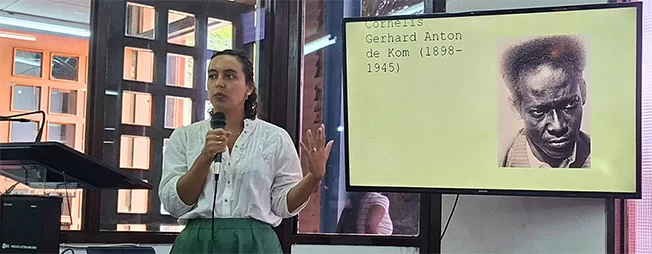
Suriname witnessed a landmark academic event as scholars gathered at the Anton de Kom University Library for the nation’s inaugural Anton de Kom Lecture. The Friday symposium, jointly organized by Stichting Skrifi, the Anton de Kom Foundation, and the University Library, brought renewed attention to the enduring intellectual legacy of the Surinamese writer and anti-colonial visionary.
Eighty-nine years after the publication of his seminal work “We Slaves of Suriname” (1934), De Kom’s philosophical contributions continue to resonate across generations. The event featured pioneering research by Dutch-Surinamese literary scholar Thalia Ostendorf, who presented previously unexamined archival materials revealing the author’s multifaceted literary production.
De Kom (1898-1945), recognized as both a resistance hero and groundbreaking thinker, authored what scholars consider a foundational text in the struggle against colonial oppression. His work maintains profound influence contemporary discourses on freedom, justice, and emancipation, with his birthday anniversary observed annually on February 22nd.
Ostendorf’s lecture emerged from her current research residency in Suriname, where she is preparing a biography on Surinamese author Bea Vianen. Her investigation into the Literary Museum in The Hague uncovered De Kom’s extensive archival collection, comprising two boxes of documents that challenge conventional understanding of his literary output.
“During his lifetime, De Kom published only one book,” Ostendorf revealed. “The archive demonstrates he was actually a versatile writer who transcended genre boundaries—producing novels, poetry, Anansi stories, and even a complete film script with shooting directions.”
The researcher emphasized the significance of physical archival materials, including correspondence with publishers, handwritten poems, and detailed screenplays, while noting the unfortunate disappearance of the original manuscript for “We Slaves of Suriname.”
The event also honored the late Carl Haarnack, former chairman of the Anton de Kom Foundation, who contributed to the lecture’s preparation. This gathering marks growing scholarly interest in De Kom’s work, particularly as his ideas gain broader recognition beyond Surinamese-Dutch communities in the Netherlands.