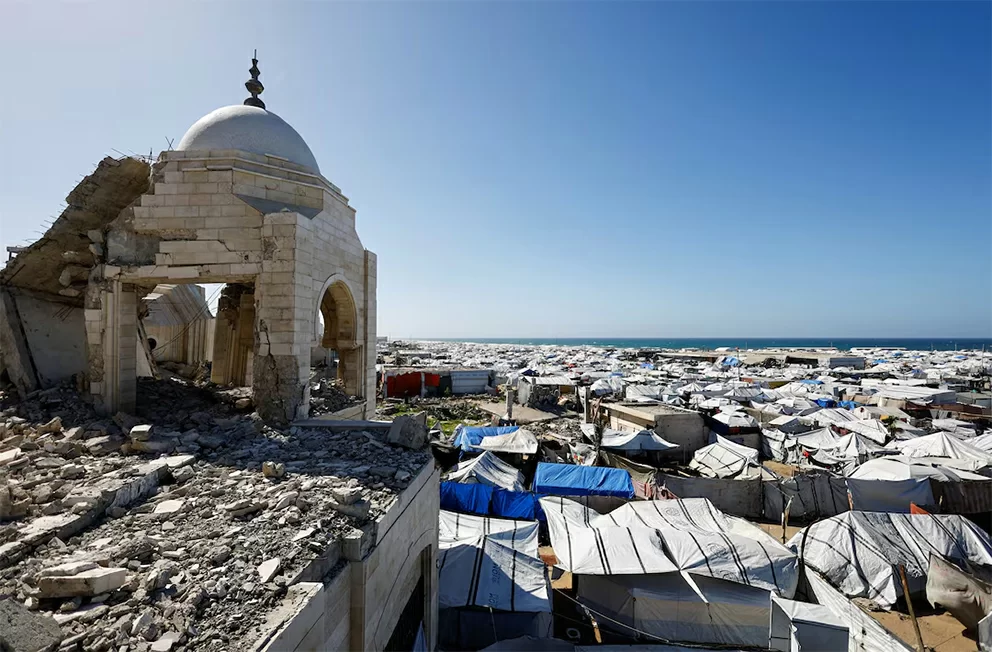
As the holy month of Ramadan commenced in Gaza on Wednesday, Palestinian worshippers turned to the shattered remnants of destroyed mosques and improvised prayer spaces constructed from tarpaulins and wood, demonstrating remarkable spiritual resilience amid widespread devastation.
The landscape of Gaza City reveals the profound scale of destruction, with the dome of the obliterated Al Hassaina mosque now resting atop mounds of rubble. What was once a courtyard filled with worshippers has transformed into a living space where displaced families now sleep, cook, and hang laundry between broken columns and debris.
Sami Al Hissi, a 61-year-old mosque volunteer, expressed profound grief while standing amidst the ruins: “I cannot bear to look at this destruction. We once prayed here comfortably, surrounded by friends and loved ones. Now there are no loved ones, no friends, and no mosque remaining.”
The current reality represents both spiritual and societal devastation for Gaza’s residents. According to figures from the Hamas-run government’s media office, 835 mosques have been completely destroyed and 180 partially damaged during the conflict that began after Hamas’s cross-border attack on October 7, 2023, which Israeli authorities say killed 1,200 people. Additionally, 40 of Gaza’s 60 cemeteries have reportedly been destroyed.
Israel maintains that its military operations target Hamas infrastructure and accuses Palestinian armed groups of using civilian areas, including mosques, for military purposes—an allegation Hamas denies. Palestinian health authorities report approximately 72,000 Palestinian casualties since the conflict began.
Despite catastrophic damage and severe shortages of construction materials, community efforts have created 430 makeshift prayer spaces using repurposed plastic greenhouse covers, wood, and tent materials, according to Amir Abu Al-Amrain, director of Gaza City’s religious affairs ministry.
Khitam Jabr, a displaced resident now sheltering in a mosque, articulated the collective disappointment: “We had hoped to celebrate Ramadan in a different atmosphere. With most mosques destroyed, we now pray in tents that have become shelters for the displaced.”
The commencement of Ramadan in Gaza underscores both the depth of religious faith persisting through conflict and destruction, and the community’s extraordinary resilience despite overwhelming hardship. The situation highlights the urgent need for humanitarian assistance and sustainable solutions to alleviate Palestinian suffering in the region.