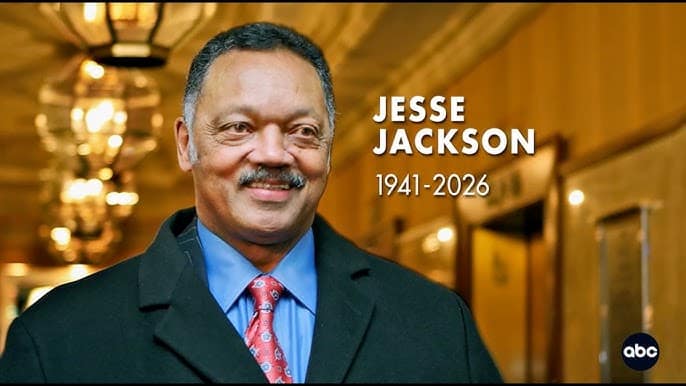
The Reverend Jesse Louis Jackson, a monumental figure in the American civil rights movement whose profound moral leadership and powerful oratory permanently altered the nation’s political landscape, has passed away at age 84. The confirmation came from a spokesperson for the Rainbow Push Coalition, the organization Jackson founded.
Jackson, who had been hospitalized in recent months while battling progressive supranuclear palsy (PSP), emerged from humble beginnings in segregated Greenville, South Carolina. Born to an unmarried teenage mother during the Jim Crow era, he would eventually become one of America’s most influential civil rights leaders and a transformative political force.
As a protégé of Dr. Martin Luther King Jr., Jackson first gained national prominence in the 1960s. Following King’s assassination in 1968, he charted his own course as a dynamic leader, sometimes drawing criticism from other King associates who considered him overly bold in his approach.
Jackson’s most significant political contributions came through his groundbreaking presidential campaigns in the 1980s. His dual bids for the Democratic nomination electrified Black communities nationwide and surprised political analysts with their ability to attract substantial White voter support. Long before Barack Obama’s national emergence, Jackson demonstrated that a Black candidate could achieve significant crossover appeal.
His visionary Rainbow Coalition concept—an ambitious alliance embracing Blacks, Whites, Latinos, Asian Americans, Native Americans, and LGBTQ individuals—fundamentally reshaped Democratic Party politics. Jackson famously articulated this vision: “Our flag is red, white and blue, but our nation is a rainbow – red, yellow, brown, Black and White – and we’re all precious in God’s sight.”
Beyond his inspirational rhetoric, Jackson engineered concrete political changes with lasting impact. He successfully advocated for replacing winner-take-all delegate allocation in Democratic primaries with a proportional system—a reform that ultimately facilitated Obama’s come-from-behind victory over Hillary Clinton in 2008.
Jackson’s signature mantra, “Keep hope alive,” became more than just a catchphrase; it embodied his lifelong commitment to social justice across three distinct eras: Jim Crow segregation, the civil rights movement, and the post-civil rights period culminating in Obama’s election and the Black Lives Matter movement.
Despite facing childhood insecurities as what biographers described as a “double outcast” due to his race and circumstances of birth, Jackson developed into one of America’s most gifted communicators. He masterfully incorporated the rhythmic cadences and poetic imagery of Black church tradition into political discourse, captivating audiences with his eloquence and his empowering refrain: “I Am Somebody.”
Historians now recognize Jackson as a crucial trailblazer who demolished the perception that a Black candidate couldn’t be politically viable on the national stage. His legacy endures in the multicultural Democratic Party he helped create and in the millions of Americans who continue to draw inspiration from his dream of a vibrant, multiracial democracy.