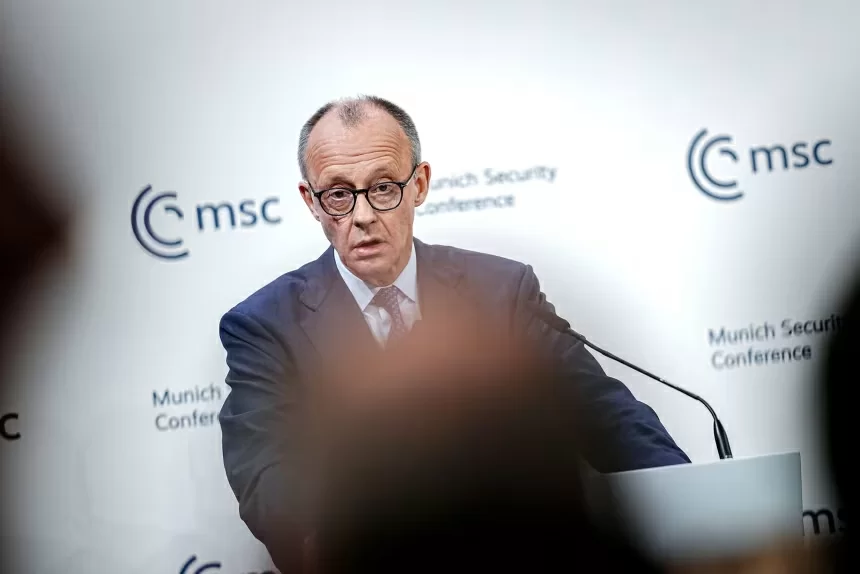
The 62nd Munich Security Conference has delivered a sobering assessment of the current global landscape, with German Chancellor Friedrich Merz declaring that ‘the old world order no longer exists.’ The gathering revealed a world increasingly characterized by rearmament, geopolitical tensions, and diminishing trust among nations.
Major powers are actively redistributing spheres of influence while strengthening their military arsenals, often appearing indifferent to human suffering in conflict zones that fall outside their strategic interests. What was once viewed as an era of globalization and interconnectedness is rapidly transforming into an age of fragmentation and intense competition.
Europe is accelerating its rearmament efforts, largely driven by the ongoing war in Ukraine which is perceived as an existential threat. Simultaneously, as the United States and China escalate their power struggle, numerous crisis regions including Syria, Sudan, Myanmar, Kenya, and Gaza continue to demand international attention and humanitarian assistance that remains insufficient.
The conference highlighted concerning trends: the rules-based international order that provided stability since the end of the Cold War appears increasingly obsolete. Major nations are prioritizing their own security interests above collective action, resulting in eroding trust among traditional allies. Recent tensions surrounding Greenland and ongoing trade conflicts between the US and European partners illustrate this fragmentation.
This new reality emphasizes national sovereignty as the supreme value while international cooperation faces unprecedented pressure. The emerging paradigm requires nations to ensure self-reliance in security matters, leading to increased military spending, technological competition, cybersecurity enhancements, and expansion of geopolitical influence.
Alarmingly, as global powers focus on armament and strategic positioning, millions suffer in forgotten conflicts. Syria’s decade-long war has produced hundreds of thousands of casualties and millions of refugees. Sudan descends into chaos amid renewed conflict, Myanmar remains trapped under military dictatorship, Kenya experiences escalating violence, and Gaza continues to endure daily casualties in a conflict spanning decades.
The Munich Conference served as a mirror reflecting this troubling reality—a world where sanctions, alliance-building, and weapons accumulation take precedence over human security. The fundamental question remains: how can sustainable peace be achieved when the international community turns away from the suffering of its most vulnerable populations?
The path forward requires conscious choice between continuing the cycle of distrust and armament or investing in innovative forms of cooperation and trust-building. True security may ultimately depend less on military might and more on recognizing shared humanity across all nations and conflicts.