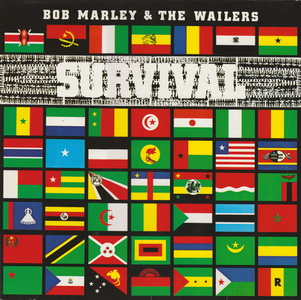
Released in October 1979, Bob Marley’s ‘Survival’ stands as arguably his most politically charged album, conceived during a pivotal era of African anti-colonial movements. The album’s distinctive visual identity emerged from the creative genius of Neville Garrick, Marley’s longtime art director, who recently revealed the profound conceptual thinking behind the iconic cover in an interview with journalist Chris Morrow.
Garrick described ‘Survival’ as his personal favorite among the twelve album covers he created for Marley and The Wailers. Originally titled ‘Black Survival,’ the project underwent significant reconsideration to ensure its message would resonate universally rather than alienate non-black audiences. This philosophical shift prompted Garrick to develop a powerful visual language that conveyed black identity without explicit verbal declaration.
The groundbreaking cover design featured the assembled flags of independent African nations, meticulously handcrafted by Garrick using construction paper at twice the standard album size to achieve perfect color fidelity upon reduction. Notably, Garrick made a conscious political statement by excluding Rhodesia’s flag—then still under white minority rule—and instead incorporating the banners of liberation movements ZANU and ZAPU fighting for what would become Zimbabwe.
Garrick’s most inspired innovation came through a sudden ‘mind-flash’ addressing the African diaspora’s lack of national symbols. He conceptually reversed the word ‘Survival’ from the blueprint of a slave ship, powerfully connecting contemporary liberation struggles with the historical trauma of slavery.
The album’s release coincided with extraordinary historical momentum, culminating in Marley’s historic performance at Zimbabwe’s independence celebrations in April 1980 before over 100,000 people in Harare. Featuring anthems like ‘Africa Unite’ and ‘Zimbabwe,’ the album presented a stark contrast to the more relaxed ‘Kaya’ released the previous year.
This retrospective gains poignancy considering Marley’s untimely death at 36 in May 1981—he would have turned 81 this week—and Garrick’s recent passing in November 2023 at age 73, closing a chapter on one of music’s most visually and politically significant collaborations.