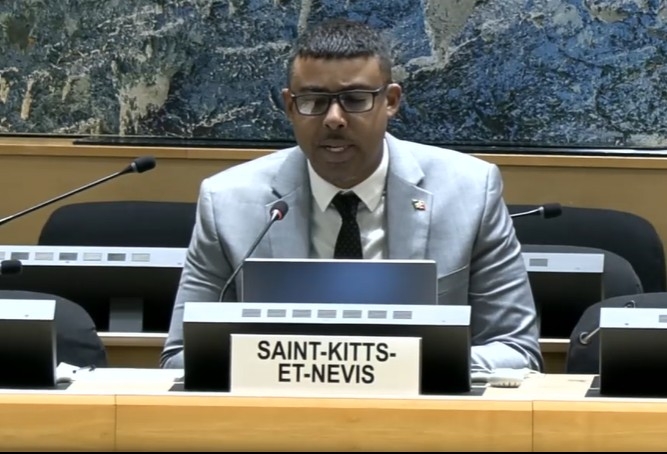
In a significant address to the United Nations Geneva Office on January 27, 2026, St. Kitts and Nevis Attorney General Garth Wilkin presented the Federation’s Human Rights Country Report, emphasizing the nation’s practical implementation of human rights reforms rather than mere commitments.
During his comprehensive 15-minute presentation, Wilkin articulated the government’s multifaceted approach to human rights, which is fundamentally rooted in constitutional governance, rule of law, and a people-centered development philosophy. He emphasized that this framework operates within the context of the nation’s 43-year-old Constitution while acknowledging the challenges of limited institutional capacity and vulnerability to external shocks.
The Attorney General detailed the government’s systematic approach to implementing recommendations from the Universal Periodic Review (UPR), highlighting the establishment of a national mechanism for implementation, reporting, and follow-up. This mechanism consolidates recommendations from various international bodies including treaty organizations and special procedures.
Judicial independence emerged as a cornerstone of the presentation, with Wilkin explaining the unique regional constitutional framework through the Eastern Caribbean Supreme Court that provides additional layers of institutional independence beyond national processes. The Judicial and Legal Services Commission operates under constitutional safeguards specifically designed to prevent undue influence and ensure merit-based judicial appointments.
Significant progress was reported in several key areas:
Gender equality remains a national priority through the ongoing implementation of the Gender Equality Policy and Action Plan 2022-2027. The government has strengthened inter-ministerial coordination and integrated gender considerations into social protection, education, citizen security, and climate resilience frameworks.
Most notably, the Federation achieved a remarkable 75% reduction in homicides from 2024 to 2025, representing a 68% decrease from the 15-year average. This achievement positions St. Kitts and Nevis as having one of the most significant violence reduction rates in the Caribbean region.
The government is addressing domestic and sexual violence through enhanced legal safeguards, institutional protocols, specialized training, and sustained public education campaigns. Work continues to strengthen standard operating procedures across correctional, health, and justice institutions to improve sanitation, healthcare access, and risk management.
Regarding freedom of expression, Wilkin acknowledged ongoing international discussions about criminal defamation, noting the government’s careful examination of the issue within broader legal modernization efforts while balancing proportionality and access to remedies. Simultaneously, the administration supports initiatives promoting responsible journalism and media ethics through training and engagement programs.
Wilkin candidly acknowledged persistent challenges in human and technical capacity, data availability, and competing reporting obligations. He emphasized the importance of pragmatism, institutional ownership, and targeted technical cooperation to ensure sustainable progress, particularly in the administration of justice.
The Attorney General concluded by reaffirming the Federation’s commitment to continuous improvement, stating that the government “doesn’t just talk the talk, but walks the walk when it comes to human rights-related reform,” demonstrating tangible results in violence reduction and judicial strengthening.