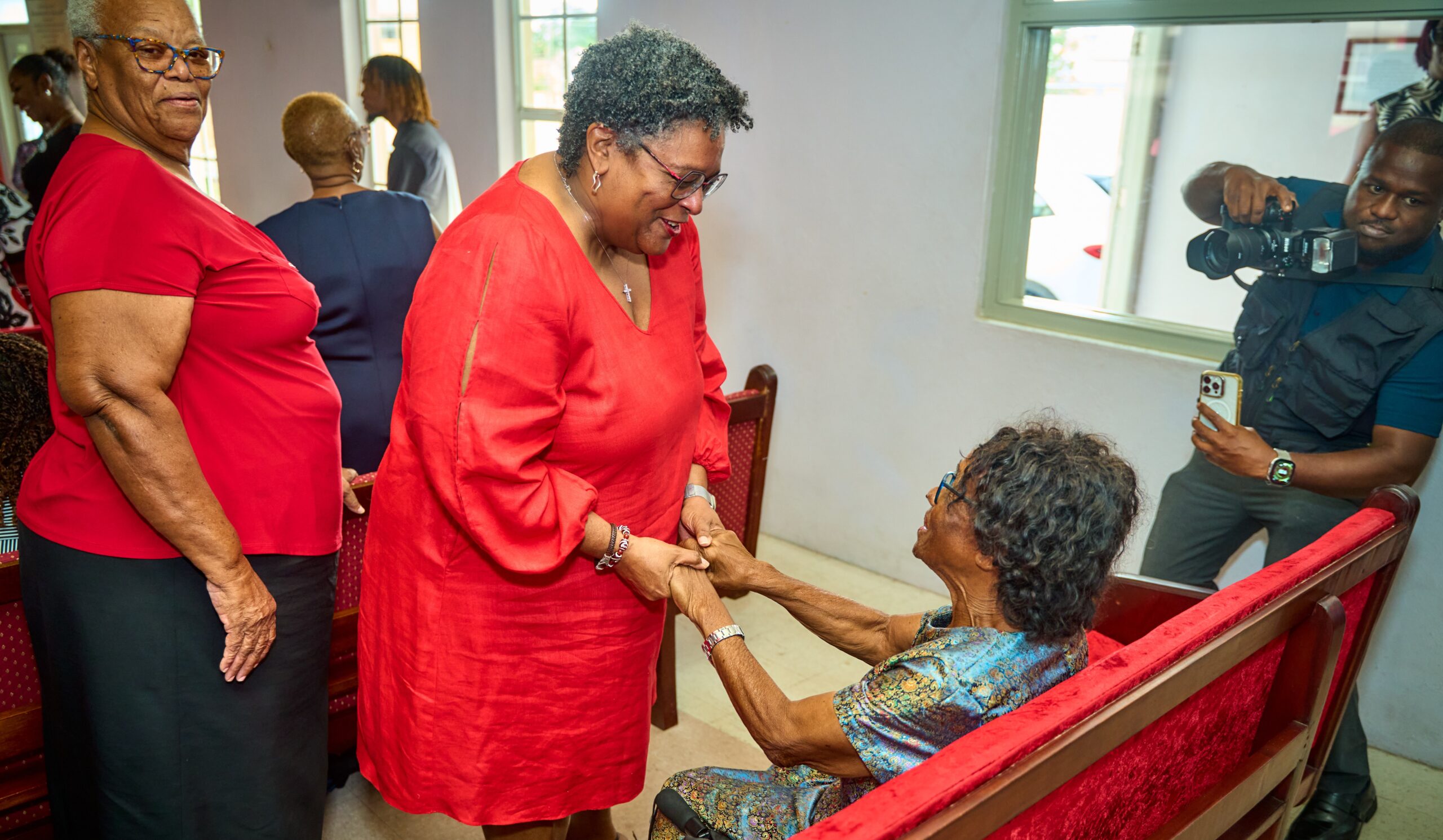
Barbados Prime Minister Mia Mottley has revealed that her administration will unveil a suite of groundbreaking national policies within the coming fortnight, designed to fortify the Caribbean nation’s socioeconomic foundations against growing global instabilities. The announcement came during a public address following a religious service at Jackson’s Church of God in St. Michael on Sunday.
Mottley emphasized that these forthcoming measures would transcend political affiliations, targeting holistic societal support from infancy through senior citizenship. “I have some exciting new policies that we will announce over the course of the next two weeks that I hope will allow us as a people, not the [Barbados] Labour Party family, not the Dems, but us as a people to continue to provide the resilience we need,” stated the Prime Minister, who also represents St. Michael North East constituency.
Defending her government’s track record, Mottley acknowledged the challenges of national recovery while highlighting consistent progress. She cited critical infrastructure stabilization through acquisitions of garbage trucks and buses, though admitting services weren’t yet perfect. “This is a journey and on a journey you see progress, but you’re not yet at your final destination,” she remarked.
The administration’s economic strategy has centered on alleviating cost-of-living pressures through innovative fiscal reforms. Since 2019, tax system restructuring has effectively eliminated income taxes for citizens earning under $35,000 annually. From April, homeowners with properties valued below $400,000 will be exempt from land taxation.
Additional consumer protection measures include VAT and import duty removals on essential goods, with recent expansions to cover stewed beef and Horlicks. Electricity VAT has been capped at 10%, while the Ask Dealia price comparison application empowers consumers to make informed purchasing decisions.
Social protection frameworks have been significantly enhanced through pioneering disability grants and supporting legislation. Economic resilience efforts include bolstering food security via the International Food Centre at Newton and a new St. Philip tissue culture laboratory to improve agricultural material access.
Mottley conceded administrative imperfections, citing ongoing roadwork challenges, but framed Barbados’ development within broader global context of conflict-induced weariness and economic uncertainty. She urged national perseverance, referencing the Mission 2030 agenda as a long-term developmental framework rather than expecting immediate transformations.
“This is a journey. This is not a single event,” Mottley concluded, expressing confidence that sustained effort and national resilience would propel Barbados toward significant achievements despite global headwinds.