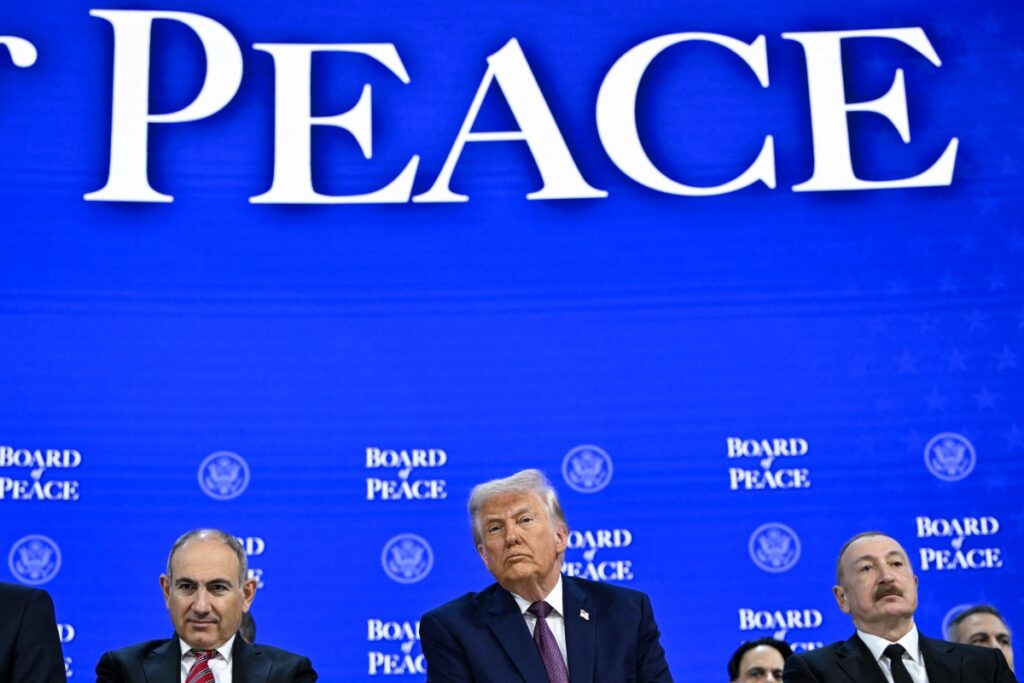
DAVOS, Switzerland — U.S. President Donald Trump formally inaugurated the “Board of Peace” during a high-profile signing ceremony at the World Economic Forum on Thursday. The newly established international body, which requires a $1 billion fee for permanent membership, has already drawn significant criticism over its funding model and controversial list of participant nations.
Leaders and senior officials from 19 countries joined Trump on stage for the charter signing, including staunch allies such as Argentina’s Javier Milei and Hungary’s Viktor Orban. Trump, who serves as the board’s chairman, remarked that the assembled leaders were “in most cases very popular leaders, some cases not so popular,” acknowledging the divisive nature of some invitations.
Originally conceived to oversee post-war peace efforts in Gaza following the Hamas-Israel conflict, the board’s charter now envisions a broader mandate in international conflict resolution. This expansion has raised concerns among diplomatic circles that Trump intends to position the organization as a potential rival to the United Nations, though Trump emphasized the board would operate “in conjunction” with the UN.
The membership criteria have proven particularly contentious. Russian President Vladimir Putin, who launched the invasion of Ukraine four years ago, has received an invitation to join. Trump confirmed Putin’s agreement to participate, while the Kremlin stated the invitation remains under consideration. The $1 billion membership requirement has prompted accusations that the board could become a “pay-to-play” version of the UN Security Council.
Notable absences marked the ceremony, with key U.S. allies including the United Kingdom and France declining to attend. British officials confirmed their non-participation earlier Thursday, reflecting widespread skepticism among traditional Western partners.
The signing nations predominantly represented governments with close ties to Trump or those seeking to demonstrate allegiance to the U.S. administration. Participants included officials from Bahrain, Morocco, Armenia, Azerbaijan, Bulgaria, Indonesia, Jordan, Kazakhstan, Kosovo, Pakistan, Paraguay, Qatar, Saudi Arabia, Turkey, the United Arab Emirates, Uzbekistan, and Mongolia.
Israeli Prime Minister Benjamin Netanyahu, who faces an International Criminal Court arrest warrant related to the Gaza conflict, affirmed his intention to join despite not attending the ceremony. U.S. Secretary of State Marco Rubio stated the board’s initial focus would be “first and foremost on making sure that this peace deal in Gaza becomes enduring.” Trump delivered a stern warning that Hamas must disarm under the next phase of the Gaza ceasefire accord or face elimination.
The board’s launch coincides with Trump’s expressed frustration over not receiving the Nobel Peace Prize, despite his claims of having ended eight conflicts during his presidency.
In related diplomatic developments, Trump is scheduled to meet with Ukrainian President Volodymyr Zelensky in Davos following the ceremony to discuss ceasefire negotiations in Ukraine. Trump’s special envoy Steve Witkoff revealed that talks with Moscow have made “a lot of progress” and have been narrowed to “one issue,” though he declined to specify the nature of this remaining obstacle. Witkoff and Jared Kushner are expected to travel to Moscow for further discussions before proceeding to Abu Dhabi for military-to-military talks.
Zelensky has expressed concerns that Trump’s highly publicized effort to acquire Greenland—which has dominated Davos discussions and strained transatlantic relations—might divert attention from Russia’s ongoing invasion of Ukraine. In a significant development, Trump announced Wednesday evening that he had reached a “framework of a future deal” with NATO chief Mark Rutte, resulting in the waiver of tariffs scheduled to hit European allies on February 1. Although details remain scarce, sources indicate the agreement will involve renegotiation of a 1951 Greenland defense pact.