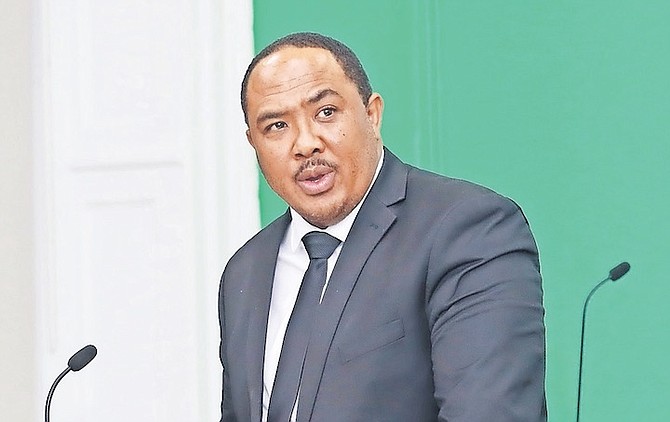
The House of Assembly witnessed escalating tensions as opposition lawmakers confronted the Davis administration regarding its recently implemented VAT reduction policy. Shanendon Cartwright, deputy leader of the FREE National Movement, spearheaded the challenge by demanding precise clarification on the actual financial benefits Bahamian households should anticipate from the value-added tax removal on unprepared food items.
During heated parliamentary debates, Cartwright emphasized the government’s apparent failure to communicate concrete details about the policy’s practical implications for citizens experiencing economic pressures. The discourse centered on whether the measure would generate substantial relief for families grappling with persistent financial constraints.
Cartwright referenced a Nassau Guardian analysis projecting approximate monthly savings of $11 per household, translating to roughly $127 annually. This calculation derived from distributing the government’s estimated $15 million revenue shortfall across the national household count—a methodology subsequently disputed by the Office of the Prime Minister.
The St. Barnabas representative characterized these projected savings as ‘shameful,’ particularly questioning the significance of such an amount for a typical four-person family unit.
Government MP Zane Lightbourne countered these assertions, arguing that quantifying savings with a universal figure fundamentally misrepresents the VAT relief mechanism. Lightbourne stressed that individual savings would inherently vary based on income disparities and distinct consumption patterns, making standardized estimates impractical.
Prime Minister Philip Davis defended the policy’s timing, emphasizing his administration’s commitment to fiscal responsibility and asserting that international financial institutions had previously advised against premature tax reductions. Davis indicated that current economic conditions finally permitted the implementation of this relief measure.
Opposition members, including East Grand Bahama MP Kwasi Thompson, maintained that the policy lacked transparency, thorough analysis, and accountability. Thompson noted that despite growing dependence on non-profit assistance organizations, the government’s approach seemed more focused on headline-driven announcements than evidence-based policy-making.