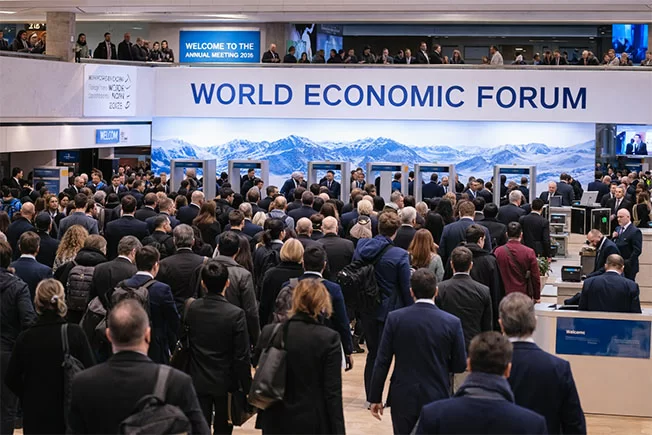
The 2026 World Economic Forum (WEF) commenced officially on Monday in Davos, Switzerland, gathering approximately 3,000 participants from over 130 countries. The prestigious assembly brings together heads of state, government officials, corporate executives, and civil society leaders for a four-day convention running through January 23. This year’s theme, ‘A Spirit of Dialogue,’ emphasizes fostering cooperation during an era marked by complex geopolitical and economic challenges.
Suriname’s Vice President Gregory Rusland is among the distinguished attendees, having received a special invitation to join an exclusive meeting of forty international decision-makers comprising heads of state, CEOs, and ministers. Rusland is scheduled to engage with global leaders on the critical topic: ‘From Commitments to Implementation: Scaling Sustainable Tourism and Hospitality.’
For decades, the annual WEF summit has served as a crucial platform for addressing pressing global issues including economic growth, multilateral cooperation, technological advancement, and climate change. The 2026 program features more than 200 sessions covering diverse subjects such as global risks, economic inequality, artificial intelligence, and sustainable development.
Key discussion topics this year include the role of dialogue in an increasingly fragmented global economy. According to recent WEF risk analysis, economic confrontations including trade conflicts and protectionist measures have gained significant prominence on the world stage. The forum will also address the growing divide between economic elites and broader populations. Larry Fink, CEO of investment firm BlackRock and interim co-chair of the forum, emphasized the need for economic systems to evolve toward generating broader societal benefits and reducing distrust.
Additional focal points include digital innovation and artificial intelligence, investments in strategic sectors like defense and technology, the future of energy and climate policy, and the vital role of international cooperation in tackling global challenges.
The geopolitical dimension features prominently in this year’s agenda. National security advisors from multiple countries convened in Davos to discuss sensitive matters including policy responses to trade conflicts surrounding Greenland, which have recently created tensions between the United States and European nations. The presence of numerous state leaders and government heads underscores the forum’s continued importance as a diplomatic platform for international collaboration amid global uncertainties including conflict zones and challenges in multilateral relations.