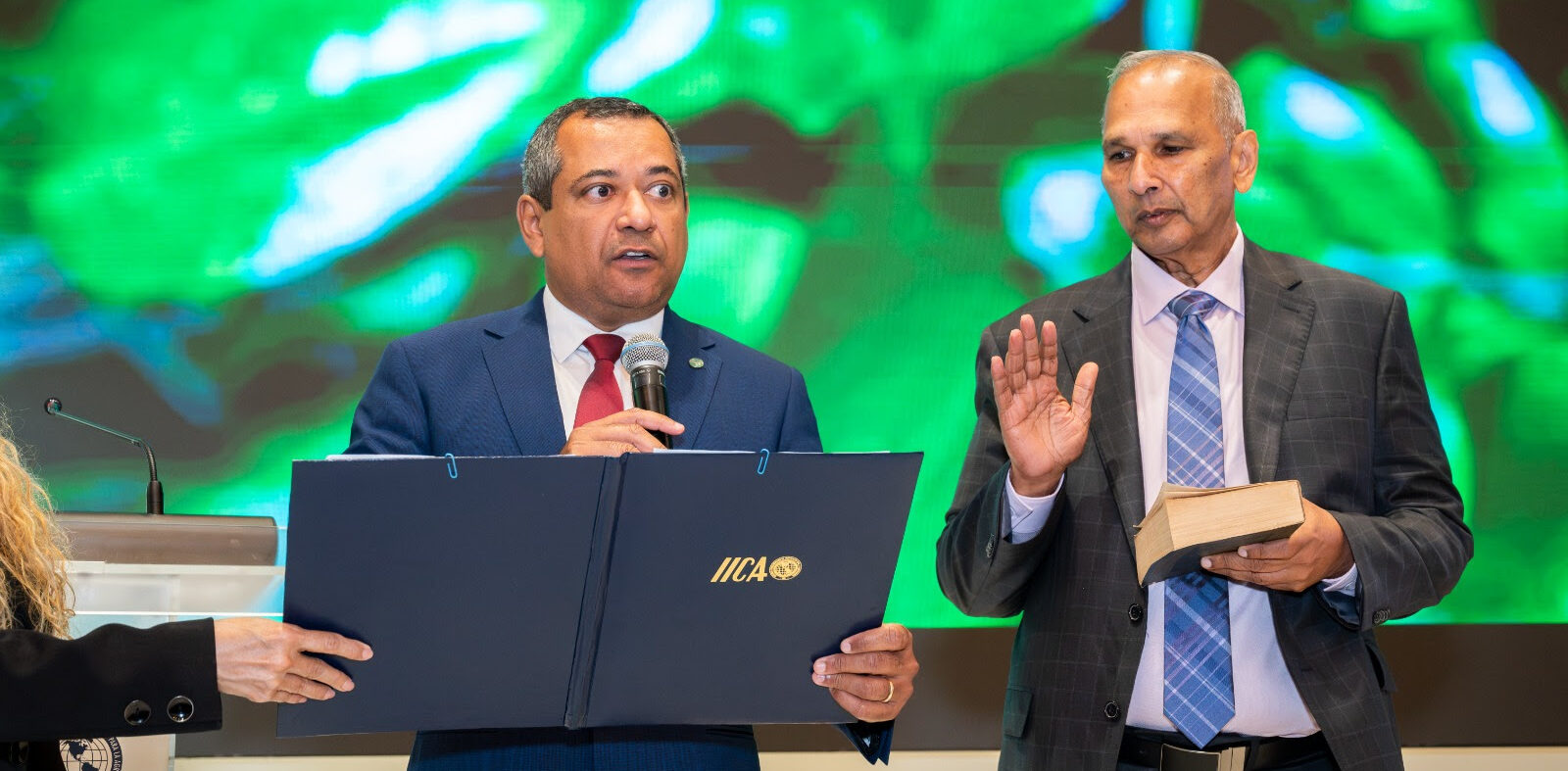
Brazil has expressed strong confidence in Muhammad Ibrahim’s new leadership role at the Inter-American Institute for Cooperation on Agriculture (IICA), highlighting his extensive expertise in agricultural management and innovation-driven competitiveness. The endorsement came during Ibrahim’s swearing-in ceremony in San José, Costa Rica, where he officially began his four-year term as Director General.
Cleber Soares, Brazil’s Deputy Minister of Agriculture and Livestock, represented Minister Carlos Fávaro at the ceremony and emphasized Ibrahim’s comprehensive understanding of both opportunities and challenges facing agricultural systems across the Americas. Soares confirmed Brazil’s commitment to collaborative efforts with IICA member states under Ibrahim’s guidance.
The newly appointed Director General, a distinguished Guyanese agronomist, was elected by the continent’s agriculture ministers in November, succeeding Argentina’s Manuel Otero who completed two terms. Soares revealed that preliminary discussions with Ibrahim are already underway to facilitate knowledge sharing, particularly regarding Brazil’s advancements in tropical agriculture.
Brazil’s remarkable agricultural transformation serves as a model for technological progress in the sector. Once a major food importer, the nation has emerged as a global agricultural powerhouse through research-driven innovations that significantly boosted productivity and sustainability.
Looking forward, Soares identified IICA’s critical mission: strengthening partnerships between major food-exporting nations like Brazil and import-dependent countries, especially in Central America and the Caribbean. A key challenge involves integrating small-scale farmers into modern agricultural systems through sustainable technologies and value-added approaches.
‘Our objective extends beyond production techniques,’ Soares explained. ‘Producers require comprehensive support in farm management, marketing strategies, distribution networks, input procurement, and climate adaptation. Additionally, we must address the resurgence of plant and animal diseases that transcend national borders—an area where IICA’s coordination role becomes essential.’
The deputy minister also emphasized two fundamental pillars for continental agricultural sustainability: accessible credit and agricultural insurance. He noted that without credit facilities, many smallholders cannot sustain their operations, while insurance protection remains particularly crucial in tropical regions vulnerable to production losses.