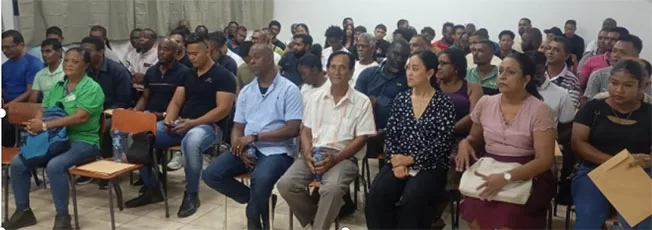
PARAMARIBO – In a significant demonstration of personal initiative and educational commitment, 87 students received vocational certification on January 15, 2026, after successfully completing self-financed training programs. The ceremony, organized by the Foundation for Labor Mobilization and Development (SAO), highlighted courses in Basic Refrigeration Technology, Electrical House Installation, Water Sanitation (GaWaSa), and Printed Circuit Board Repair.
The graduation event witnessed notable attendance from Deputy Minister of Health, Welfare, and Labor Raj Jadnanansing, SAO Director Joyce Lapar, and Izaak Hill, representing the Board of Directors. Originally commencing with 103 participants, the program achieved an impressive 84% completion rate, with all graduates personally covering their training expenses without corporate sponsorship.
Deputy Minister Jadnanansing praised the graduates’ perseverance and conscious investment in their professional capabilities. He emphasized Suriname’s impending need for skilled labor, particularly driven by expansion in the oil and gas sectors. “Suriname must prepare proactively to prevent future labor market shortages,” he stated, advocating for a shift in perception regarding vocational trainees—from ‘drop-outs’ to ‘drop-ins’ who strategically choose alternative educational pathways.
SAO Director Lapar highlighted the distinctive character of this cohort, noting the participation of motivated youth, including two 16-year-olds, as a strong indicator of responsibility and forward-thinking. She underscored the necessity of lifelong learning in adapting to rapidly evolving job markets.
Board representative Hill echoed these sentiments, urging graduates to embrace entrepreneurial thinking and collaborative ventures. All speakers emphasized the critical importance of applying acquired skills to foster confidence and sustainable career growth.
The government reaffirmed its commitment to supporting funded, subsidized, and partially subsidized vocational training, aligning with broader strategies to enhance workforce readiness and economic resilience.