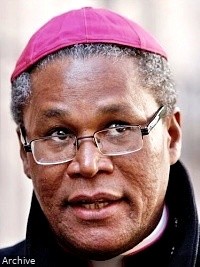
In a significant development within Haiti’s ongoing political crisis, Bishop Pierre-André Dumas of Anse-à-Veau and Miragoâne has formally withdrawn from his potential role as national mediator. The announcement came through an extensive statement released on social media platforms on January 14, 2025.
The bishop, who also serves as Vice-President of the Haitian Episcopal Conference, clarified that his initial involvement stemmed from external requests by political coalitions, civil society organizations, and international figures rather than personal ambition. He emphasized that his participation was always conceived within a strictly pastoral context, aligned with Church teachings but not as an official representative of Haiti’s Conference of Bishops.
Bishop Dumas articulated his philosophical approach to conflict resolution, referencing the Church’s ‘culture of encounter’ principle that emphasizes inclusive listening and dialogue without condemnation. His vision centered on creating spaces where constructive conversation could replace violence, though he explicitly denied any intention to develop political solutions directly.
However, recent developments including misinformation campaigns, misinterpretations of his role, and apparent political manipulation have compelled his withdrawal. After consulting with advisors and engaging in spiritual reflection, the bishop determined that continued operational involvement would be counterproductive to the peace process.
Notably, Bishop Dumas referenced personal physical scars from past violence as symbolic of Haiti’s broader wounds from internal divisions and fratricidal conflicts. Despite his withdrawal from formal mediation, he reaffirmed his unwavering belief in Haiti’s potential for renewal and called for authentic Haitian-led solutions faithful to the nation’s founding ideals of liberty, equality, and fraternity.
The bishop’s statement concludes with a powerful call to honor Haitian sovereignty while choosing responsibility and hope, maintaining his commitment to supporting dialogue and national reconstruction through spiritual rather than political channels.