KINGSTON, Jamaica – Inflationary pressures in Jamaica experienced a significant resurgence at the close of 2025, reversing previous months of moderation as Hurricane Melissa’s enduring impact triggered sharp increases in food prices and electricity costs. The nation’s consumer inflation accelerated markedly in December, underscoring the vulnerability of small island economies to climate-related disruptions.
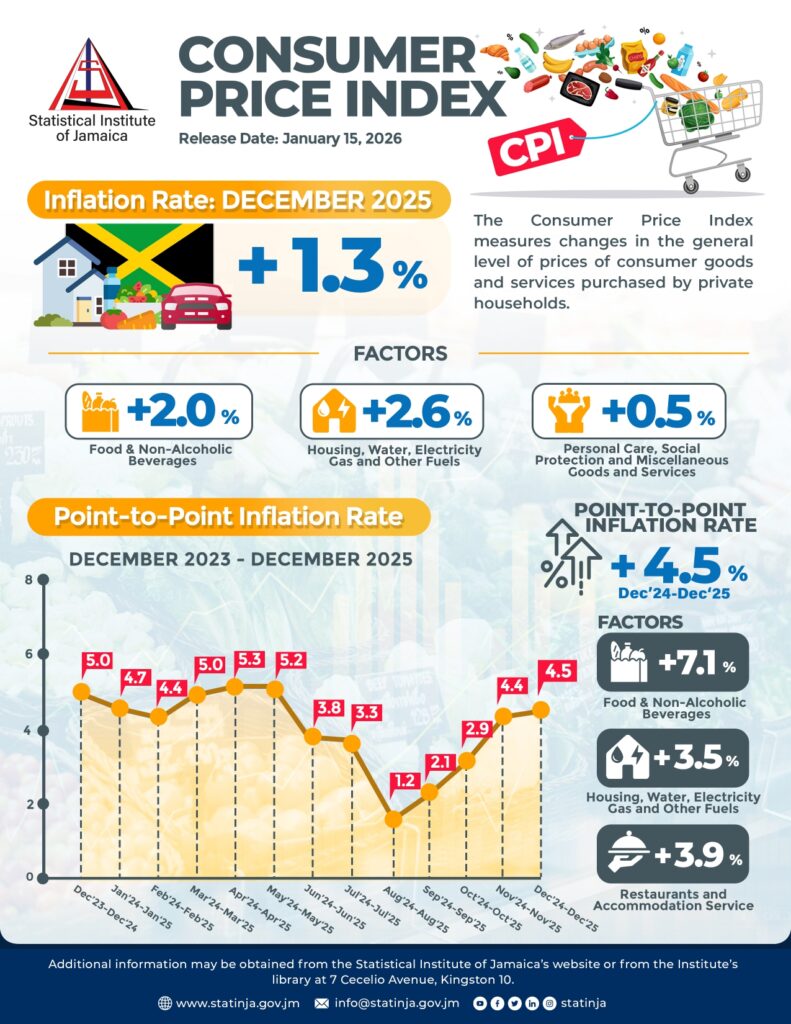
According to the Statistical Institute of Jamaica (Statin), the All-Jamaica Consumer Price Index (CPI) climbed by 1.3% during December, building upon November’s 2.4% advance. This consecutive monthly acceleration represents one of the most substantial back-to-back inflation movements recorded throughout the year. Director General Leesha Delatie-Budair emphasized that the December data provides the first comprehensive reflection of post-hurricane economic conditions, unlike earlier economic indicators that captured pre-storm activity.
The primary driver behind this inflationary spike was a 2.0% monthly increase in food prices, with particularly severe impacts on agricultural commodities. Vegetable, tuber, plantain, and pulse categories surged by 4.5%, while fruits and nuts jumped by 5.6%. These increases directly resulted from Hurricane Melissa’s disruption to agricultural production and supply chains, with the full effect taking several weeks to manifest in consumer markets.
Concurrently, housing and utility expenses exerted additional upward pressure, with the corresponding index rising 2.6% for the month. Electricity costs alone escalated by 5.4%, compounded by rising rental charges. The combination of food and housing expenditures accounted for the majority of December’s inflation outcome, intensifying concerns about household affordability and living standards.
Year-end analysis revealed that point-to-point inflation between December 2024 and December 2025 reached 4.5%, substantially higher than earlier annual lows. Food inflation emerged as the dominant contributor at 7.1% year-on-year, while housing and utilities increased by 3.5%. The restaurant and accommodation sector also experienced notable inflation at 3.9%, reflecting higher costs for meals consumed away from home.
Statin officials detailed the methodological adaptations employed to maintain data accuracy despite widespread operational challenges including damaged infrastructure, power outages, and business closures. The institution extended fieldwork periods and implemented international statistical techniques such as class-mean imputation for temporarily unavailable items, ensuring the CPI’s reliability amid difficult post-disaster conditions.
Geographic analysis indicated broadly consistent inflation patterns across regions, with the Greater Kingston Metropolitan Area recording 1.4% inflation, compared to 1.1% in other urban centers and 1.3% in rural areas. While headline inflation remains within the Bank of Jamaica’s target range, the December figures suggest mounting persistence in price pressures, particularly for essential commodities, potentially necessitating policy responses in coming months.