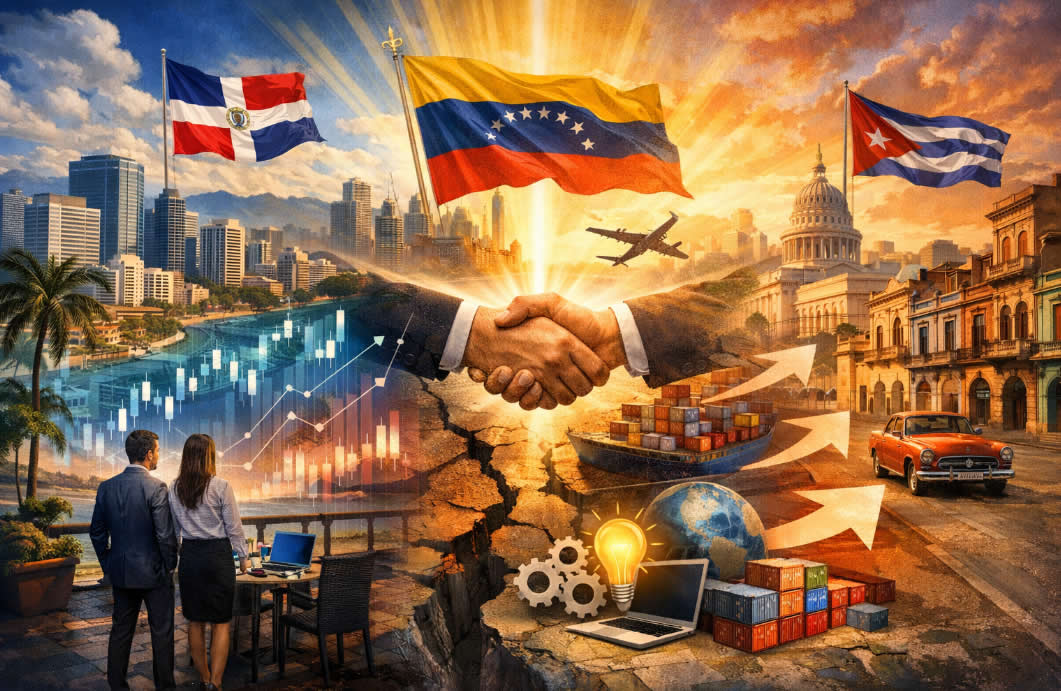
A strategic recalibration is underway across Latin America, driven not by political declarations but by subtle shifts in economic posture. Venezuela’s gradual reintegration into regional dialogues—alongside potential Cuban transitions—is triggering significant behavioral changes among investors, entrepreneurs, and diaspora communities. This evolving landscape presents both unprecedented opportunities and critical warnings for the Dominican Republic.
The real prize isn’t merely participating in reopening markets but becoming the operational platform that enables regional expansion. Historical patterns demonstrate that when long-closed economies reopen, they don’t gradually return—they experience explosive growth. The true beneficiaries are rarely the reopening countries themselves, but rather the nations that establish themselves as command centers for incorporation, talent development, capital structuring, and intellectual property registration.
The Dominican Republic possesses unique advantages for this platform role: a growing digital nomad ecosystem, culturally agile workforce, emerging startup scene, international visibility, and economically influential diaspora networks. However, positioning requires deliberate engineering rather than passive assumption.
For digital nomads, this represents leverage opportunity—early embeddedness in developing ecosystems grants access to high-value consulting, cross-border ventures, and equity opportunities. For Dominican entrepreneurs, it’s about scaling exportable structural necessities: logistics systems, financial infrastructure, workforce platforms, and compliance technologies rather than consumer apps alone.
The critical risk involves strategic preparation. Without establishing itself as the designated center for company formation, system design, and operational management, the DR risks being overshadowed when Venezuela and Cuba attract massive international attention, infrastructure investment, and returning diaspora resources.
Strategic imperatives include transitioning from talent destination to system builder, developing exportable intellectual property in SaaS, fintech, and smart city technologies, and preparing to provide payment systems, workforce pipelines, and compliance structures for reopening markets. This requires architectural design rather than mere hustle—creating frameworks that transform creativity into scalable value.
This moment represents a rare convergence of stability, visibility, talent mobility, and regional curiosity. The Dominican Republic’s opportunity lies not in its size but in its timing. The fundamental question remains: will the nation design the changes benefiting the region or merely benefit from changes designed elsewhere?