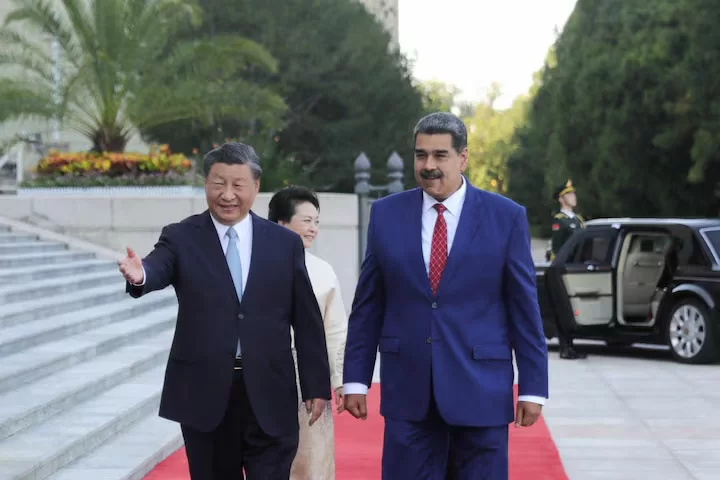
Amidst Venezuela’s political turmoil following the U.S.-led military intervention that ousted President Nicolás Maduro in January 2026, China has emerged as a critical economic lifeline and strategic partner for the South American nation’s crippled oil industry. Despite Washington’s efforts to reshape Venezuela’s political landscape and control its energy resources, Beijing maintains substantial leverage through both oil purchases and infrastructure investments.
Venezuela’s oil production has experienced a dramatic collapse, plummeting from approximately 3.5 million barrels per day in the 1990s to just 1.1 million barrels daily in 2025. This decline stems from chronic mismanagement, insufficient investment, and stringent U.S. sanctions that have crippled the country’s primary economic engine.
China has become Venezuela’s most significant oil customer, with Vortexa energy data indicating imports of approximately 470,000 barrels per day in 2025—representing about 4.5% of China’s total seaborne crude imports. Much of this oil flows to independent Chinese refineries known as ‘teapots,’ which capitalize on discounted prices. Additionally, portions of these shipments serve as repayment for Venezuela’s estimated $10 billion debt to China.
Chinese state-owned enterprises maintain dominant positions in Venezuela’s energy sector. Sinopec and CNPC control the largest oil entitlement reserves among foreign companies, holding 2.8 billion and 1.6 billion barrels respectively. Since 2016, Chinese firms have invested approximately $2.1 billion in Venezuela’s oil infrastructure despite mounting political risks.
Although CNPC ceased direct oil imports from Venezuela in 2019 due to sanctions, it continues production operations through the Sinovensa joint venture with Venezuela’s state oil company PDVSA. Similarly, Sinopec maintains significant oil reserves through its joint venture arrangements. Several private Chinese companies—including China Concord Resources Corp., Kerui Petroleum, and Anhui Erhuan Petroleum Group—also hold oil production and service contracts, though their current operational status remains unclear.
The geopolitical implications extend far beyond energy markets. China’s deepening involvement in Venezuela represents a strategic challenge to U.S. influence in Latin America. While the Trump administration pursued regime change to reorient Venezuela’s political alignment, China has positioned itself as a stabilizing force committed to respecting Venezuela’s sovereignty and international law.
Beijing’s investments form part of a broader strategy to secure access to vital energy resources while expanding economic influence in regions traditionally dominated by Western powers. These partnerships simultaneously bolster Venezuela’s resilience against American sanctions and political pressure.
The post-intervention landscape remains highly volatile, with uncertainty surrounding Venezuela’s political future and China’s ability to maintain its economic interests amid escalating U.S.-China tensions. Despite Chinese investments, Venezuela’s oil industry continues to grapple with infrastructure deficiencies and economic instability, suggesting that recovery will require more than foreign investment alone.