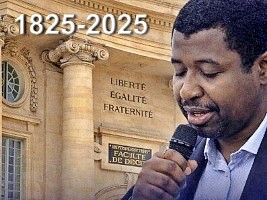
In a landmark address at Paris’ prestigious Panthéon-Sorbonne University, Dieuseul Prédélus, Rector of Haiti’s State University and President of the Haitian National Committee for Restitution and Reparation (CNHRR), presented a compelling case for historical justice regarding what he termed Haiti’s “double debt” imposed by France in 1825.
Addressing academics, students, diaspora members, and distinguished guests, Prédélus delivered an emotionally charged speech that traced Haiti’s two-century struggle for dignity and reparations. He recounted how Haiti, having achieved independence through bloodshed, was subsequently forced under threat of French naval invasion to pay massive indemnities to its former colonizers—creating what he described as a “moral absurdity” where a liberated people had to pay to avoid re-enslavement.
The financial burden, contracted through what Prédélus characterized as “usurious” French banking interest rates, trapped the Caribbean nation in a century-long debt spiral that permanently crippled its development prospects. The CNHRR president emphasized that Haiti’s demand constitutes neither charity nor revenge but rather “an act of basic justice” grounded in contemporary international law and UN principles regarding crimes against humanity.
Prédélus cited current estimates valuing the debt between $21-115 billion in today’s terms, posing a fundamental moral question: “How can one demand that a people pay for their liberation from a crime against humanity?”
The address acknowledged evolving attitudes in France, including the emergence of a new generation willing to confront historical truths, the establishment of a joint Franco-Haitian historical commission, and the French National Assembly’s June 2025 resolution encouraging governmental consideration of restitution pathways.
Outlining the CNHRR’s 2026 roadmap, Prédélus issued a passionate appeal for national unity and diaspora mobilization, framing the restitution struggle as transcending political and generational divisions. He positioned reparations not as historical score-settling but as an opportunity to build a more just future—for Haiti’s regained dignity and development possibilities, and for the international community to redress profound historical injustice.
The speech concluded with a solemn call for global solidarity around what Prédélus characterized as a fundamental matter of historical justice and human dignity.