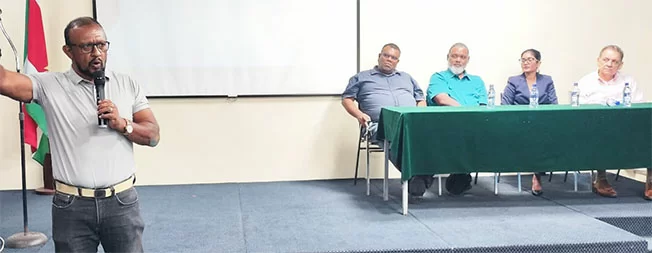
Suriname’s agricultural industry faces a critical juncture as it grapples with a self-perpetuating cycle of small-scale operations, stagnant productivity, and insufficient investment. This stark assessment emerged during the inaugural public forum of the newly established Association of Agronomists in Suriname (VAS), held Thursday evening at the Anton de Kom University Guesthouse.
The gathering, themed ‘Challenges Within the Agricultural Sector,’ featured extensive dialogue among stakeholders who unanimously characterized the event as both intellectually substantial and motivationally impactful. Attendees expressed particular appreciation for the initiative and anticipation for subsequent activities. VAS Chairman Soedeshchand Jairam declared the evening a resounding success, noting that ‘despite the festive season, attendance was excellent and the discussion was of exceptionally high quality.’
Industry representatives from fruit and vegetable production, coconut cultivation, livestock farming, fisheries, and rice sectors provided comprehensive insights into both the sector’s potential and its systemic challenges. The expert panel included Gerald Tjon A San (LVV), Rewish Somai (Anton de Kom University), Vijantie Awadhpersad (NOB), and Gilbert van Dijk (Suriname Business Development Center).
According to Jairam, the consensus was unmistakable: Suriname possesses significant agricultural capabilities but lacks the fundamental conditions to leverage them effectively. ‘Our small-scale structure inherently limits innovation capacity. Technological adoption remains minimal, productivity persists at low levels, and investment continues to lag—all factors that maintain the sector’s constrained size.’
Stakeholders identified multiple governmental shortcomings, including outdated laboratory facilities, inadequate irrigation and drainage systems, weak storage and cold chain infrastructure, and insufficient transportation options. Research and innovation initiatives were similarly deemed deficient, with insufficient attention to disease management, improved crop varieties, and modern technologies such as sensor systems and precision agriculture methodologies.
Additionally, participants criticized institutional fragmentation, noting poor inter-ministerial collaboration on critical issues including land policy, financial mechanisms, and taxation frameworks.
Jairam emphasized that agricultural research represents an urgent priority, particularly given the rapid pace of global sector innovation. ‘While other nations deploy drones, sensor networks, and advanced cultivation techniques, we remain entrenched in traditional practices. Without research into competitive varieties and more efficient production systems, we risk complete market irrelevance.’
The VAS intends to position itself as a central hub for knowledge consolidation and dissemination, bridging policy, practical implementation, and scientific advancement. Jairam stressed that research enhancement is indispensable, warning that ‘without innovation, we will lose our competitive positioning entirely.’ He further highlighted broader societal implications, stating that ‘oil alone cannot achieve national self-sufficiency. Food security remains a fundamental prerequisite for development.’
Through this inaugural forum, the VAS has established itself as both a critical and constructive voice in national agricultural discourse. The message is unequivocal: without visionary planning, collaborative effort, and technological modernization, the sector faces continued stagnation—a scenario Suriname cannot afford.