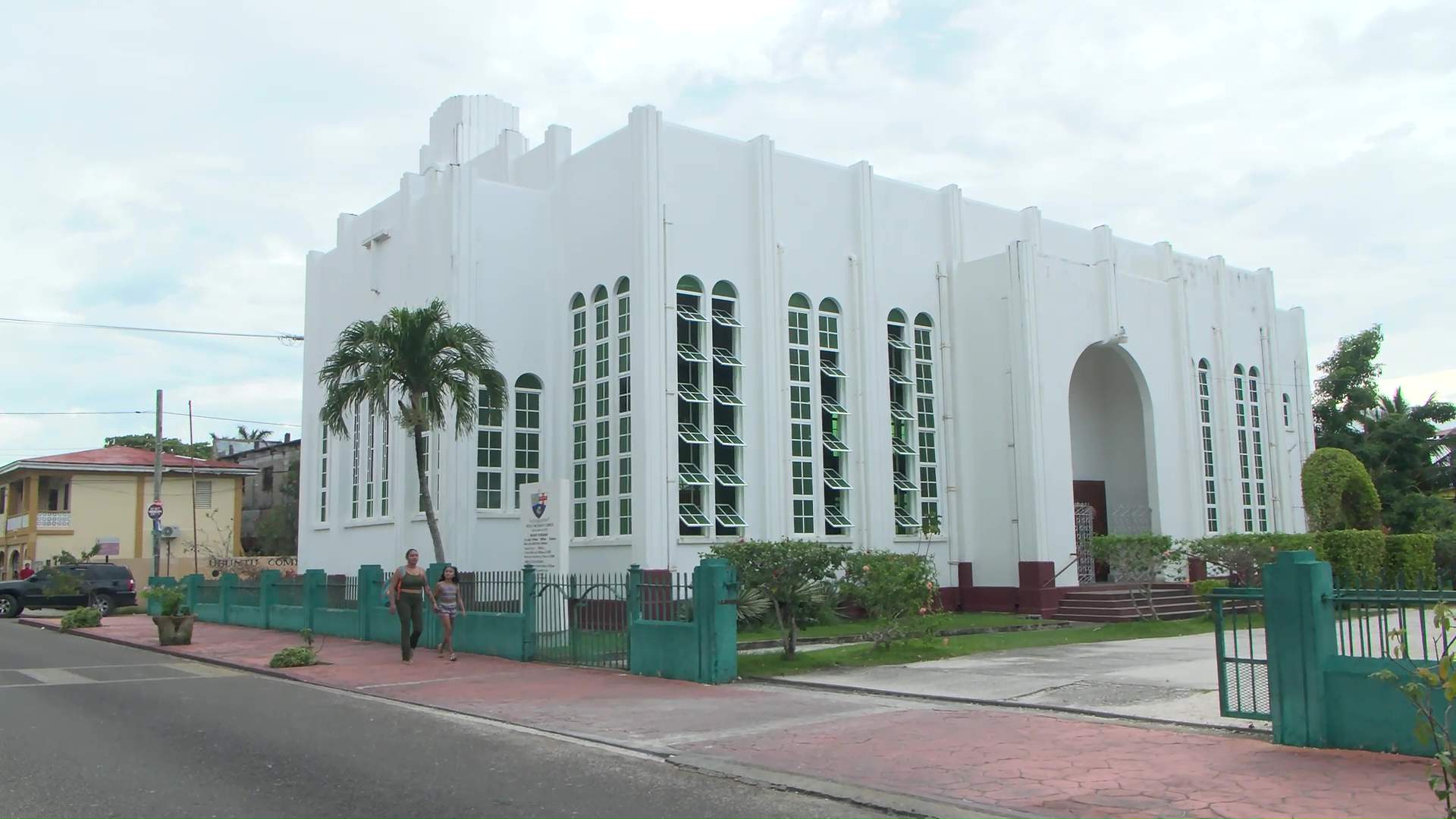
BELIZE CITY – Standing proudly on Albert Street since 1951, Wesley Methodist Church embodies more than seven decades of spiritual devotion and historical significance in Belize. This architectural landmark, however, conceals extraordinary secrets within its stone walls that few outside its congregation have known.
Behind the church’s unassuming exterior lies a historical treasure: a sealed time capsule containing artifacts from the early 1950s, including period currency, a glass bottle, and contemporary newspapers. Even more remarkably, the remains of the church’s designer, Reverend Dr. Claude Cadogan, rest beneath the pulpit, creating a permanent connection between creator and creation.
The current structure represents the third iteration of Methodist worship on this sacred ground. The original church succumbed to fire, while its magnificent red-brick replacement—celebrated throughout the region as Belize’s most beautiful church—was devastated by the catastrophic 1931 hurricane that claimed approximately 2,000 lives.
Historian and lifelong member Brenda Armstrong recounts the tragedy: ‘There was an unawareness that the eye of a storm is calm. When the eye passed, people emerged thinking the danger had ended, resulting in devastating loss.’
The church’s construction presented extraordinary challenges. Workers discovered an underground spring during foundation work, ingeniously using the gushing water to mix cement. The gallery railing, constructed offsite, arrived with an unexpected gap that craftsmen creatively bridged with a custom panel.
Methodism’s roots in Belize trace back to 1825 when Reverend Thomas Wilkson, the country’s first Methodist missionary, arrived to minister among enslaved populations in the Belize River Valley and southern coastline. The church’s theological symbolism extends to its central cross, designed by George Gabb to represent Methodist theology through a silhouette rather than a corporeal representation of Christ—embodying the concept of the ’empty cross.’
Throughout its turbulent history, one message has sustained the community: ‘God is Love.’ As retired Reverend Charles Goff reflects, ‘To acknowledge that God is love helps us recognize that we too must share God’s love—that is the mission of the church.’
Today, Wesley Methodist Church stands as both architectural treasure and living testament to perseverance, unity, and the enduring power of faith through natural disasters and historical challenges.