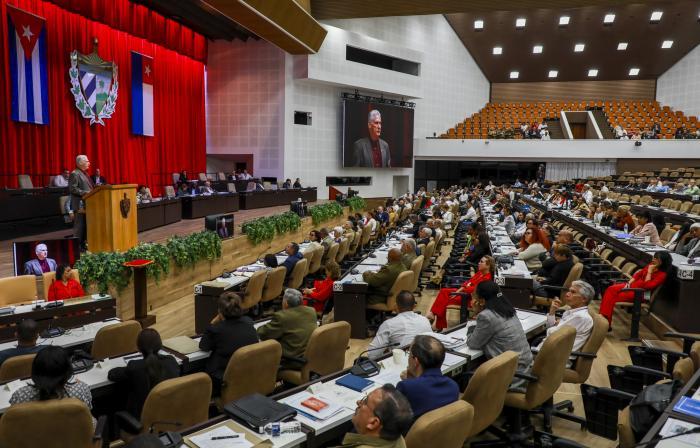
In a comprehensive address concluding the Sixth Ordinary Session of Cuba’s National Assembly, President Miguel Díaz-Canel presented a stark assessment of the nation’s challenges while outlining a path forward through economic reforms and strengthened national unity. The President characterized Cuba’s current situation as an accumulation of structural distortions exacerbated by what he described as an “extremely aggressive external siege” from the United States.
Díaz-Canel condemned U.S. foreign policy approaches, particularly what he termed the doctrine of “peace through strength,” which he argued represents imperialist ambitions threatening international law and regional stability. He specifically highlighted concerns about U.S. military presence in the Caribbean and threats against Venezuela, while reaffirming Cuba’s solidarity with the Bolivarian Republic.
The address detailed several approved measures including the Economic Plan, National Budget, and a Government Program designed to correct economic distortions. The President emphasized that these initiatives are interconnected and essential for addressing both domestic challenges and regional threats. A significant focus was placed on the newly approved Science, Technology and Innovation Law, which aims to bridge the gap between research and production while fostering technological sovereignty.
Economic reforms will prioritize food production through guaranteed inputs and incentives, accelerate investments in the national electricity system combining thermal plant repairs with renewable energy expansion, and regulate foreign currency allocation to favor import substitution sectors. The President called for drastic reduction in unproductive spending and greater territorial responsibility in revenue collection and resource management.
Díaz-Canel acknowledged the postponement of the 9th Party Congress as a strategic decision to allow focus on economic recovery and implementation of necessary structural adjustments. He proposed designating 2026 as the “Year of the Centennial of Commander-in-Chief Fidel Castro Ruz” to inspire national unity and revolutionary commitment.
The President concluded by emphasizing that solutions would require “concrete work, systematic control, and active popular participation,” asserting that “the task is complex, but the will of this people is invincible.”