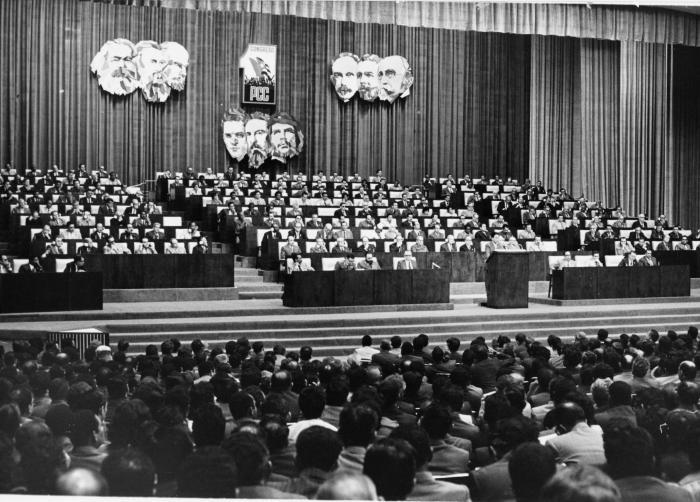
On a cold December morning in 1975, approximately 2,000 delegates representing every sector of Cuban society gathered at Havana’s Karl Marx Theater, many wearing formal suits and ties for the first time. This historic assembly marked the commencement of the First Congress of the Communist Party of Cuba (PCC) – a pivotal moment that would fundamentally shape the nation’s revolutionary trajectory.
Sixteen years after overthrowing the Batista regime and a decade following the establishment of the initial Central Committee, Commander-in-Chief Fidel Castro delivered a comprehensive report analyzing Cuba’s revolutionary journey. He proudly declared Cuba’s unique position as ‘Spain’s last colony in Latin America’ that had transformed into ‘the first socialist country in this hemisphere.’
The address provided a meticulous historical account, tracing Cuba’s struggle from independence wars through the revolutionary period. Castro detailed how the United States, upon recognizing the Revolution’s determination to resist external pressure, initiated economic aggressions while recruiting and training mercenaries for sabotage operations and military actions.
While acknowledging administrative and economic management shortcomings during the initial revolutionary decade, Castro emphasized that survival against imperialist subversion, military aggression, and relentless economic blockade had consumed the nation’s primary resources. ‘For years, we had to keep more than 300,000 men under arms to defend the country,’ he revealed.
Despite these challenges, Castro highlighted Cuba’s extraordinary advancements across multiple fields, noting that these achievements were particularly remarkable given the context of sustained pressure from a powerful northern neighbor. The real significance, he stressed, lay in Cuba’s ability to resist reestablishment of ‘corrupt, exploitative, and oppressive systems’ while making substantial progress under exceptionally difficult circumstances.
Over six intensive days (December 17-22, 1975), the Congress produced foundational documents including the Theses, Statutes, and Programmatic Platform of the PCC. Critical resolutions addressed cadre training policies, selection procedures, placement strategies, promotion systems, and improvement protocols, alongside Directives for economic and social development during the 1976-1980 five-year period.
This landmark event initiated Cuba’s institutionalization process, which would subsequently manifest through a new political-administrative division, establishment of People’s Power organs, and ratification of the 1976 Socialist Constitution replacing the 1940 document.
The Congress also addressed international solidarity efforts, particularly Cuba’s support for Angola’s MPLA against South African troops. Castro explicitly stated that Cuban involvement represented ‘a basic internationalist duty’ rather than pursuit of material resources: ‘We are not looking for oil, or copper, or iron, or anything at all. We are simply applying a policy of principles.’
On December 22, hundreds of thousands of Cubans gathered at Revolution Square to endorse the Congress agreements in what Fidel characterized as the ‘People’s Congress’ – a demonstration of mass support that confirmed the revolutionary movement’s deep popular roots. He framed contemporary efforts as continuing ‘the humble inheritance of entire generations of Cubans who for more than a hundred years have fought for justice, freedom, and dignity.’