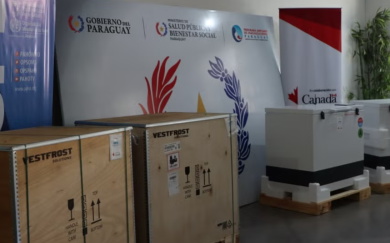
BRIDGETOWN, Barbados – A significant health infrastructure initiative is transforming vaccine distribution capabilities across the Caribbean region. The Pan American Health Organization (PAHO), with substantial funding from the Government of Canada, has deployed approximately 1,000 units of advanced cold chain equipment to 18 Caribbean territories including Anguilla, Antigua and Barbuda, British Virgin Islands, Cuba, Curacao, Dominica, Grenada, Haiti, Jamaica, Montserrat, St Kitts and Nevis, St Vincent and the Grenadines, Suriname, Trinidad and Tobago, and St Maarten.
This strategic enhancement addresses critical logistical challenges in vaccine preservation through state-of-the-art temperature-monitoring devices, passive cold boxes engineered for complex environments, vaccine carriers with extended thermal protection, and ice-lined refrigerators featuring freeze-protection technology. The equipment ensures vaccine potency from port arrival to final community distribution points.
Santiago Cornejo, Executive Manager of PAHO’s Regional Revolving Funds, emphasized the transformative impact: “This new cold chain infrastructure fundamentally strengthens national capacities to safeguard every vaccine dose throughout the distribution journey. These technological solutions enhance safety protocols, minimize wastage, and promote equitable immunization access across diverse geographical challenges.”
The donation constitutes a core component of Canada’s broader initiative “Improving Equitable Access and Coverage of COVID-19 Vaccination in Latin America and the Caribbean,” implemented by PAHO to reinforce regional public health systems beyond pandemic response.
Concurrently, PAHO’s Regional Revolving Funds mechanism continues to demonstrate remarkable efficiency. Through pooled purchasing and coordinated planning, participating nations have achieved approximately 50% cost savings on vaccines and medical supplies over the past two years, extending vital health resources to an estimated 180 million people across the Americas. This collaborative procurement model has historically supported advancements against HIV/AIDS, malaria, tuberculosis, while simultaneously improving immunization coverage and reducing maternal and child mortality rates.