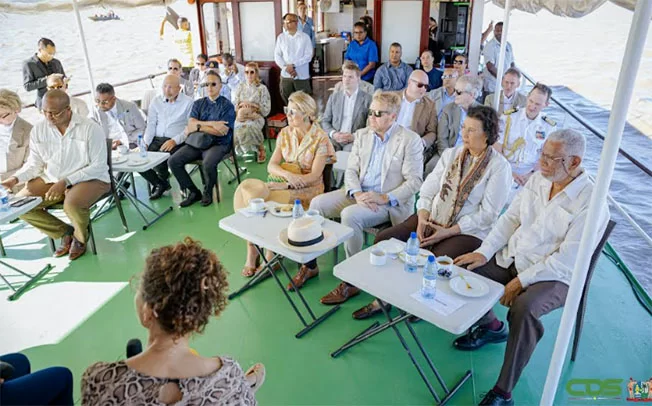
In an unconventional departure from typical diplomatic formalities, King Willem-Alexander and Queen Máxima of the Netherlands engaged in an immersive environmental and cultural journey along Suriname’s waterways during their state visit on Wednesday, December 3rd. Hosted by President Jennifer Simons and her spouse Glenn Geerlings aboard the charming salon boat Mi Gudu, the royal delegation navigated the Suriname and Commewijne rivers, transforming what began as a ceremonial occasion into an educational exploration of natural heritage and ecological challenges.
The expedition commenced with historical context provided by author and documentary filmmaker Tessa Leuwsha, who illustrated how diverse communities have coexisted with these waterways for generations. Her narratives effectively converted the vessel’s deck into a floating open-air museum within minutes. Simultaneously, environmental specialists briefed the distinguished guests on aquatic ecosystems, water quality assessments, and future conservation challenges facing the riverine environments.
A particularly compelling presentation came from Usha Satnarain of Anton de Kom University, who elucidated the critical protective function of mangrove forests. These intricate root systems serve as natural coastal guardians, wave breakers, and nurseries for numerous fish and crustacean species. Satnarain emphasized that without robust mangrove preservation, both biodiversity and dependent human communities would face severe deterioration, noting that legislation without rigorous enforcement would yield limited results.
Monique Pool of the Green Heritage Fund subsequently highlighted the region’s remarkable aquatic biodiversity, spotlighting the rare Guyana dolphin that appears only when salinity levels reach optimal conditions. Several dolphins serendipitously surfaced during the presentation, while Pool also noted the presence of more reclusive manatees. She characterized dolphins as environmental indicators, stating their sensitivity to water quality changes makes them early warning systems for ecological distress.
The journey concluded with natural advisor John Goedschalk outlining Suriname’s significant yet underutilized potential in global climate and biodiversity leadership. Despite possessing extensive forests that position the nation as a carbon sequestration powerhouse, Suriname has struggled to translate these assets into economic benefits. Goedschalk advocated for sustainable models that generate value through ecosystem services and forest products without resorting to deforestation. He expressed appreciation for President Simons’ efforts to finalize the Sustainable Nature Management Act, which is nearly ready for parliamentary consideration.
This unique river voyage blended cultural heritage with environmental advocacy, demonstrating how Suriname’s waterways serve as living narratives connecting historical legacy with future ecological responsibility.