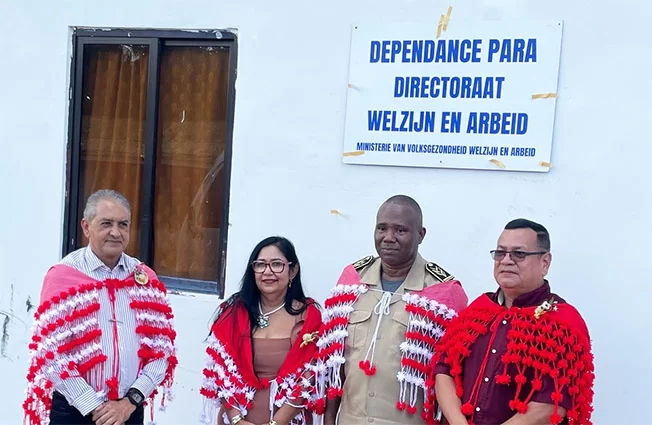
The Directorate of Welfare and Labor under Suriname’s Ministry of Health, Welfare, and Labor inaugurated its first district branch in Para on Friday, marking a significant step in the government’s decentralization initiative. The new facility at Witsanti Educational Center immediately commenced operations by awarding certificates to 56 participants who successfully completed vocational training programs administered by the Foundation for Labor Mobilization and Development (SAO).
In addition to their certifications, graduates received starter kits funded through the ‘Wroko Fu Mek Moni’ project, enabling immediate application of their newly acquired skills. This Para branch represents the initial phase of a comprehensive government plan to establish similar facilities across all districts, accelerating development outside the capital city of Paramaribo through decentralized service delivery.
Vice Minister Raj Jadnanansing emphasized that the new center will provide Para residents, particularly youth, with enhanced access to vocation-oriented training and employment guidance. He instructed coordinator Brian Swedo to conduct assessments in thirteen surrounding villages to identify the most critically needed skills. The branch will also develop a database of job seekers to facilitate targeted employment programs and will serve an educational role in addressing youth alcohol and drug abuse issues.
District Commissioner Patrick Kensenhuis described the opening as a crucial advancement in bringing essential services closer to the community. Kensenhuis specifically highlighted the need to strengthen Labor Inspection services given the substantial number of businesses operating within Para.
The ceremony featured the distribution of 90 certificates across multiple disciplines including Gawasa (Gas, Water and Sanitation), Electrical House Installation, Textile Works, and various computer training programs. Although administrative delays postponed the certification event, participants received compensatory support packages:
– Gawasa and electrical course graduates received basic toolkits
– Textile Works participants obtained household sewing machines
– Computer training participants will receive complimentary internet training from SAO in January
Notably, the programs demonstrated strong female participation in both Gawasa and Electrical House Installation courses. According to SAO Director Joyce Lapar, many trainees have already applied their skills within their communities, including repairing toilets at the LBO school in Wit Santi and performing electrical work at a school in Onverwacht.