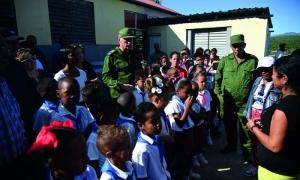
Cuban President Miguel Díaz-Canel Bermúdez conducted a comprehensive inspection tour of Santiago de Cuba, the province most severely impacted by Hurricane Melissa’s recent devastation. The presidential visit included Cayo Granma, a historic fishing community situated three nautical miles inland from Santiago Bay, where the hurricane’s destructive forces wreaked particular havoc on the island’s infrastructure.
The presidential delegation, comprising deputy prime ministers, ministers, and key sector directors coordinating recovery efforts, assessed the extensive damage across coastal communities including La Socapa, Caracoles, and Aguadores. Local residents compared Melissa’s destruction to Hurricane Sandy’s impact thirteen years prior, with many describing the recent storm as equally or more devastating.
Remarkably, comprehensive evacuation procedures prevented casualties or injuries—a point of local pride shared with the visiting president. This marked the first presidential visit to Cayo Granma according to island residents, symbolizing the administration’s commitment to affected regions.
The tour included Juan Gualberto Gómez Primary School, which had lost its entire roof during the October 29th storm but has since been reroofed and reopened for its 61 students. President Díaz-Canel engaged with students and faculty, discussing educational continuity, meal programs, and athletic facilities. When the president suggested basketball court installation, students unanimously requested soccer facilities instead—a request the president laughingly committed to fulfilling.
Damage assessments reveal 170 of Cayo Granma’s 256 homes sustained damage, with 15 completely destroyed and 20 partially destroyed. Roof damage affected 115 structures, while 170 mattresses required replacement. Recovery assistance has included approximately 1,000 roofing tiles and food kits from the Cuban government, World Food Programme, Venezuela, and private donations from MSMEs and Cuban citizens.
At a subsequent Provincial Defense Council meeting, President Díaz-Canel reviewed recovery progress, noting electrical service restoration at 84% completion and damage validation for 48,768 of 141,000 initially reported damaged homes. The president committed to deploying national resources for final recovery pushes, emphasizing that Santiago de Cuba—the cradle of the Cuban Revolution—deserves and will receive full national support in rebuilding efforts.