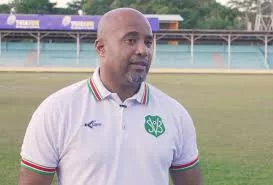
Since the Surinamese government introduced the sports passport in 2018, the national football team has predominantly consisted of professional players born and trained abroad. This initiative also led to the recruitment of coaches with professional football backgrounds and ties to the country. Dean Gorré was the first in a series of such coaches, willing to work with an entirely amateur organization. While the goal was clear—qualifying for the World Cup—the path to achieving it was fraught with disagreements. Many expected Suriname to secure a spot in the 2022 World Cup, but when this didn’t happen, cracks in the collaboration began to show. Despite winning the Gold Cup, which signaled growth, the board lacked confidence in the team’s ability to advance, as evidenced by prematurely booked return tickets. A dispute over a player’s inclusion during the Gold Cup escalated, leading to Gorré’s dismissal in a press conference where he was publicly humiliated. Following this, the ‘Menzo I era’ began but was short-lived due to a lucrative offer in China. Winter then took over, assisted by Ten Cate, but failed to meet expectations, even missing the Gold Cup. The ‘Menzo II era’ saw an influx of new players and significant progress, culminating in Gold Cup qualification and a chance for direct World Cup entry. However, a loss in the final group match dashed these hopes, leaving Suriname to vie for a spot through intercontinental playoffs. Meanwhile, Gorré, undeterred by his dismissal, joined Curaçao’s football association. There, his leadership and collaborative efforts secured a coveted World Cup ticket, making history for Curaçao. While Suriname continues to struggle, Gorré and his team are celebrated for their historic achievement, highlighting the stark contrast between the two nations’ football trajectories.