
In a historic triumph, Haiti’s national football team, the Grenadiers, has secured direct qualification for the 2026 FIFA World Cup, marking their return to the global stage after a 51-year hiatus. The decisive moment came on November 18, 2025, during the final phase of the CONCACAF qualifiers, where Haiti faced Nicaragua in the second leg of their sixth group match at the Estadio Ergilio Hato in Willemstad, Curaçao. The Grenadiers emerged victorious with a 2-0 win, cementing their place at the top of Group C. Deedson Louicius opened the scoring in the 9th minute with a precise left-footed shot, while Ruben Providence doubled the lead with a close-range header just before halftime. The team’s defensive prowess in the second half ensured Nicaragua’s repeated attacks were thwarted. This achievement not only signifies Haiti’s second World Cup appearance since their debut in 1974 but also unites generations of Haitians worldwide in celebration. Under the guidance of French coach Sébastien Migné, the Grenadiers showcased resilience and skill, with standout performances from players like Louicius, Providence, and Carlens Arcus. The victory is a testament to Haiti’s growing football legacy and a source of national pride.
标签: Haiti
海地
-
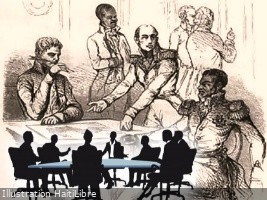
Justice : 2026 Roadmap of the Haitian National Committee for Restitution and Reparation
The Haitian National Committee for Restitution and Reparations (CNHRR) has unveiled an ambitious 2026 Roadmap aimed at addressing the historical and moral debt owed by France for the ‘double ransom’ imposed on Haiti in the 19th century. This initiative seeks to transform the struggle for justice into a comprehensive societal project involving education, research, diplomacy, and public mobilization.
Historical Context:
In 1825, France demanded Haiti pay 150 million gold francs (later reduced to 90 million) as compensation for the loss of its colony and colonists’ properties. This sum, borrowed at exorbitant rates, crippled Haiti’s economic and social development for over a century, earning the term ‘double ransom.’CNHRR’s Formation and Mission:
Established on August 8, 2025, the CNHRR comprises representatives from Haiti’s Presidency, Prime Minister’s Office, Ministry of Economy and Finance, Ministry of Foreign Affairs, civil society, and academic experts. Its mandate is to advocate for restitution and reparations from France and the international community.2026 Roadmap Highlights:
1. **Action Plan and Structures**: The CNHRR has finalized its annual action plan and established working subgroups to address various aspects of restitution and reparations.
2. **Educational Reforms**: Collaboration with the Ministry of Education to revise history curricula and textbooks, ensuring the ‘double ransom’ is accurately represented.
3. **Public Awareness**: Nationwide conferences, webinars, and a national survey to gather public opinion on restitution.
4. **Academic Research**: Scholarships for Haitian students to conduct master’s and doctoral research on the topic.
5. **Scientific Conferences**: Two major conferences planned for 2026 on slavery, reparations, and public health.
6. **White Paper Publication**: A comprehensive document outlining arguments for restitution will be published and made accessible to all Haitians.
7. **Financial Calculations**: Collaboration with experts to determine actuarial and discounted amounts for negotiations.
8. **Student Engagement**: Study days and literary competitions to foster awareness among Haitian youth.
9. **Research Chair**: Establishment of a Research Chair at the State University of Haiti to host academic conferences and lectures.
10. **Social Mobilization**: A communication plan to involve civil society and grassroots organizations in the restitution process.
11. **International Collaboration**: Strengthening ties with CARICOM, African, American, and European organizations to build a united front for restitution.This roadmap represents a significant step in Haiti’s quest for historical justice, aiming to rectify centuries of economic and social injustice inflicted by colonial exploitation.
-
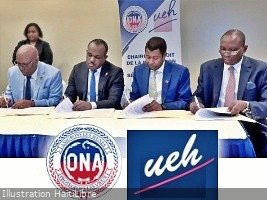
Politic : UEH and ONA unite to build a stronger social security system
In a landmark move to address Haiti’s pressing social security challenges, the State University of Haiti (UEH) and the National Old Age Insurance Office (ONA) have joined forces to establish the University Chair in Social Protection and Security Law. This initiative, the first of its kind in the country, was formalized through a partnership agreement signed on November 14, 2025, by Professor Dieuseul Prédélus, Rector of UEH, and Ronald Bazile, Director General of ONA. The Chair will be housed at UEH’s Faculty of Law and Economics (FDSE) and aims to enhance academic, scientific, and professional capacities in the field of social protection and security. Rector Prédélus highlighted the dire state of social security in Haiti, where only 8.2% of the population is covered, compared to 43% in the Dominican Republic and 65% in Jamaica. The Chair sets ambitious goals, including training 300 specialized professionals within five years, producing 30 scientific publications, and fostering national and international partnerships. Director General Bazile emphasized the Chair’s role in combating misconceptions, modernizing public action, and building a sustainable social protection system. The initiative has garnered support from key stakeholders, including the Minister of Social Affairs and Labor, Georges Wilbert Franck, who praised the project for its potential to transform social security from a concept into a tangible reality. The Chair, established for an initial 10-year term, will offer a range of programs, including undergraduate and graduate degrees, short-term training, and research activities, benefiting social security employees, UEH students, and professionals in the sector.
-

222nd of Vertières : Reflections of former interim President Jocelerme Privert
On November 18, 2025, Haiti commemorated the 222nd anniversary of the Battle of Vertières, a pivotal moment in its history that led to the nation’s independence. Former interim President Jocelerme Privert delivered a poignant address, reflecting on Haiti’s enduring struggles and the urgent need for renewal. He emphasized the significance of this date as a cornerstone of national identity, symbolizing the country’s relentless pursuit of freedom, dignity, and sovereignty. However, Privert also highlighted the dire challenges facing Haiti today, including rampant gang violence, economic collapse, and social instability. Port-au-Prince, the capital, has been under siege by armed groups, forcing government institutions to flee and leaving the Toussaint Louverture International Airport abandoned. The economy has been in decline for six years, with negative growth rates and dwindling investments. Social conditions are equally alarming, with over 60% of the population living in extreme poverty and food insecurity. Nearly 1.4 million people have been displaced due to violence, and millions of children are deprived of education. Privert called for the restoration of constitutional order, credible elections, and a collective effort to reject corruption and violence. He urged Haitians to draw inspiration from their history and work together to build a stable, prosperous, and united nation. Privert’s message was a rallying cry for civic responsibility, courage, and unity, reminding Haitians that their destiny lies in their hands.
-

BRH : Training on financial market development
The Bank of the Republic of Haiti (BRH) recently spearheaded a pivotal training initiative aimed at bolstering the nation’s financial market infrastructure. On November 14 and 15, 2025, representatives from Savings and Credit Unions (CEC) in the Greater South region convened in Les Cayes to gain expertise in utilizing the Central Securities Depository (CSD). This advanced system, integral to the modernization of Haiti’s financial sector, operates in tandem with the Automated Transfer System (ATS) to enhance the registration, safekeeping, and transfer of securities, including Treasury bills. The ATS further ensures secure, real-time payment clearing and settlement, while optimizing liquidity management. This training is a cornerstone of the Financial Market Development Project, which seeks to modernize Haiti’s financial system, boost liquidity, bolster investor confidence, and democratize access to Treasury bills. By equipping CECs with the necessary skills, the initiative aims to empower them as effective Securities Account Keepers, elevate service quality, and pave the way for the successful implementation of the Financial Market Development project.
-
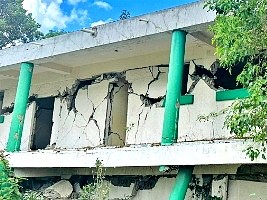
Health : Towards the reconstruction of the L’Asile Community Referral Hospital
The L’Asile Community Referral Hospital (HCR) in Haiti’s Nippes Department, severely damaged by the devastating earthquake of August 14, 2021, has been operating in temporary spaces that are inadequate to meet the healthcare needs of the local population. Despite these challenges, the hospital continues to provide essential services. On September 14, 2025, a significant step was taken toward its reconstruction. Dr. Esther Ceus Dumont, Departmental Director of the Nippes Health Directorate (DSNI), alongside Carl Yvans Petit Frère, Project Management Unit Supervisor for the World Bank, and other officials, conducted a site visit to prepare for the tender process. This visit aimed to gather critical data for the demolition of damaged structures and the construction of a new, modern hospital center, a priority project of the Ministry of Public Health. In addition to the L’Asile Hospital, several other health infrastructure projects in Nippes are making progress. The Lomond Health Center is nearing completion, the Paillant Health Center is being reconstructed satisfactorily, and work on the Changeux Health Center is set to begin soon, with initial funding already disbursed. These initiatives underscore the DSNI’s commitment to enhancing the departmental health system, improving access to care, and building resilient infrastructure tailored to the needs of local communities.
-

FLASH : Barbecue warns the population of the imminent start of a major counter-offensive by «Viv Ansanm» (video)
Haiti is bracing for a potentially violent confrontation as Jimmy Chérizier, known by his alias ‘Barbecue,’ the leader of the ‘Viv Ansanm’ terrorist coalition, has issued a stark warning to the public. In a video message, Chérizier urged citizens to remain indoors starting Monday, November 17, 2025, as his group prepares to launch a major counter-offensive against law enforcement in the streets of Port-au-Prince. He emphasized the need to avoid civilian casualties, stating, ‘Leave the streets to ‘Viv Ansanm’ and the police so that we can confront them.’ The Haitian National Police (PNH) has taken the threat seriously, suspending all leave and vacations since November 16 and maintaining a high state of alert. The French Embassy in Haiti has also announced its closure on November 17 as a precautionary measure. This development follows a recent large-scale joint operation by the PNH, the Armed Forces of Haiti (FAD’H), and the Gang Suppression Force (GSF) against the ‘400 Mawozo’ gang, which has long held the communes of Tabarre and Croix-des-Bouquets hostage. Chérizier’s message underscores the escalating tensions in Haiti, as the country grapples with widespread gang violence and instability.
-

Croix-des-Bouquets : The Haitian National Police (PNH) deals a decisive blow against the «400 Mawozo» gang
In a landmark operation on November 14, 2025, the Haitian National Police (PNH), in collaboration with the Gang Suppression Force (GSF) and the Armed Forces of Haiti (FAd’H), launched a meticulously planned assault against the infamous ‘400 Mawozo’ gang. This criminal organization had entrenched itself along National Road 3 (RN3), fortifying key sections and disrupting public safety. The coordinated strike, driven by precise intelligence, resulted in the seizure of a vast arsenal of weapons and ammunition, significantly weakening the gang’s operational capabilities. Among the confiscated items was an armored bulldozer, a tool the gang used to erect barricades and destroy state infrastructure. Notably, the PNH recovered a .50 caliber American Barrett rifle, a high-precision sniper weapon capable of penetrating steel plates from considerable distances. This weapon had been a centerpiece of the gang’s propaganda. The operation neutralized critical gang resources, marking a turning point in the fight against organized crime in Haiti. Several gang members were killed or wounded, while security forces emerged unscathed. This decisive action underscores the PNH’s growing capacity to dismantle criminal networks and restore order in gang-controlled areas.
-

Insecurity : U.S. Marines exchanged fire with gang members
U.S. Marines stationed in Haiti to safeguard the American Embassy were involved in a firefight with suspected gang members earlier this week, according to military officials. The incident, which took place on Thursday evening in Port-au-Prince, saw Marines returning fire after being attacked. Captain Steven Keenan, a Marine Corps spokesperson, confirmed that no Marines were injured during the exchange. Keenan emphasized the Marines’ dedication to protecting U.S. embassies globally, stating they respond to threats with precision and professionalism. The U.S. State Department, Embassy in Haiti, and U.S. Southern Command have yet to comment on the incident. This clash follows heightened security measures implemented at the Embassy last year in response to escalating gang violence. In August, the Embassy announced the arrival of additional Marines to bolster security and support ongoing diplomatic efforts, including collaboration with Haitian police and a multinational security mission. Despite the volatile environment, the Embassy remains operational for emergency services, though it has reported nearby gunfire incidents earlier this year. The State Department had previously evacuated non-essential personnel in March 2024 and issued a travel advisory in July, declaring Haiti in a state of emergency.
-

FLASH : Official Calendar of Upcoming Elections
The Provisional Electoral Council (CEP) of Haiti has formally presented the Executive branch with a detailed electoral calendar and draft electoral decree, marking a significant step toward the nation’s upcoming elections. The calendar, submitted on November 14, 2025, outlines a meticulous timeline of activities leading to the election of a new president by early 2027. For the process to proceed smoothly, the CEP has emphasized the necessity of three critical prerequisites: the timely publication of the electoral decree in the official journal ‘Le Moniteur,’ the establishment of adequate security conditions, and the availability of sufficient financial resources. The calendar spans over two years, encompassing key phases such as voter registration, candidate accreditation, electoral campaigns, and the deployment of temporary staff. The first round of legislative and presidential elections is slated for August 30, 2026, with the second round scheduled for December 6, 2026. Final results for the presidential and legislative elections are expected to be published by January 7, 2027, while local government results will be announced by January 20, 2027. The CEP has also highlighted the importance of public awareness campaigns and the recruitment of personnel to ensure the integrity and efficiency of the electoral process. The full calendar is available for download in PDF format, providing transparency and accessibility to the public.