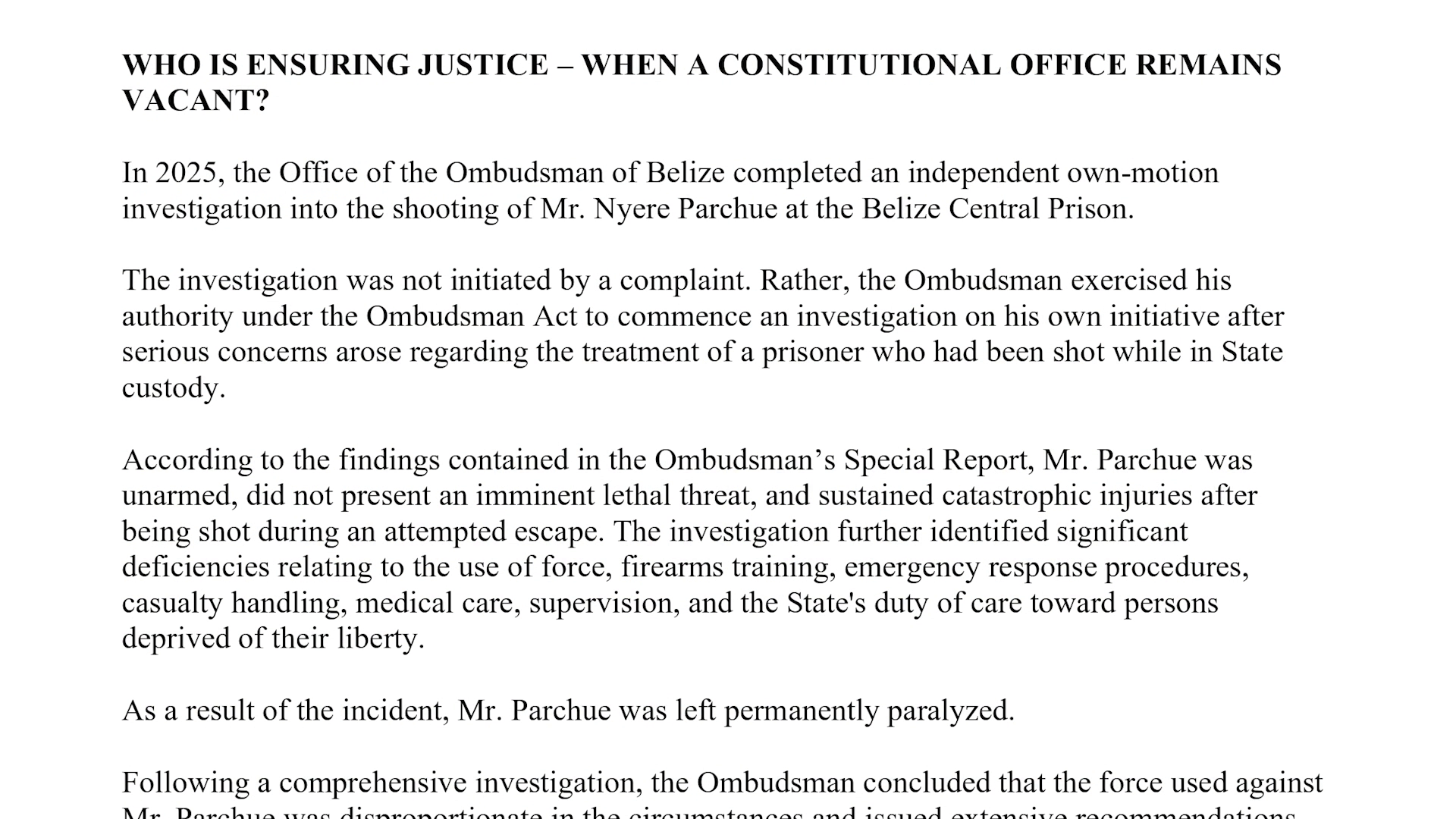
On July 3, 2026, a damning posthumous final report from retired former Belize Ombudsman Major Gilbert Swaso has brought critical systemic failures at Belize Central Prison to public attention, centered on a 2025 shooting that left an inmate permanently disabled. The incident in question occurred in August 2025, when inmate Nyere Parchue attempted to escape the facility. Prison officers opened fire on Parchue during the attempt, resulting in a permanent spinal injury that left him paralyzed. After a two-month investigation launched immediately after the shooting, Swaso’s team has confirmed that the force used by officers far exceeded what was legally and ethically justified. Prison officials have long justified the use of lethal force against escaping inmates under Section 39 of the Belize Central Prison Act, which the institution claims codifies a right to use deadly gunfire in escape scenarios. Swaso acknowledged that this statutory allowance exists on paper, but emphasized that the law must be interpreted to require lethal force only as a last resort when no other options are available. In this specific case, the investigation found that multiple non-lethal resources and alternative intervention strategies were available to responding officers at the time of Parchue’s escape attempt. As such, the lethal gunfire used was disproportionate to the threat and could have been entirely avoided, the report concluded. Beyond the excessive use of force, the investigation also uncovered deep, systemic gaps across three critical areas of prison operations: inadequate protocols for use of force, delayed and uncoordinated emergency medical response for injured inmates, and a complete lack of effective internal oversight over guard conduct. To address these failures, the report puts forward three core recommendations: expanded, regular training for prison personnel on proportional use of force, widespread deployment of non-lethal weapons for response to incidents like escape attempts, and the implementation of stronger accountability mechanisms to penalize unjustified use of force. Despite the clear findings and actionable recommendations published nearly a year after the incident, key questions about reform and accountability remain unresolved as of the 2026 report release. The most pressing barrier to follow-through is the fact that the Office of the Ombudsman, the only body legally empowered to launch, oversee, and enforce investigations into institutional misconduct, has been completely vacant since December 2025. Under the current Ombudsman Act, only the sitting Ombudsman has the legal authority to initiate, continue, or conclude investigations into complaints. Ombudsman office staff can only receive and log complaints, with no power to advance investigations or push for response from state institutions. Swaso, who left office at the end of 2025, confirmed that even if the prison has submitted a response to his final report, sitting staff lack the authority to act on it, leaving the entire reform process in limbo. This transcript is adapted from an evening television news broadcast original to the outlet.
分类: society
-

Christopher Noble Gets Expanded Crime-Fighting Role
Two weeks following the appointment of Julius Espat as Belize’s new Minister of Home Affairs, the Belize Police Department is launching a transformative initiative to combat violent crime: a specialized interdivisional task force that also brings a major leadership shakeup to the country’s top law enforcement agency.
The new operational body, named the Violence Prevention and Enforcement Team, merges seasoned personnel from two existing Special Patrol Unit detachments, one based in Belize’s Eastern Division and the other in the popular coastal community of San Pedro. The team will be directly commanded by Assistant Superintendent of Police Rodney Jones, who in turn will report to Senior Superintendent Christopher Noble — a veteran officer whose remit has just been expanded dramatically to oversee three of the department’s most critical anti-crime units.
Before the restructuring, Noble led just one specialized unit, the Leadership Intervention Unit. His new portfolio adds two high-priority commands: the Gang Intelligence, Investigation and Interdiction Unit, and now the newly formed Violence Prevention and Enforcement Team. This consolidation places the full spectrum of violence intervention, gang-focused intelligence, and targeted enforcement operations under a single, unified leadership structure.
In an official circular distributed to all department heads, Commissioner of Police Dr. Richard Rosado outlined the core mandate of the new task force: it will center its work on identifying and monitoring high-risk offenders, combining proactive preventative patrols, sustained outreach to local communities, and concentrated enforcement actions to disrupt potential violence before it occurs.
Law enforcement leadership anticipates that grouping these three key units under Noble’s centralized command will deliver tangible improvements to Belize’s anti-crime response. By streamlining interunit coordination, breaking down traditional information silos to strengthen cross-team intelligence sharing, and creating a clearer chain of command, the restructuring is designed to make the police’s response to violent crime faster, more targeted, and more effective.
This report is adapted from a transcript of an evening television newscast, with original Kriol-language remarks transcribed using a standardized spelling system for accuracy.
-

Digi Scholarships Open Doors for Fifty-Seven Students
As Belize prepares for the 2026 academic year, 57 talented local students have been awarded comprehensive Digi Scholarships from telecommunications provider BTL, removing financial barriers and creating long-term opportunities for young people across the country. Of the 2026 cohort, 40 recipients are entering high school, while 17 are moving on to junior college, marking a significant expansion of a program that has supported Belizean education for more than three decades.
Unlike many traditional scholarships that only cover tuition costs, the Digi award includes full coverage for textbooks, required school supplies, residential internet access, and ongoing one-on-one mentorship to help students stay enrolled and meet their academic goals. For recipients like Silverio Hernandez, a soon-to-be freshman at Muffles, the support represents far more than financial aid—it is a life-changing opportunity to pursue his lifelong dream of becoming an attorney, even amid significant personal and economic challenges.
As a single-mother household, Hernandez’s family has struggled to keep up with rising education costs amid Belize’s ongoing economic pressures. For Hernandez, the scholarship eliminates the constant stress of covering expensive school bills, allowing him to redirect all his energy to his studies. His mother, Cyndy Hernandez, described the award as a miracle, noting that the financial relief could not have come at a more critical time for their family.
Ramon Cervantes Jr., Belize’s Minister of State for Education, Science and Technology, praised the public-private partnership behind the Digi Scholarship program, emphasizing that collaborations between corporate stakeholders and government are key to advancing the national goal of universal accessible education for all Belizean children. Cervantes congratulated the 2026 recipients on their hard-earned awards and encouraged them to push forward to reach their full potential.
For BTL, the program serves a dual purpose: investing in Belize’s future leaders while building a pipeline of skilled local talent for the company’s growing workforce. This year, all 17 junior college scholarships were reserved for students pursuing studies in STEM (science, technology, engineering, and mathematics) fields, aligned with a new internship initiative that places program recipients in key roles across the company’s network operations, IT infrastructure, and cybersecurity divisions.
Digi CEO Ivan Tesucum explained that the targeted STEM focus addresses the company’s growing demand for skilled local workers, allowing the firm to nurture young talent from early in their academic careers through summer internships and long-term professional development.
The 2026 program received more than 200 applications from students across Belize, reflecting high demand for the support. The initiative launched in 1991 with just 25 awards, and BTL has steadily expanded access over the past 35 years. The company announced plans to grow the program again next year, with a goal of offering 75 scholarships to qualifying Belizean students in 2027.
The award ceremony was covered by News Five reporter Shane Williams, who filed this report from the event.
-

Benefactor Donates 18 Acres for San Ignacio Cemetery
For many years, families across the twin municipalities of San Ignacio and Santa Elena in Belize have faced a growing, heart-wrenching crisis: the region’s only public cemetery had completely run out of burial space, forcing grieving residents to travel outside their home community to lay loved ones to rest. That long-standing crisis is finally nearing a resolution, thanks to a transformational gift from a generous local-born philanthropist.
Thelma Jenkins, a Belizean-American benefactor with ties to the region, has donated 18 acres of prime undeveloped land to the municipal government to establish a brand new public cemetery and memorial park. The donation not only resolves the urgent space shortage that has plagued the community for years, but also saves local taxpayers hundreds of thousands of dollars that had been earmarked for land purchases. According to San Ignacio/Santa Elena Mayor Earl Trapp, the municipality had been preparing to spend roughly $300,000 to acquire just 10 acres of land for the expansion project—far less space than what Jenkins has gifted entirely free of charge.
For Trapp, the announcement marks the end of an 11-year advocacy effort that began when he first took office more than a decade ago. In remarks following the announcement, the mayor shared the emotional weight of the crisis he had witnessed firsthand, noting that for years he had turned away countless local families who hoped to bury their relatives in San Ignacio’s existing cemetery, only to find no plots available. Those families were forced to arrange burials in the neighboring Santa Elena cemetery instead, a disappointing and inconvenient outcome for residents with deep community roots in San Ignacio.
“Eleven years ago, when I took office, expanding burial space became one of my top priorities, and today that work has finally come to fruition,” Trapp said in his public remarks. “It hurt my heart to tell families we couldn’t bury their loved ones here, where they belonged. Now, residents of both San Ignacio and Santa Elena have a choice: they can lay their family members to rest in either community, according to their wishes.”
Trapp called Jenkins the project’s biggest benefactor, emphasizing that the donation removes the full financial burden of land acquisition from the municipal council and local taxpayers. The new site, which will be developed as both a cemetery and public memorial park, is expected to meet the region’s burial needs for decades to come. The project’s inauguration marks a major milestone for the municipality, closing a chapter of unmet need and opening new space for the community to honor its departed residents.
*This report is adapted from a transcript of a televised evening newscast.*
-

Businessman on attempted abduction charge granted GY$1 million bail
On Friday, July 3, 2026, a 36-year-old city businessman from Georgetown, Guyana was granted one million Guyanese dollars in bail after being formally charged with attempted abduction, court documents confirm.
Avishkar Singh, a resident of 208 Alexander Village in Greater Georgetown, faces an indictable charge connected to an alleged incident that occurred on June 30, 2026. The person identified as the intended target of the alleged plot is Joshua Samaroo.
Singh’s legal representative, attorney Joel Persid-Edmond, told local outlet Demerara Waves Online News that bail was approved by Chief Magistrate Faith McGusty following more than 60 minutes of legal arguments from both the prosecution and the defense. Persid-Edmond told reporters that he presented a clear case to the court asserting the charge against his client is unfounded, claiming the entire accusation is a failed conspiracy to frame Singh for a crime he did not commit.
The case is scheduled to return to court for further proceedings on July 29, 2026.
The incident traces back to a police operation launched by the Guyana Police Force, which initially categorized the event as an attempted kidnapping. According to initial police statements, investigators launched an operation that uncovered allegations Singh had arranged and handed over a sum of cash as partial payment to other parties to carry out the kidnapping of the male victim.
Following the operation, Singh was taken into police custody, and the sum of cash allegedly involved in the arrangement was seized as evidence for the ongoing case.
-
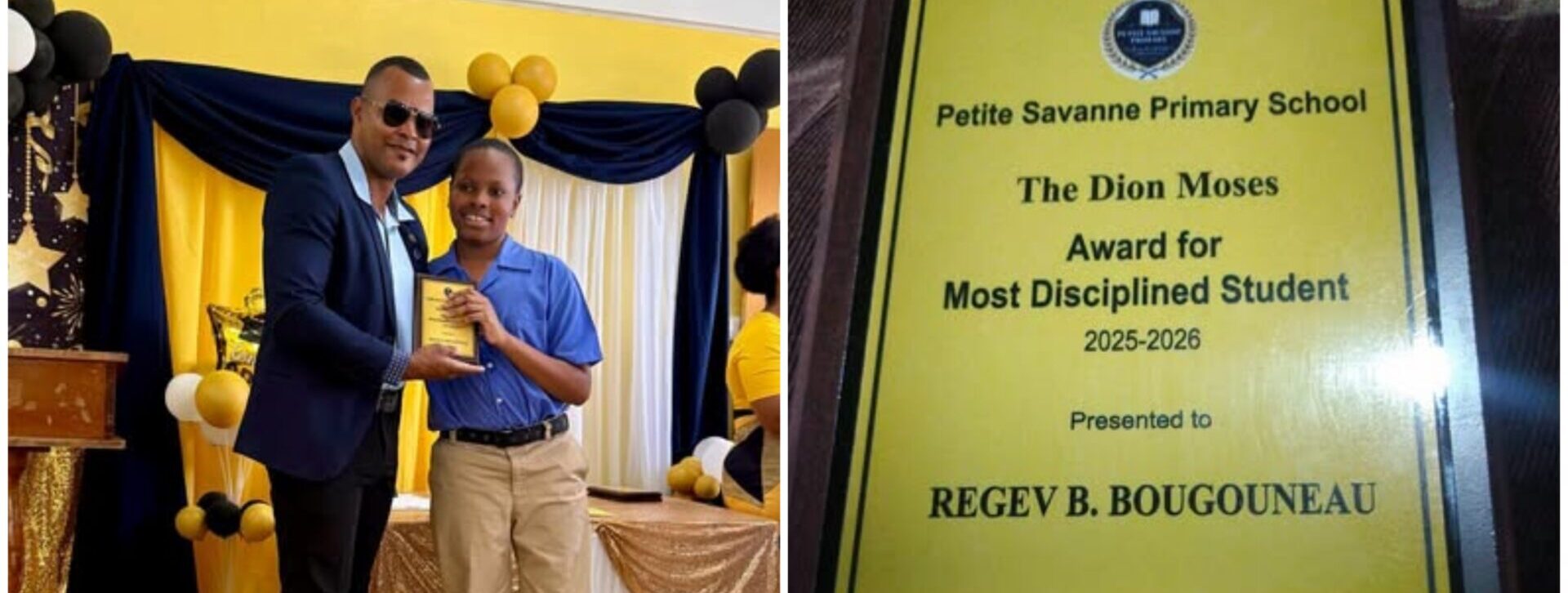
Acting Sergeant Dion Moses presents discipline award at Petite Savanne Primary graduation
On July 1, 2026, the graduation and annual awards ceremony of Petite Savanne Primary School in Dominica hosted a special recognition segment led by a local law enforcement officer, highlighting an ongoing partnership between the national police force and island educational institutions.
Acting Sergeant Dion Moses took to the stage during the event to present the inaugural Dion Moses Most Disciplined Student Award to graduating student Regev B. Bougouneau, who was selected for the honor out of all pupils at the school.
As outlined in an official announcement shared to the Commonwealth of Dominica Police Force’s public Facebook page, the award was created to celebrate students who maintain exceptionally high standards of conduct across an entire academic year. To earn the distinction, candidates must consistently show unwavering self-discipline, respect for peers and staff, a strong sense of personal responsibility, and behavior that serves as a model for other students throughout the school community.
This awards presentation is not an isolated event, but a core component of the Commonwealth of Dominica Police Force’s wider Community Policing Programme. The program was developed with a clear dual mission: to build deeper, trust-based connections between local law enforcement teams and educational institutions across the island, and to create consistent, positive opportunities for police officers to engage with Dominica’s young population outside of traditional law enforcement contexts.
In its statement, the police force emphasized that the long-term goal of this youth-focused initiative is to nurture strong moral character among school-aged children. By publicly celebrating positive behavior and outstanding conduct, organizers hope to inspire young Dominicans to practice intentional decision-making from an early age, empowering them to grow into engaged, responsible leaders who will contribute positively to their local communities in the years ahead.
Along with recognizing Bougouneau’s achievement, the police force’s Facebook post extended formal congratulations to every graduating student of Petite Savanne Primary School’s 2026 class, wishing each cohort member smooth transitions and ongoing academic achievement as they advance to the next stage of their educational careers.
-

Police recover illegal firearms, more than 1 000 rounds of ammunition in operation
Against a backdrop of rising serious and violent crime across the Caribbean island nation of Saint Lucia, the Royal Saint Lucia Police Force (RSLPF) has concluded a sweeping, multi-unit law enforcement campaign that has delivered significant results against illegal weapons, drug trafficking and organised crime. The operation, codenamed Operation Zero Hour, ran for six weeks from May 24 through July 1, launched specifically to counter a growing wave of offences tied to unregistered firearms, prohibited narcotics, dangerous weapons and coordinated organised criminal activity.
Unlike scattered reactive patrols, Operation Zero Hour was built on actionable intelligence and coordinated collaboration across almost every branch of the RSLPF. Officers from the specialized Gangs, Narcotics and Firearms Unit (GNFU), Special Services Unit (SSU), Criminal Investigations Department (CID), Police Marine Unit (PMU), Division of Road Safety and Traffic Investigations (DRSTI), and Vulnerable Persons Team (VPT) joined forces with uniformed patrol teams and territorial police divisions covering the Northern, Central and Southern regions of the island. This cross-unit partnership allowed law enforcement to cover both land and maritime entry points that criminal networks often exploit to move contraband.
The operation’s core strategy centered on proactive intervention rather than just responding to crimes after they occurred. Teams focused their efforts on identifying and targeting known repeat offenders, executing court-authorized search warrants based on gathered intelligence, breaking up supply chains for illegal firearms and narcotics, increasing uniformed police presence in high-crime areas to deter potential offending, and stopping violent criminal acts before they could be carried out.
Over the six-week campaign, law enforcement officers carried out an extensive schedule of enforcement activity: 484 individuals were searched, 4,851 vehicles were stopped for checks, 216 of those vehicles and 17 private premises were searched, and 49 judicially approved search warrants were executed across the island. To counter smuggling through maritime routes, officers stopped and boarded 37 commercial and private vessels, and carried out seven targeted sweeps of courier services that are sometimes used to move illegal contraband. Four dedicated highway patrol operations were also run to intercept vehicle-borne shipments of illegal goods.
Enforcement outcomes of the operation reflect the scope of the effort: authorities made nine arrests for traffic-related offenses, 16 arrests on drug charges, seven arrests for illegal firearms possession, and a further 12 arrests for serious violent offenses including murder, attempted murder, armed robbery and aggravated assault. To date, 12 of the individuals arrested have been formally charged with criminal offences. Along with arrests, officers seized seven unregistered illegal firearms, 1,006 rounds of live ammunition, and 54 assorted dangerous weapons. Three dedicated cannabis eradication operations were also carried out to destroy illegal cannabis crops being cultivated for the illegal drug trade. Beyond contraband seizures, police impounded 48 unregistered or unroadworthy vehicles, issued 453 traffic citations for violations, and issued 45 formal police cautions for minor offenses.
In an official statement following the conclusion of the operation, the RSLPF emphasized that the removal of these illegal weapons and contraband from communities represents a major blow to criminal operations across the island. The force noted that the seizures have almost certainly prevented multiple planned acts of violence that would have otherwise threatened public safety. The wide range of activity carried out during Operation Zero Hour – from executing search warrants to drug arrests, crop eradication, and extensive checks of vehicles and vessels – demonstrates the RSLPF’s ongoing commitment to clearing illegal firearms, drugs and dangerous offenders from Saint Lucia’s communities, the statement added.
The operation also underscored the critical value of coordinated collaboration between specialized police units and territorial divisions, the RSLPF said. The combination of targeted intelligence gathering, sustained consistent enforcement, and proactive, prevention-focused policing has not only improved immediate public safety but also helped strengthen public confidence in local law enforcement. Looking ahead, the RSLPF is continuing to call on members of the public to support law enforcement efforts by sharing any information they have about ongoing criminal activity. Tips can be submitted anonymously through the dedicated Crime Hotline at 555, via the official Crime Hotline mobile app, or by visiting any local police station across the island.
-
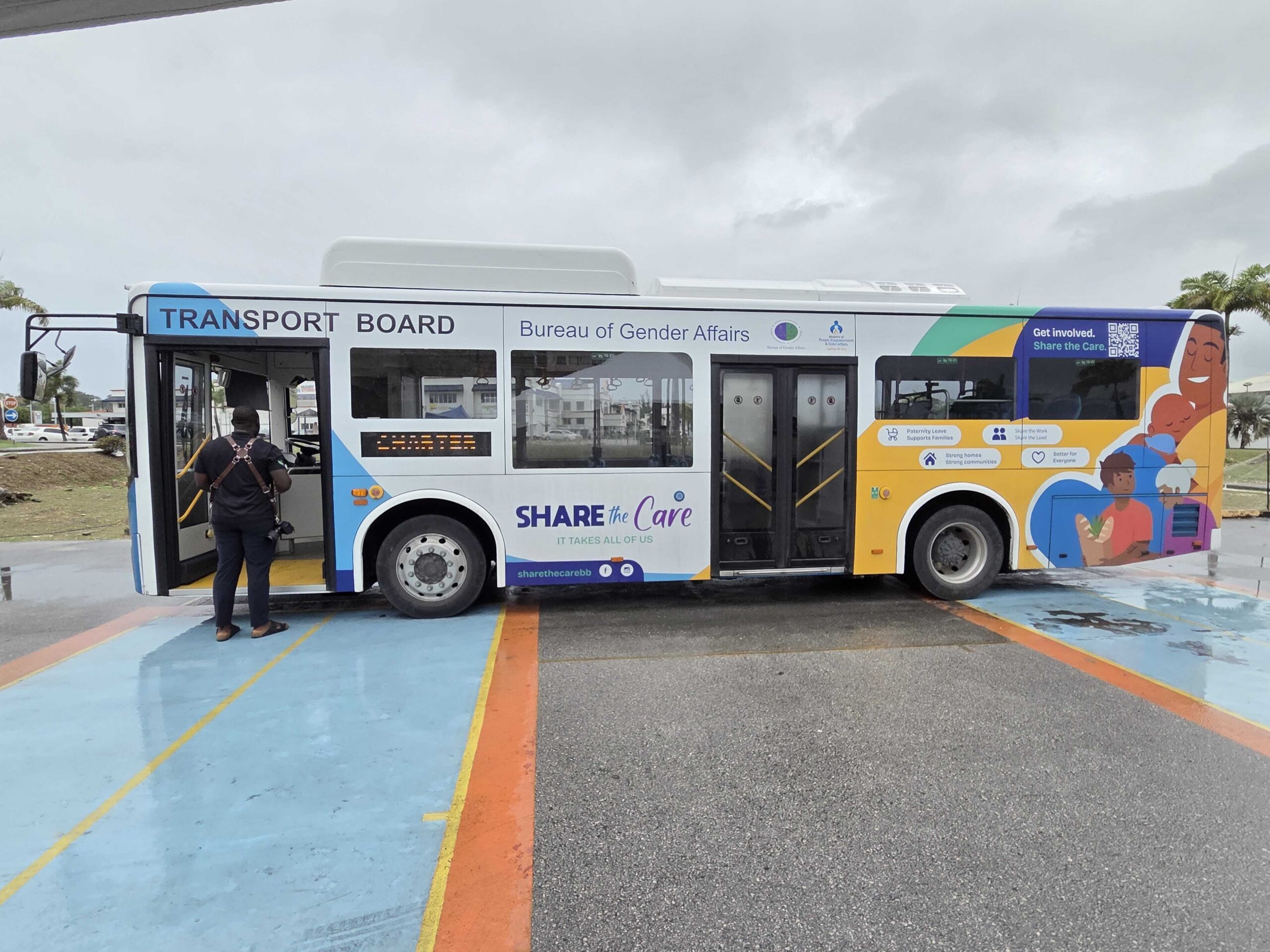
‘Share the Care’: Govt launches campaign to promote men as caregivers
Barbados has ushered in a historic shift in family dynamics and gender equity, rolling out a national public awareness campaign called ‘Share the Care’ to encourage men and boys to take on more active caregiving responsibilities, paired with the country’s first-ever legislated paid paternity leave policy. The dual initiative, spearheaded by the Ministry of People Empowerment and Elder Affairs in partnership with the Bureau of Gender Affairs, aims to dismantle centuries-old entrenched gender norms that have long confined care work exclusively to women across the Caribbean island.
The campaign made its public debut on one of Barbados’ modern electric public buses, a deliberate choice to maximize visibility among everyday commuters as it builds support for the newly implemented paternity leave legislation contained in the updated Family Leave Act. Passed by the government in October of the previous year, the landmark law not only expands maternity leave from 12 to 14 weeks for single births and to 17 weeks for multiple births, but also guarantees all new fathers three weeks of paid paternity leave — a policy first for both Barbados and the broader CARICOM regional bloc.
Speaking at the official launch to journalists and government stakeholders, Minister of People Empowerment and Elder Affairs Adrian Forde stressed that building a truly progressive, inclusive society demands a nationwide cultural shift in how caregiving is framed and valued across all communities. He framed the ‘Share the Care’ campaign as an open call for Barbadian men to reevaluate their roles within their homes, extended families, and local neighborhoods.
“Share and care. We must understand and appreciate that sharing is caring, but equally, if you juxtapose it, caring is sharing as well,” Forde told attendees. “It is for us, especially our men, to be imbued with a sense and appreciation of caring — caring for their loved ones, caring for their extended family, caring for their neighborhoods, caring for their communities, and, by extension, caring for Barbados.”
Forde positioned the new paternity leave legislation as a foundational policy step toward closing gender equity gaps in domestic life, noting that the guarantee removes the structural barriers that once prevented fathers from being present for the earliest, most formative moments of their children’s lives. What was once a distant dream for many working fathers is now a protected right, he emphasized.
From the government’s earliest days in office, leaders have centered men as equal partners in national conversations around gender equity, Forde added. “We have said that paternity leave must not only be a part of men’s imagination, it must all be part of the active conversation, and that is why we moved a place to have paternity leave for men so that they take care of their little babies and share that love, care, and attention that is desperately needed.”
Local creative agency Visual Element has been tapped to lead the strategic and creative execution of the national campaign. Ardith Burgess, the agency’s marketing team lead, explained that the initiative’s core mission is to break down rigid gender stereotypes that have for generations assigned all care work — from childcare to elder care to caring for sick family members — to women. The need for more balanced caregiving has grown increasingly urgent as Barbados grapples with a rapidly ageing population, which has put growing pressure on women to take on unpaid care work, she noted.
“The whole focus of this campaign was generated by the legislation that has been recently enacted,” Burgess said. “We’ve been pigeonholed by gender roles where people only think that caring for children, caring for the elderly, caring for someone who’s ill, is a responsibility of our womenfolk. We want to move beyond that where anybody can share care and don’t have a complex about it or assume that that is the responsibility of the females in the household.”
Acknowledging long-standing societal challenges including widespread paternal absenteeism and a lack of positive male caregiving role models in many communities, Burgess said campaign leaders recognize shifting culture will take time. The initiative is designed to build a sustainable framework for long-term behavioral change, rather than offering a quick fix, she explained.
Looking beyond public media advertisements, the Bureau of Gender Affairs plans to integrate the campaign’s core values into national school curricula starting from primary education, to embed equitable caregiving norms in younger generations early on. “We want to be able to have our men and boys more engaged in terms of not just waiting for a partner or significant other to have a baby, but to be involved as their parents age, as their aunts age, that everybody puts their hand to the floor, in essence, to give care,” Burgess said. “Our whole intent is to spread the word, have people more aware of the legislation, and we would like to take it further into the school system — not just secondary schools, primary schools — to let boys know that sharing care starts at a young age.”
To reach broad audiences across the island, the campaign runs eye-catching mobile advertisements on Barbados’ national transit system, each equipped with scannable QR codes that connect commuters to free educational resources and the Bureau of Gender Affairs’ social media channels. In addition to transit ads, the ministry and its partner organizations will host community outreach pop-up events across every part of the island, featuring public information sessions and branded promotional materials to drive local engagement.
The official launch event brought together a cross-section of key leaders in policy and social development, including Wayne Marshall, Permanent Secretary in the Ministry of People Empowerment; William Warner, Director of the Bureau of Gender Affairs; Nicole Daniel, Social Project Development Manager from local non-profit One Family; and Kim Bobb-Waithe, Acting Director of the National Wellbeing and HIV Commission.
-

Authorities defend handling of horse export amid Grenada euthanasia controversy
A controversial case of equine euthanasia following cross-border transport between two Caribbean nations has ignited fierce debate across the region over veterinary protocols, biosecurity rules, and animal welfare priorities. The incident, which unfolded on May 29 after two horses arrived in Grenada from Saint Lucia, has drawn conflicting perspectives from veterinary experts, government officials, and animal welfare advocates since it came to light. The two horses, owned by Rohan Smith of Bonanza Stables, were put down after Grenadian authorities confirmed they tested positive for Babesia spp., the tick-borne parasite responsible for Equine Piroplasmosis, a disease that impacts equine species but cannot spread to humans. Early unconfirmed reports claimed both animals were pregnant at the time of transport, but Saint Lucia’s Ministry of Agriculture, Fisheries, Food Security and Sustainable Development has refuted this claim, stating pre-export clinical inspections found no evidence of pregnancy in either horse.
In the wake of the incident, Grenadian Prime Minister Dickon Mitchell has disputed Saint Lucia’s claims of procedural compliance, noting that Saint Lucian veterinary authorities held no official records of an export permit being issued for the horses. Mitchell added that the unauthorized movement of the animals violates animal health laws in both countries. The decision to euthanize the horses has also faced sharp public criticism from veterinary professionals on both sides of the border. Dr. Kenrith Carter, a practicing veterinarian, has publicly questioned whether all alternatives to euthanasia — including targeted quarantine, medical treatment, and cross-border expert consultation — were fully explored before the final verdict was reached. Dr. George Joseph, former Chief Veterinary Officer of Saint Lucia, has echoed these concerns, arguing that euthanasia was an unnecessary overstep. He pointed out that while the parasite poses risks to other equines, it cannot jump to human hosts, and established treatment protocols are widely used in regions where the disease is endemic.
Defending the euthanasia order, Grenada’s Chief Veterinary Officer Dr. Kimond Stuart Cummings argued that the decision was rooted in protecting the country’s overall animal health ecosystem and preventing a potentially devastating biosecurity breach. For its part, the government of Saint Lucia has staunchly defended the actions of its veterinary team, maintaining that all required domestic procedures were followed at every step of the process. In a press briefing earlier this week, Saint Lucia’s Agriculture Minister Lisa Jawahir laid out the government’s account of events, noting that authorities acted fully in line with existing national regulations when the owner notified officials of his plan to move the horses back to Grenada. “There is no domestic law that prohibits a person from moving their own animals off the island,” Jawahir explained. “Our regulatory authority centers on controlling what enters our borders, not what leaves, in this case. We followed all required steps, notified Grenada of the test results, and made the owner fully aware of the risks.”
In a detailed timeline released by the ministry last Friday, Saint Lucia’s current Chief Veterinary Officer Dr. Sharmine Melville-Edwin broke down the step-by-step sequence of events leading up to the unauthorized transport. On May 22, seven days before the horses arrived in Grenada, Saint Lucian veterinary officers completed a full inspection of the two animals to meet Grenada’s official import requirements. During that check, the horses were treated for both internal and external parasites, blood samples were collected for laboratory analysis, and initial clinical exams found no signs of infectious or contagious disease. On May 26, four days before transport, lab results confirmed the presence of Babesia spp. in both animals, and the owner was notified immediately of the positive result.
Following the positive test, Melville-Edwin confirmed that Saint Lucia’s top veterinary official directly contacted his Grenadian counterpart to ask if the horses could be allowed entry for quarantine and treatment. In response, Grenada’s veterinary team advised that the animals would not be permitted to enter the country, and recommended that the horses complete treatment and retesting in Saint Lucia before any future export application. Both nations also explicitly notified the owner that Grenada had never issued an official import permit for the animals, and that they would be turned away on arrival. Despite multiple explicit warnings, Saint Lucian authorities later discovered the owner had arranged transport of the horses to the port of Vieux Fort for export. By the time officials contacted the local transporter contracted to move the animals, the horses had already been loaded onto the departing vessel.
Jawahir emphasized that Saint Lucian authorities had no legal standing to intercept and detain the horses once they were loaded. “We fully informed Grenada of our findings, asked if they would accept the animals, got a clear answer of no, and passed that answer directly to the owner,” she said. “He made the independent choice to proceed with transport anyway.” After the horses arrived in Grenada, authorities followed through on their threat and ordered immediate euthanasia. Jawahir noted that the case is now moving into a law enforcement phase, confirming that the owner has been charged by Grenadian police, and further comment will be limited as the legal process moves forward.
In closing, the Saint Lucian Ministry of Agriculture took the opportunity to remind the public of existing animal transport regulations. The ministry confirmed that Equine Piroplasmosis affects only equine species including horses, donkeys, mules, and zebras, and poses zero risk to human health. It also reiterated that all imports of live animals, animal products, and animal by-products into Saint Lucia require a valid import permit under the national Animal (Diseases and Importation) Act, and encouraged anyone planning cross-border animal movement to consult the Veterinary and Livestock Services Division in advance to avoid similar incidents.
-

Parents seek action amid abuse claims at Reunion Primary
A growing wave of discontent is shaking Reunion Primary School, a rural campus located in Choiseul, Saint Lucia, as multiple parents and even some school staff have leveled serious allegations against the school’s sitting principal, Sheran Pierre, calling for urgent educational authorities to intervene and hold those responsible accountable.
The first public allegation came from Melonie King, a local parent with four children currently enrolled at the school. In a handwritten complaint submitted to the District Education Officer earlier this year, a copy of which has been acquired by St Lucia Times, King claims that Pierre physically assaulted her 10-year-old son during a school-wide student assembly in February. King told reporters that after her son disclosed the incident to their family, her husband arranged a face-to-face meeting with the principal, who King says explicitly admitted she had acted inappropriately. Despite this confession, King says no disciplinary action has been taken against Pierre to date, even after she repeatedly escalated the issue to senior education officials. Beyond the abuse allegation, King has also accused the principal of misusing food donations that King herself personally contributed to the school for student meal programs.
A second parent, Dr. Mark Melius, has come forward to back King’s claims, adding his own separate set of allegations against the principal. The conflict between Melius and Pierre dates back to April 21, when Melius confronted a student who had reportedly struck his young daughter on school grounds. In an official complaint dated May 20, 2026 addressed to Chief Education Officer Beverly Dieudonne, Melius alleges that Pierre launched a coordinated campaign to damage his reputation among the school community, falsely claiming that he used aggressive foul language toward the student who had harmed his daughter. Melius calls these claims a complete fabrication, part of a misleading false narrative crafted to deflect blame from the school administration.
When reached for comment by St Lucia Times, Pierre pushed back aggressively against all allegations, denying every claim of abuse, mismanagement, and reputational harm. She refuted King’s assault allegation outright, stating that the incident never occurred, and suggested that King is motivated by personal grievances to deliberately tarnish her professional reputation. Regarding the conflict with Melius, Pierre clarified that the claim of Melius using obscene language did not originate with her – it was the student involved in the altercation who first made the assertion. She added that the entire Melius incident had already been reviewed and addressed by the Office of the Chief Education Officer in a formal meeting.
That meeting, which included Melius, Pierre, Chief Education Officer Dieudonne, and a third representative, did little to resolve tensions, according to Melius. The parent told reporters that the discussion failed to address what he calls the core issue: Pierre’s alleged unprovoked attack on his character. He also added that Pierre showed no concern or empathy for his daughter, who was injured in the earlier student altercation. Far from offering accountability, Melius says meeting attendees advised him that the simplest solution to the conflict would be to transfer his children out of Reunion Primary School entirely.
Beyond the two named parents’ complaints, St Lucia Times has obtained additional correspondence that points to widespread discontent with Pierre’s leadership across the school community. An unsigned open letter dated May 10, 2026, published under the name “the Concerned Staff, Parents & Legal Guardians of the Students of the Reunion Primary School” echoes many of the allegations leveled by King and Melius. Separately, a signed letter from an anonymous current staff member at the school also corroborates King’s claim that the principal has misused donated food resources earmarked for student use. To date, the Ministry of Education has not issued an official statement on the allegations, nor announced any formal investigation into the claims.