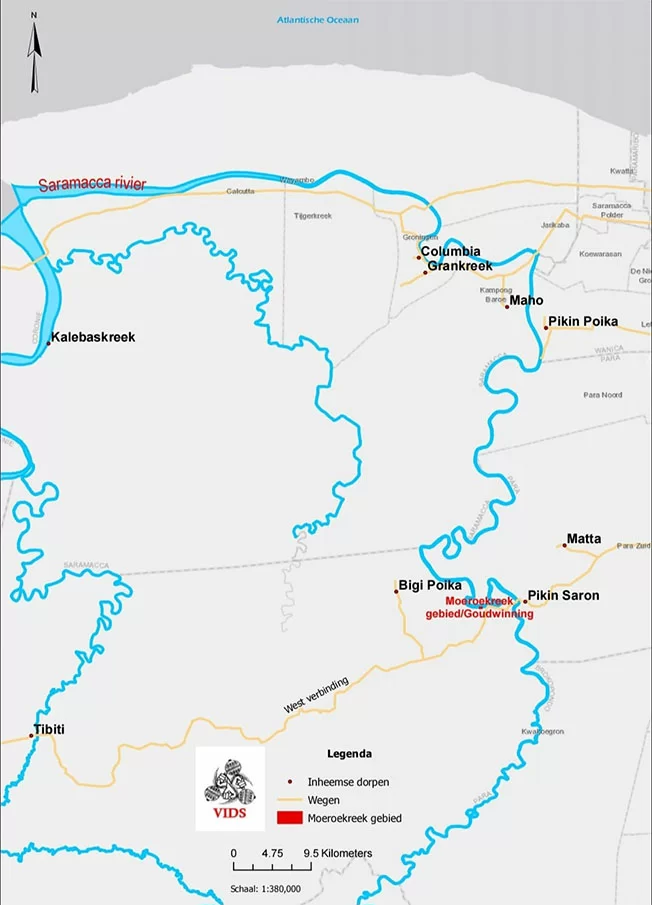
Unrest is escalating among Indigenous villages dotted along Suriname’s Saramacca River, as deepening discontent spreads over the flawed approach authorities are taking to an ongoing investigation into a recent mass fish die-off. That is the core message from Joan Van der Bosch, village head of Pikin Poika, who laid out the severe harm the fish death has inflicted on local residents and publicly criticized the government’s handling of the crisis during a recent press conference.
The latest wave of anger was sparked by a recent meeting with Suriname’s National Environmental Authority (NMA), where officials confirmed that affected Indigenous communities are required to provide practical logistical support for supplementary sampling at test sites the communities themselves proposed. According to the NMA, this extra round of testing demands access to a boat, fuel, and local guides from the communities, with the follow-up investigation initially scheduled to start this past Thursday.
This demand has sparked outright resistance from local villages. While the NMA says it has already allocated significant resources to the ongoing probe, Indigenous leaders argue it is unacceptable that communities forced to bear the brunt of an environmental disaster they did not cause should also have to cover the logistical costs of investigating it. To date, the NMA has stated that supplementary testing at the requested sites cannot move forward until Pikin Poika arranges the required transportation, with no new sampling timeline set until that requirement is met.
As the investigation stalls, the tangible impacts of the mass fish death grow more severe by the day. The village council of Columbia, located in the Saramacca region, has sounded an urgent alarm over the crisis: local fishermen have lost their primary source of income, as they refuse to go out on the river over safety concerns. Food security across the region is also faltering: fish has grown extremely scarce, prices have spiked sharply, and many residents refuse to eat river-caught fish over fears of unaddressed health risks. Families have also stopped letting children swim in the river’s waters, prompting local leaders to call on the national government to deliver immediate financial and food support to affected fishermen and their households.
For the Indigenous communities involved, the conflict over the investigation also highlights a broader, longstanding issue: their lack of meaningful input into processes that directly impact their ancestral lands. Leaders note that while authorities often pay lip service to hearing community concerns, Indigenous groups are rarely given actual decision-making power over policies and projects that shape their home territories.
The current meeting followed a formal letter Van der Bosch sent the previous Monday to NMA Director Vanessa Gefferie, where she outlined widespread frustration over the lack of communication and transparency surrounding the fish death, which has roiled multiple Saramacca River communities over the past weeks. During the subsequent meeting, NMA officials acknowledged that communication around the crisis had fallen short, and agreed that all future contact with affected communities would go through the Association of Indigenous Village Heads in Suriname (VIDS), the representative body for Indigenous communities in the country.
Van der Bosch emphasized that the crisis extends far beyond a standard environmental issue, touching on core rights to health, food security, and economic survival for the Indigenous groups that have lived along the river for generations. “We live in harmony with nature, and we depend on it directly for our survival,” she wrote in her letter. “When that nature is poisoned, our very existence is threatened.”
VIDS also used the meeting to push for a meaningful role for Indigenous knowledge in the investigation, arguing that local observations and traditional ecological expertise must be systematically integrated into ongoing analysis of the fish die-off. The NMA has indicated it is open to incorporating this local knowledge into the probe.
The investigation was launched earlier this month after the National Coordination Center for Disaster Management received formal reports of the mass fish death. To date, the NMA has collected water samples that are currently being tested by the Suriname Food and Agriculture Laboratory (FILAP), while tissue samples from dead fish have been sent to the national Veterinary Inspection Institute for analysis.