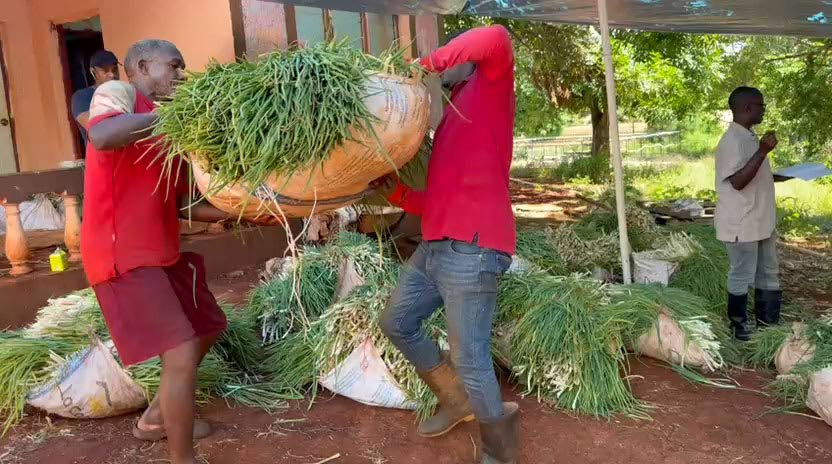
In New Forest, Manchester, Jamaica, Agriculture Minister Floyd Green has confirmed that targeted support will continue reaching local scallion producers grappling with a major supply glut, delivered through a coordinated public-private partnership designed to absorb the region’s unexpectedly large harvest.
Speaking to reporters during an on-site visit Sunday, Green outlined that the relief effort is already underway, with produce moving out of the New Forest agro-park steadily. Just one week prior, private sector partner GraceKennedy Group moved roughly 50,000 pounds of excess scallion out of the area. On the same day of Green’s announcement, the ministry launched its next phase of intervention, covering transportation costs for the produce in a new collaboration with food processor Walkerswood.
Over the course of this week alone, the partnership will purchase 125,000 pounds of scallion from local growers to take excess supply off the market. Beyond Walkerswood’s commitment, Green confirmed that additional private firms have stepped in to buy a further 200,000 pounds of the crop. Altogether, the two-week relief intervention will move approximately 600,000 pounds of scallion, a volume that Green says will substantially ease the financial pressure on farmers who have been stuck with unsellable product.
The crisis first drew public attention just over a week earlier, when Opposition Member of Parliament Peter Bunting, who represents Manchester Southern, raised alarms about plummeting demand and widespread spoilage impacting dozens of farmers in New Forest’s key agricultural belt during a community tour.
Green pushed back against any suggestion that the ministry was slow to act, noting that officials began coordinating a response weeks before the issue gained public attention. After recognizing that strong growing conditions had led to a bumper harvest that outstripped existing demand, the ministry called together major Jamaican agro-processors to map out a solution.
Officials learned that GraceKennedy had already stockpiled nearly three years of scallion inventory due to a recent industry-wide drop in demand, leading the firm to cut back on new purchases. With that context, the ministry partnered with Walkerswood to design the targeted buy-in initiative that is now being rolled out.
Green also highlighted that the current overproduction is actually a sign of a remarkable recovery for the region’s agricultural sector. Just six months prior, New Forest’s farmlands were entirely flooded and severely damaged by Category 5 Hurricane Melissa. In the wake of the storm, the ministry implemented aggressive support measures to help growers restart production, including providing free irrigation water to all farmers in the New Forest agro-park through the end of February.
That support paid off with a far larger harvest than initially projected, creating the current supply-demand imbalance. “One of the good things we have seen since Hurricane Melissa is a tremendous recovery, especially in our agro-parks,” Green said. “The reason we are seeing that recovery is because we have taken definitive steps to help the farmers get back on their feet.” He credited local growers for their extraordinary resilience in rebuilding their operations after the devastating storm, adding that the current intervention will help them stabilize their incomes and continue investing in future production.