作者: admin

  • Reflections on faith, rest, work as Old Year’s Night approaches

    Reflections on faith, rest, work as Old Year’s Night approaches

    As the final hours of the year approach, Barbados showcases a rich tapestry of traditions and personal philosophies surrounding Old Year’s Night celebrations. Across the island nation, residents are preparing to welcome the new year through distinctly different yet equally meaningful approaches that reflect their values, circumstances, and outlooks on life.

    For many Barbadians, religious observance forms the cornerstone of their year-end activities. Arla Daniel represents those who prioritize spiritual connections, describing her plans to attend services at All Saints Anglican Church in St. Peter after sharing a meal with her congregation. She emphasizes the transformative atmosphere of the ‘fully lit’ church, where admission fees grant participants a memorable visual and spiritual experience to conclude the year surrounded by community.

    In contrast, numerous islanders embrace a more spontaneous approach to the occasion. Roger Carter exemplifies this perspective, expressing his philosophical acceptance of life’s uncertainties by deliberately avoiding structured plans. His attitude reflects a broader sentiment that meaningful moments cannot be scheduled, preferring to let the evening unfold organically rather than conform to societal expectations.

    Home-centered celebrations provide comfort and practicality for many residents. Vincent Taylor and Anderson Barnes both advocate for domestic tranquility, with Taylor planning to enjoy spiritual music while welcoming what he hopes will be a peaceful new year. Barnes reinforces this perspective, noting the annual recurrence of the celebration makes extravagant observances unnecessary, choosing instead to appreciate Christmas purchases in the comfort of his home.

    The economic realities of modern life shape another dimension of Barbadian year-end traditions. Jerome Wilkerson openly prioritizes productivity over celebration, stating plainly that his primary objective is to ‘work and make money.’ His pragmatic approach—planning to potentially celebrate only after securing earnings—highlights how financial considerations influence cultural practices.

    Family connections and tempered optimism emerge as additional themes in Barbados’s year-end landscape. Eugene Joseph plans to combine parental bonding with modest celebrations, intending to share quality time with children while hopefully witnessing fireworks displays. Her acknowledgment of upcoming challenges demonstrates a characteristically Bajan resilience—approaching difficulties with calm determination rather than apprehension.

    This spectrum of traditions, from deeply spiritual to resolutely practical, illustrates how Barbadians across demographic and philosophical lines find personal significance in the transition between years, blending cultural heritage with individual circumstances to create meaningful rituals.


  • Transport unions end dispute and move forward with 27 de Febrero Corridor

    Transport unions end dispute and move forward with 27 de Febrero Corridor

    SANTO DOMINGO – In a landmark development for Dominican Republic’s public transportation, a coalition of major transport associations has formally presented a unified operating agreement to the National Institute of Transit and Land Transportation (Intrant). The agreement, submitted on Tuesday, paves the way for the long-stalled 27 de Febrero Transport Corridor to commence operations in the coming year.

    The breakthrough was achieved through collaboration between the National Transportation Federation New Option (Fenatrano), the Association of Car Owners of 27 de Febrero (Asoprocavefe) under Juan Hubieres’ leadership, and transport operator Pedro Gómez. This memorandum of understanding effectively resolves a multi-year conflict that had paralyzed the infrastructure project, marking a significant step toward modernizing the nation’s transit systems.

    Hubieres clarified that the current submission implements an accord originally established in June between Fenatrano, Asoprocavefe, and the transport collective represented by Pedro Marcelino Gómez Morel. This resolution eliminates internal disputes and ongoing legal challenges that previously obstructed progress. The formalization of this agreement ensures no further impediments to the government’s scheduled corridor initiatives for the upcoming period.

    Pedro Gómez celebrated the consensus as a pivotal moment for the sector, highlighting how the resolution ends years of discord while creating mutual benefits for all operators and fostering sustainable growth in public transportation. The parties confirmed that the operating license for the 27 de Febrero Corridor will be registered under the current consortium of operators, including Asoprocavefe, Sitraur R-1, Aspchopicma, and Asochotrece.

  • FLASH : Weapons and large quantities of ammunition seized at the Port of Cap-Haïtien

    FLASH : Weapons and large quantities of ammunition seized at the Port of Cap-Haïtien

    In a significant counter-trafficking operation on December 29, 2025, Haitian law enforcement intercepted a substantial cache of illicit weapons and ammunition at the Port of Cap-Haïtien. The joint operation conducted by the Anti-Narcotics Brigade (BLTS) and Customs authorities uncovered the concealed arsenal within shipping containers that had originated from the United States.

    Authorities discovered the weapons meticulously hidden inside boxes within a container operated by international shipping giant CMA CGM. The seizure included sophisticated military-grade equipment: three firearms comprising two 9mm pistols (manufactured by Ruger and Taurus) and one high-caliber 7.62mm AK-47 assault rifle. The inventory further revealed eight magazines (four for each caliber) alongside 1,800 rounds of 9mm ammunition systematically packaged across 36 boxes containing 50 rounds each.

    During the operation at the CTSA 2 terminal, law enforcement apprehended 43-year-old Jean Marie Clément Thelusma, identified as both the owner of the contraband and a suspected arms trafficker. Thelusma was taken into custody at the scene following the discovery.

    This successful interdiction highlights enhanced coordination between specialized units of the Haitian National Police (PNH) and customs authorities, demonstrating considerable progress in securing the nation’s critical entry points against transnational trafficking networks. The operation marks a substantial victory in Haiti’s ongoing efforts to combat organized crime and stabilize regional security.

  • Staatsolie behaalt doelen in 2025 en verstevigt basis voor offshore-toekomst

    Staatsolie behaalt doelen in 2025 en verstevigt basis voor offshore-toekomst

    Suriname’s state-owned oil company, Staatsolie Maatschappij Suriname N.V., concluded 2025 with exceptional financial and operational results, demonstrating robust performance across both onshore and emerging offshore sectors. The energy enterprise successfully met all production targets while laying foundations for sustainable growth in the nation’s burgeoning oil and gas industry.

    The company reported impressive financial metrics for the year, with projected revenues reaching approximately $802 million and pre-tax profits totaling $418 million. Production figures revealed 6.35 million barrels of oil extracted, exceeding established targets. The refinery operations outperformed expectations, generating 3.1 million barrels of diesel and gasoline combined. A significant milestone was achieved with the inaugural commercial production and subsequent delivery of sulfuric acid to Suralco.

    Through its subsidiary Staatsolie Power Company Suriname (SPCS), the corporation supplied approximately 1.37 million MWh of electricity, accounting for 69% of power distributed through the EPAR network to Paramaribo and surrounding districts. Infrastructure development continued with GOw2’s modernization initiative, which completed two upgraded pumping stations and established a new facility in Saramacca.

    Staatsolie’s contribution to national finances proved substantial, injecting an estimated $387 million into state coffers through taxes, dividends, and royalty payments. This represented approximately 32% of total government revenues and accounted for nearly 9% of Suriname’s gross domestic product.

    Offshore developments marked particularly significant progress throughout 2025. The GranMorgu project in Block 58 advanced according to schedule, achieving 25% overall completion with the floating production storage and offloading (FPSO) vessel halfway constructed. First oil production remains anticipated for 2028. Additionally, the company granted commercial approval for the Sloanea-1 gas field in Block 52, representing a crucial step toward offshore gas production pending final investment decision in 2026.

    To finance its 20% participation in the GranMorgu venture, Staatsolie secured over $2 billion through a successful bond issuance and international bank loan, demonstrating strong investor confidence in Suriname’s energy prospects.

    The corporation maintained its commitment to social responsibility, channeling $2.7 million into community projects through the Staatsolie Foundation supplemented by an additional $3 million allocation commemorating the company’s 45th anniversary.

    Despite global oil market uncertainties, Staatsolie approaches 2026 with confidence, supported by solid financial positioning, strategic partnerships, and continued dedication to creating lasting value for Suriname’s economy and society.

  • Over 420 Kilos of cocaine seized at San Juan Port from Santo Domingo

    Over 420 Kilos of cocaine seized at San Juan Port from Santo Domingo

    In a significant pre-Christmas interception, U.S. Customs and Border Protection (CBP) agents in Puerto Rico have confiscated a massive shipment of cocaine with an estimated market value of over $6.7 million. The seizure occurred on December 24th at the bustling Port of San Juan during a standard inspection of a commercial vessel that had journeyed from Santo Domingo in the Dominican Republic.

    The discovery was initiated when vigilant CBP officers identified suspicious anomalies within the chassis of a cargo platform. This prompted an escalated inspection protocol, which incorporated the use of specialized narcotics detection canines. The canines provided a positive alert, leading investigators to a concealed compartment. A thorough search revealed a substantial quantity of a white powdery substance, which subsequent field testing confirmed to be cocaine, totaling more than 420 kilograms.

    Kian Tomas, the Director of the Port of San Juan, publicly commended the acute vigilance and unwavering professionalism demonstrated by the CBP personnel. He emphasized that this successful operation highlights their relentless dedication to safeguarding United States borders, a duty that continues unabated during holiday periods. The contraband was securely removed and processed in a coordinated effort with the Puerto Rico Police Department and agents from Homeland Security Investigations (HSI). Authorities further underscored that the Mona Passage, a strategic maritime corridor separating Puerto Rico and the Dominican Republic, persists as a prevalent and active route for transnational narcotics traffickers attempting to smuggle illicit goods into U.S. territory.

  • Increased garbage, careless acts hampering SSA efforts

    Increased garbage, careless acts hampering SSA efforts

    Barbados is confronting a severe waste management crisis in the aftermath of the festive season, with systemic operational strains and widespread public non-compliance overwhelming the island’s sanitation services. The Sanitation Service Authority (SSA) reports a perfect storm of challenges: a dramatic surge in post-Christmas waste volumes, persistent improper disposal practices, and critical bottlenecks at the Mangrove landfill’s transfer system.

    Public Relations Officer Carl Alff Padmore detailed the multifaceted nature of the emergency. Commercial hubs including Bridgetown, Warrens, Speightstown, and the tourist-heavy food center of Oistins experienced particularly severe accumulation. The emerging commercial zone at Six Roads further compounded pressure on collection routes. The situation has resulted in significantly slowed collections, forced vehicle withdrawals from service, and left numerous communities only partially serviced.

    A critical issue remains the dangerous non-compliance from both businesses and residents. Padmore highlighted ongoing violations in Bridgetown’s business community, where merchants continue improperly disposing of cooking oil and failing to collapse cardboard boxes. The consequences turned hazardous in Vauxhall Gardens, Christ Church, where a resident’s disposal of engine oil in a household bin soiled workers’ clothing and contaminated collection equipment, forcing suspension of services for half the community.

    Operational capacity is stretched to its limits with nearly 50 trucks deployed islandwide. Household waste, normally averaging three to four bags, ballooned to 15 bags per household during Christmas. Transfer delays at the Mangrove Solid Waste Management Centre have created a debilitating domino effect; a process typically taking 15-30 minutes now faces extensive delays due to congestion, crippling turnaround times for trucks needing to service additional communities.

    Illegal dumping and unsecured loads on private vehicles exacerbate the crisis, with recent incidents on St Stephen’s Hill and Cave Hill leaving debris that obstructed traffic flow. Padmore urgently directed citizens to use designated facilities correctly: Mangrove for household/garden waste, Bagatelle for metals and appliances, and Lonesome Hill for slaughterhouse byproducts.

    The environmental implications are severe. Illegal dumping in gullies and drains risks critical infrastructure damage and increased flooding by blocking waterways. This also creates ideal breeding conditions for mosquitoes, presenting a public health risk.

    With 2026 on the horizon, the SSA is advocating for a fundamental behavioral shift. Padmore emphasized that embracing recycling, waste reduction, and proper disposal methods is essential to alleviate pressure on the landfill and mitigate escalating environmental consequences. He concluded with a poignant reminder: ‘If we are kind to nature… then nature will be kind to us.’

  • Traffic arrangements: Springs, St George

    Traffic arrangements: Springs, St George

    The Royal Grenada Police Force has announced comprehensive traffic management measures that will be enforced during New Year’s Eve celebrations. These regulations will take effect from 7:00 PM on December 31, 2025, through 1:00 AM on January 1, 2026, to ensure public safety and facilitate smooth traffic flow during the holiday period.

    One-way traffic systems will be implemented on key roadways to manage vehicle movement efficiently. Motorists traveling on Belmont Public Road will be required to move exclusively from the Kirani James Boulevard intersection toward the Paddock area. Similarly, Springs Minor Road will maintain one-directional traffic flow heading toward the Belmont district.

    Specific areas will be designated as no-entry zones for all vehicular traffic. Access restrictions will apply to Belmont Public Road at its junction with Paddock Public Road, while Springs Minor Road will be closed at its intersection with Belmont Public Road.

    Parking accommodations have been carefully arranged to prevent congestion. Public vehicles will be prohibited from parking along Springs Minor Road entirely. However, authorized parking will be permitted on the left-hand side of Belmont Public Road in the direction of Paddock.

    The Royal Grenada Police Force emphasizes the importance of public cooperation with these temporary measures, which are designed to maintain order and safety during the New Year’s celebrations. Motorists are advised to plan their routes accordingly and comply with all posted signage and police directives.

  • 72 Children, One Reality: Cancer in Belize

    72 Children, One Reality: Cancer in Belize

    BELIZE CITY – A deeply personal story of one child’s cancer battle has catalyzed national awareness around pediatric oncology in Belize, where official health data reveals 72 children have received cancer diagnoses over the past five years. These diagnoses create profound emotional distress and impose severe financial burdens on affected families, exposing systemic healthcare challenges in the Central American nation.

    Amidst this crisis, structured support mechanisms are emerging. The Belize Cancer Society has positioned itself as a critical intervention agency, providing comprehensive assistance with medical logistics, international travel coordination, and financial aid. “The moment a child receives a cancer diagnosis, families experience complete overwhelm. Our mission at the cancer center is to immediately step into that chaos with structured support,” explained Kim Simplis Barrow, President of the Belize Cancer Society.

    The organization facilitates navigation through complex healthcare systems and ensures timely access to treatment. “We deliver essential information and guide families through every step—from Belize to overseas care centers. Our response is typically immediate, without unnecessary delays,” Barrow emphasized.

    On the governmental front, Dr. Natalia Largaespada Beer, Technical Advisor at the Ministry of Health and Wellness, confirmed that chemotherapy treatments are fully funded at the Karl Heusner Memorial Hospital, with the government having eliminated the General Sales Tax on cancer medications to reduce financial barriers.

    Significant treatment advancements have emerged from pandemic-driven innovations. A coalition of healthcare providers now delivers specialized chemotherapy within Belize—a development initially necessitated by international border closures but now becoming a permanent enhancement to domestic care capabilities.

    Despite these improvements, critical limitations persist. Complex diagnostics and long-term treatment protocols still require international referrals, creating additional strain on families. Addressing this gap, a transformative project is underway: construction of a new pediatric cancer wing, supported by St. Jude Children’s Research Hospital, scheduled for completion in 2027. This facility promises to localize comprehensive childhood cancer care, fundamentally transforming treatment accessibility in Belize.

    “This initiative represents a monumental shift—it’s about bringing complete childhood cancer care home to Belize,” Barrow stated, highlighting the project’s potential to revolutionize pediatric oncology in the nation.

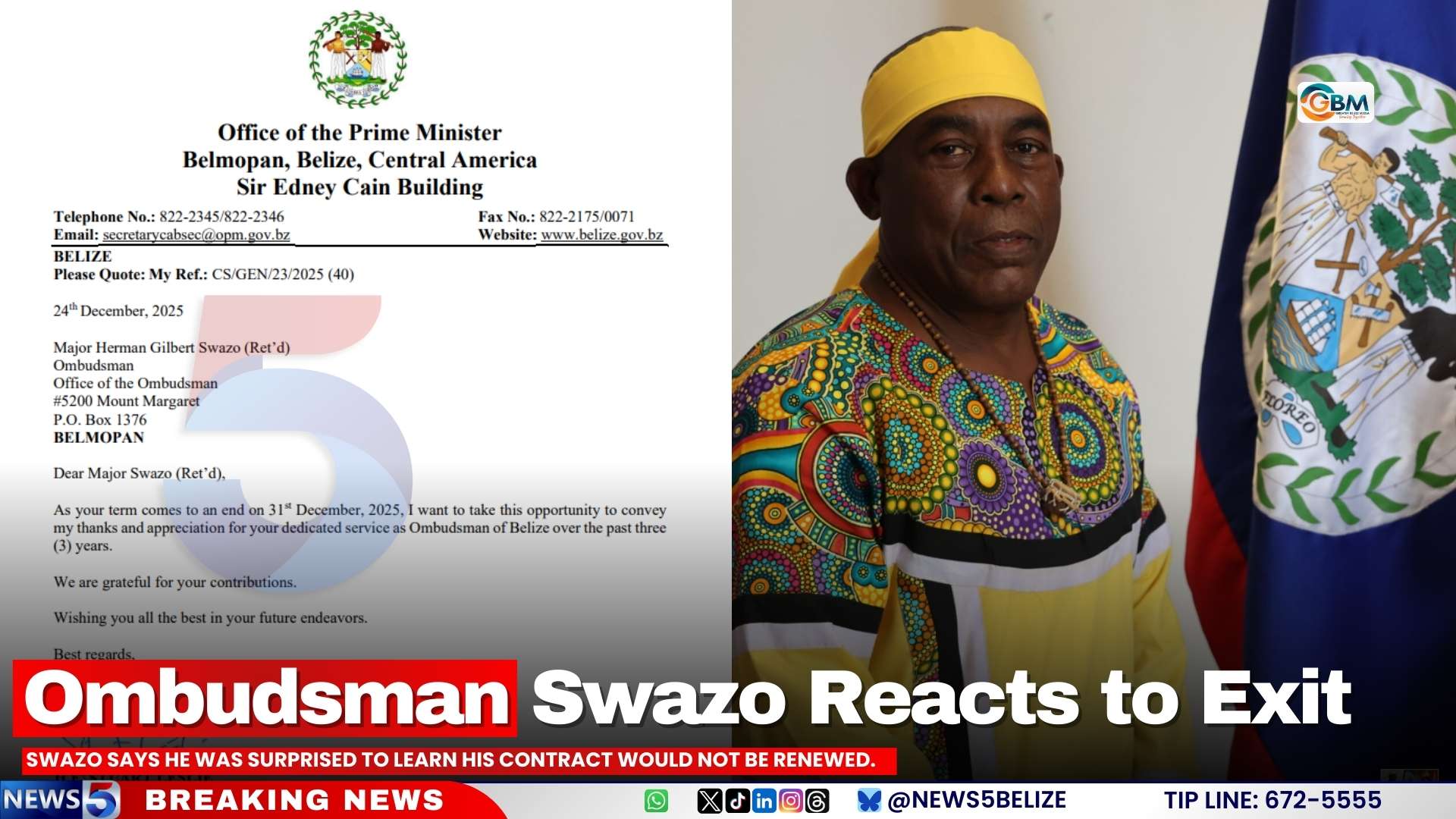
  • Ombudsman Swazo Reacts to Exit

    Ombudsman Swazo Reacts to Exit

    In a development that has raised questions about governmental transparency, Belize’s outgoing Ombudsman Major Herman Gilbert Swazo (Ret’d) has expressed surprise at the non-renewal of his contract, which concludes on December 31, 2025. The seasoned official learned of the decision through an email delivered on December 24 from Cabinet Secretary Stuart Leslie, who conveyed the government’s appreciation for Swazo’s three years of dedicated service without addressing contract renewal prospects.

    Swazo revealed to News 5 that the correspondence made no mention of reengagement possibilities despite his prior requests for continuation. “The letter did not in any way or form, in my view, address reengagement,” Swazo stated. “To me, that implies then that I am not going to be reengaged.” The timing and delivery method of the notification added to the unexpected nature of the communication.

    During his tenure, Swazo maintained several public positions on governance matters, including freedom of information requests. When questioned whether these actions might have influenced the non-renewal decision, Swazo emphasized his strict adherence to legal parameters. “I took a solemn oath to abide by the Constitution and to do right in all manner of people,” he affirmed. “I operated within the confines of the law, and that is what I did.”

    Contradicting Swazo’s interpretation, Cabinet Secretary Stuart Leslie provided clarification to News Five, characterizing the letter as standard procedural communication marking the conclusion of an existing agreement. Leslie indicated that no definitive decision regarding Swazo’s potential contract renewal has been finalized by the National Assembly, suggesting the situation remains fluid rather than conclusively terminated.

    Despite the uncertainty surrounding his professional future, Swazo maintains no regrets about his tenure, asserting that his commitment to constitutional principles and rule of law guided every action during his service as Belize’s Ombudsman.

  • ATTORNEYS’ CALL: Employers told to re-examine disciplinary practices after CCJ ruling

    ATTORNEYS’ CALL: Employers told to re-examine disciplinary practices after CCJ ruling

    A landmark Caribbean Court of Justice (CCJ) decision has triggered urgent calls for Barbados employers to overhaul workplace disciplinary practices, with legal experts warning that procedural fairness and contractual compliance are no longer optional. The ruling in Massy Stores (Barbados) Limited v Forde [2025] has established stringent new standards for employee discipline that could expose companies to significant legal liability if ignored.

    Legal attorneys Katriel Pile and Maya L. Kellman, who conducted a comprehensive analysis of the precedent-setting case, emphasize that the court’s decision fundamentally reshapes employer obligations regarding employee misconduct proceedings. The case originated from a dispute where Massy Stores bypassed its own disciplinary procedures to summarily dismiss an employee, prompting judicial scrutiny of whether such actions constituted lawful termination.

    The CCJ’s ruling clarified that while summary dismissal remains justified for repudiatory breaches of employment contracts, employers cannot automatically resort to immediate termination without considering contextual factors. The court established that mere misconduct warranting dismissal doesn’t necessarily justify bypassing progressive disciplinary measures when other considerations are present.

    Pile and Kellman identify several critical principles emerging from the ruling: contractual incorporation of disciplinary procedures creates binding obligations regardless of employee tenure; suspension without pay requires explicit contractual authorization; and employers must demonstrate proportionality in sanctions considering mitigating circumstances and historical practices.

    Perhaps most significantly, the attorneys note the ruling establishes that procedural fairness requirements apply to all employees beyond probationary periods, dismantling the common misconception that short-service employees lack protection against unfair dismissal claims. The decision also introduces what legal experts describe as a ‘humanizing patina’ approach, recognizing that not every rule violation justifies termination and employers must account for human fallibility in workplace contexts.

    The legal analysis concludes that effective discipline now requires balancing rule enforcement with lawful, proportionate implementation that acknowledges workplace realities. Failure to adopt these standards could expose employers to claims for lost wages, breach of contract allegations, and significant reputational damage.