作者: admin

  • House-Lifting Programme to Target Flood-Prone Communities

    House-Lifting Programme to Target Flood-Prone Communities

    The government of Antigua and Barbuda has unveiled a groundbreaking housing resilience strategy designed to protect vulnerable communities from devastating flood damage. Through a specialized home elevation program, authorities will physically raise flood-prone residences to safer elevations, particularly targeting wooden structures built in low-lying areas.

    Social and Urban Transformation Minister Roland Turner explained the critical need for intervention during an interview with ABS News. “Many homes in these vulnerable areas lack sufficient elevation to allow floodwaters to pass safely underneath during heavy rainfall events,” Minister Turner stated. He characterized the solution as “a very simple intervention” that could dramatically reduce property damage and financial losses for at-risk homeowners.

    The innovative program will be integrated into the existing Housing Assistance Programme Initiative (HAPI), which already facilitates repairs, renovations, and reconstruction projects for disadvantaged residents. This expansion comes alongside a significant infusion of resources, including building materials valued at over EC$1 million that have recently arrived for distribution.

    To address implementation challenges, the government has developed a comprehensive workforce strategy. Cabinet has approved the deployment of newly recruited construction workers from the Dominican Republic to supplement existing teams, including inmate labor programs. This additional manpower will support three specialized construction teams operating simultaneously across the nation, significantly accelerating the pace of housing improvements.

    The multi-faceted approach represents one of the Caribbean region’s most comprehensive housing resilience efforts, combining structural interventions, material support, and workforce development to create sustainable solutions for climate-vulnerable communities.

  • Wat we weten over de dodelijke anti-regimeprotesten in Iran…

    Wat we weten over de dodelijke anti-regimeprotesten in Iran…

    Iran has been engulfed by nationwide demonstrations for two weeks, with protests initially sparked by economic grievances rapidly escalating into violent anti-regime confrontations. The unrest, marked by significant casualties and widespread arrests, represents one of the most substantial challenges to Iran’s theocratic government in recent years.

    The protests originated in late December among Tehran merchants before spreading across all 31 provinces. What began as demonstrations against economic deterioration—including currency collapse and soaring prices—quickly transformed into broader opposition against the regime itself. Protesters have been documented burning images of Supreme Leader Ayatollah Ali Khamenei, while some have expressed support for exiled Crown Prince Reza Pahlavi.

    Iran’s economic crisis has been exacerbated by multiple factors. Since the reimposition of UN sanctions in September due to Iran’s nuclear program, the Iranian rial has entered freefall, currently trading at over 1.4 million to the US dollar. This economic pressure was compounded by a twelve-day war in June involving Israeli offensives and US airstrikes on nuclear sites. Recent price hikes for subsidized gasoline—previously among the world’s cheapest fuels—and anticipated food price increases following the central bank’s elimination of preferential exchange rates for most goods have further inflamed public anger.

    The government response has been characterized by severe measures. Authorities have shut down communication and internet networks, making independent verification of events challenging. According to the Human Rights Activists News Agency, the protests have resulted in over 544 fatalities and approximately 10,600 arrests.

    Geopolitically, Iran’s regional influence has suffered significant setbacks. The ‘Axis of Resistance’—Tehran’s coalition of allied countries and militias—has been weakened by conflicts throughout the region. Israel decimated Hamas in the Gaza war, Hezbollah lost leadership figures, and Syria’s President Bashar al-Assad fell in December 2024 after years of conflict. Iran-backed Houthi rebels in Yemen have also been heavily targeted by Israeli and American airstrikes.

    International reactions have added complexity to the situation. President Trump warned that the US would respond ‘very hard’ if the regime violently suppresses peaceful demonstrators—a warning given additional context following the capture of Venezuelan leader Nicolás Maduro, a Tehran ally. Meanwhile, China remains a significant purchaser of Iranian oil but provides no overt military support, similar to Russia, which utilizes Iranian drones in the Ukraine conflict but offers limited other assistance.

    The nuclear dimension continues to loom large. While Iran maintains its nuclear program is peaceful, increased uranium enrichment and reduced cooperation with the UN’s International Atomic Energy Agency (IAEA) have raised suspicions. The IAEA director warns that Iran could produce sufficient material for approximately ten nuclear weapons should it decide to militarize its program. US intelligence agencies believe Iran hasn’t yet initiated a nuclear weapons program but is preparing to rapidly build one if desired.

    This crisis occurs within the broader context of strained US-Iran relations dating to the 1979 Islamic Revolution, which transformed Iran from a key American ally under Shah Mohammad Reza Pahlavi to a theocratic state under Ayatollah Khomeini. The relationship has oscillated between hostility and diplomacy, highlighted by the 2015 nuclear agreement from which the US unilaterally withdrew in 2018, reigniting regional tensions.

    Iran now confronts a multidimensional crisis testing its political stability, regional influence, and international relationships, with developments being closely monitored worldwide.


  • Antigua and Barbuda Welcomes New EU Ambassador, Reviews Cooperation Priorities

    Antigua and Barbuda Welcomes New EU Ambassador, Reviews Cooperation Priorities

    The Government of Antigua and Barbuda engaged in high-level diplomatic discussions on Monday with Fiona Ramsey, the European Union’s newly appointed Ambassador to the Eastern Caribbean. The meetings, held with Prime Minister Gaston Browne and Foreign Affairs Minister E.P. Chet Greene, centered on reinforcing the longstanding partnership between the Caribbean nation and the European bloc.

    Prime Minister Browne characterized the EU as a crucial development partner since the country’s independence, advocating for a more strategic framework for regional funding mechanisms under the existing Economic Partnership Agreement. He identified transportation infrastructure as a critical barrier to Caribbean economic integration, noting that exorbitant shipping costs continue to hamper intra-regional trade. Browne proposed innovative, EU-supported maritime solutions—specifically multi-island service vessels—as a potential mechanism to enhance regional connectivity and economic cooperation.

    Foreign Minister Greene described the diplomatic engagement as particularly timely given ongoing reevaluations of EU support structures. While acknowledging decades of productive assistance, Greene expressed optimism that divergent perspectives on key issues—including European Development Fund allocations and concerns regarding Citizenship by Investment Programs—could be resolved through sustained diplomatic dialogue.

    Ambassador Ramsey reaffirmed the European Union’s dedication to maintaining open channels of communication and collaboration. She highlighted climate change mitigation and maritime connectivity as primary areas for continued cooperation, indicating potential advancements in these sectors during her tenure. The discussions established a framework for addressing both immediate concerns and long-term strategic priorities between the EU and Eastern Caribbean partners.

  • Attorney General Signals Push for CCJ Accession, Constitutional Reform Talks

    Attorney General Signals Push for CCJ Accession, Constitutional Reform Talks

    In a landmark address marking the opening of the 2026 legal year, Attorney General Steadroy Benjamin unveiled sweeping constitutional reforms aimed at asserting national sovereignty. The centerpiece announcement confirmed that Antigua and Barbuda will initiate national consultations on acceding to the appellate jurisdiction of the Caribbean Court of Justice (CCJ), terminating its reliance on the British Privy Council as its final court of appeal.

    Benjamin characterized the prolonged dependence on foreign judicial oversight as ‘an affront to our sovereignty,’ emphatically stating that ‘we are now the masters of our own destiny.’ The government simultaneously revealed plans to commence discussions on transitioning to republic status, with a national referendum to be scheduled following comprehensive public consultation.

    A Constitutional Review and Reform Committee has been established to steer these transformative initiatives. Chaired by Benjamin with former Attorney General Justin Simon KC serving as Vice Chair, the committee comprises distinguished members including Dobrene Omarde, Dr. Lenworth Johnson, MP Richard Lewis, Debra Burnette, Beverly Benjamin, and Ralph Bowen. In a gesture of cross-party collaboration, opposition leaders Jamale Pringle and Trevor Walker have received invitations to nominate representatives.

    The Attorney General concurrently addressed judicial administration concerns, acknowledging persistent delays in criminal case resolutions while noting the High Court’s civil division operates without significant backlog. Justice system reforms will feature prominently in the 2026 legislative agenda. Benjamin called upon legal professionals to actively educate citizens about CCJ integration and emphasized that constitutional modernization must balance judicial independence with public confidence built upon transparency, integrity, and equitable justice.

  • Eastern Caribbean Supreme Court Opens 2026 Law Year, Signals New AI Rules and Reforms

    Eastern Caribbean Supreme Court Opens 2026 Law Year, Signals New AI Rules and Reforms

    The Eastern Caribbean Supreme Court (ECSC) has launched its 2026 judicial term with a comprehensive modernization agenda targeting artificial intelligence governance, digital service expansion, and criminal justice acceleration across its nine-member jurisdiction.

    During the ceremonial opening of the High Court, Acting Chief Justice Margaret Price Findlay outlined groundbreaking initiatives that position the regional judiciary at the forefront of legal technology adaptation. The court is developing a formal regulatory framework to govern AI utilization by judicial officers and legal practitioners, responding to increased technological integration in court proceedings and record management.

    Substantial enhancements are underway for the court’s AI transcription system, initially implemented in 2024, to boost record accuracy and dramatically reduce judgment delivery timelines. Justice Findlay emphasized that while embracing technological efficiency gains, the judiciary remains committed to safeguarding judicial independence and procedural fairness, asserting that technology must augment rather than replace human judicial decision-making and ethical responsibilities.

    The court leadership urged universal adoption of the Electronic Litigation Portal, revealing that despite full integration of all case types, inconsistent usage has hampered system effectiveness. Technical assistance programs are being intensified to address operational challenges encountered by court personnel and users.

    Substantial criminal justice reforms show promising advancement, with judge-alone trials now operational in Antigua and Barbuda, Saint Vincent and the Grenadines, and Saint Lucia. This transformative approach aims to eliminate delays associated with jury selection and alleviate chronic case backlogs.

    The ECSC has completed comprehensive revisions to criminal procedure rules, is finalizing updated sentencing guidelines, and has circulated a draft criminal mediation framework for public consultation as part of a broader shift toward alternative dispute resolution mechanisms.
    In a historic development, Justice Findlay announced the acquisition of a permanent, purpose-built headquarters for the ECSC in Saint Lucia, concluding a two-decade pursuit for a dedicated institutional home that symbolizes the court’s enduring regional presence.

  • The Dominican Republic’s next export power play: Intellectual Property

    The Dominican Republic’s next export power play: Intellectual Property

    A transformative economic evolution is underway within the Dominican Republic’s institutional framework, positioning the nation for unprecedented competitiveness in the global knowledge economy. While neighboring Latin American countries continue pursuing marginal gains in traditional exports, the DR has been systematically constructing a sophisticated infrastructure for large-scale intellectual property exports.

    At the forefront of this strategic shift are two pivotal institutions: the National Office of Industrial Property (ONAPI) and the Ministry of Industry, Commerce, and MSMEs (MICM). Contrary to conventional perception as merely a trademark and patent registry, ONAPI has evolved into a fully digitized, ISO-standard intellectual property governance system featuring rare institutional consistency within the region. Its E-SERPI platform, CATI networks, and transparent registration data represent fundamental economic infrastructure rather than bureaucratic achievements.

    Complementing this foundation, MICM functions as the demand-side engine through its strategic initiatives in productivity enhancement, digital transformation, MSME modernization, circular economy development, and industrial innovation. The ministry has established critical pathways for converting registered intellectual property into commercially viable assets through IoT adoption programs, export onboarding systems, quality certification routes, and enterprise transformation frameworks.

    This institutional development aligns with global economic transformations documented by UNCTAD, which reports $3.8 trillion in digital service exports, and WIPO data showing 8-12% annual growth in IP licensing across emerging markets. The contemporary economic landscape increasingly rewards nations exporting ideas, designs, software, scientific innovation, and creative intellectual property rather than traditional commodities.

    A comprehensive whitepaper titled ‘Exportable Intellectual Property: Establishing a New Dominican Economic Pillar’ outlines an integrated national pipeline connecting ONAPI’s IP production capabilities with MICM’s industrial policy and export readiness programs, ProDominicana’s market activation functions, and Central Bank export performance tracking. This architectural framework provides a practical roadmap for transforming invention, software development, design, research, and creative output into revenue-generating national assets.

    The timing coincides with significant recognition for the Dominican startup ecosystem, as strategy firm Successment received ADOEXPO’s award for contributions to export innovation—signaling the country’s emerging presence in global knowledge economy discussions. With institutional foundations established, talent available, and market conditions favorable, the Dominican Republic stands at a decisive crossroads: continue competing through traditional factors like price and logistics, or embrace creativity, invention, and intellectual capability as the currency of modern economic leadership.

  • Antigua and Barbuda’s Energy Minister Elected IRENA Vice President for Latin America and Caribbean

    Antigua and Barbuda’s Energy Minister Elected IRENA Vice President for Latin America and Caribbean

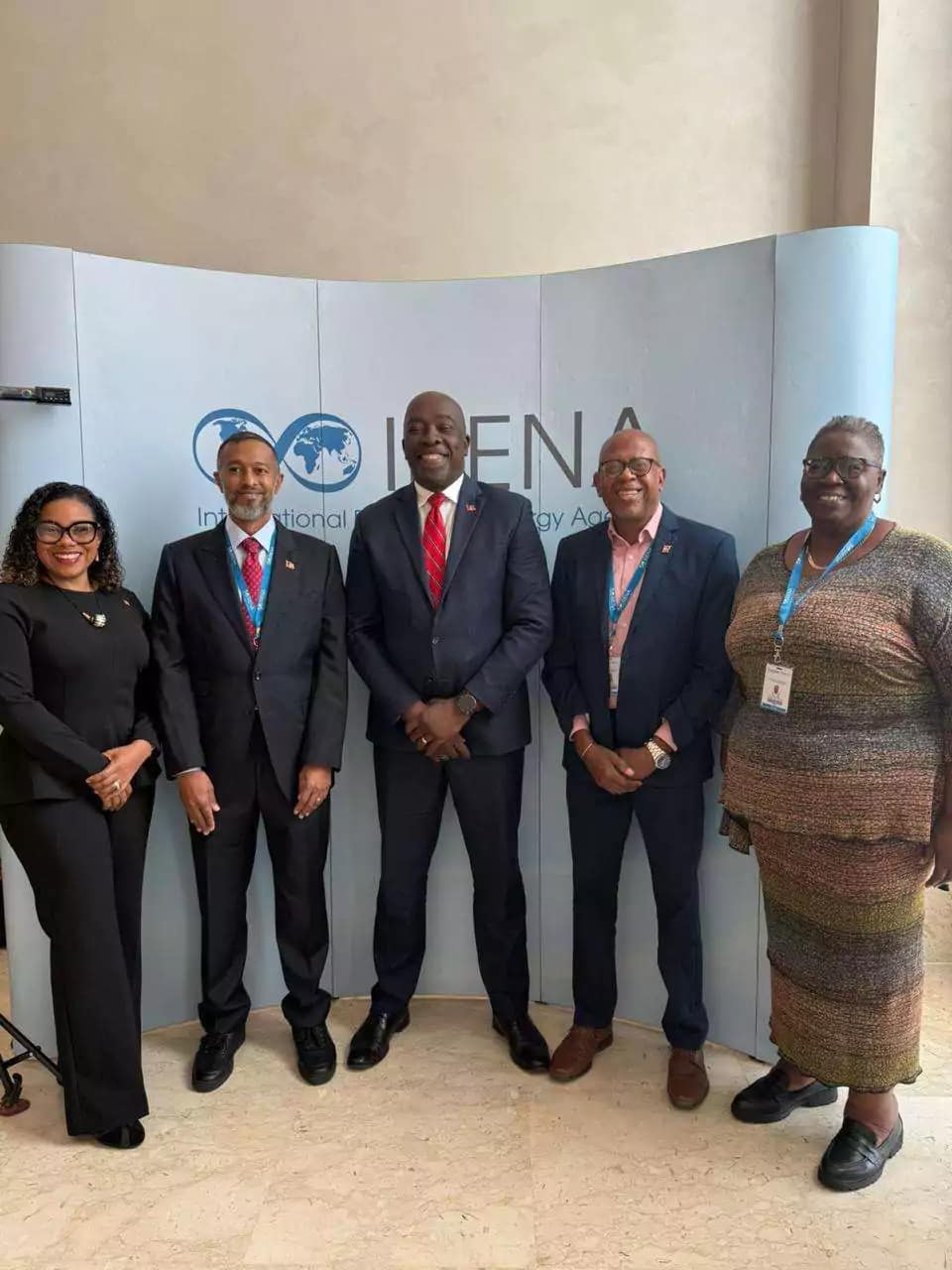
    In a significant development for Caribbean representation in global energy governance, Antigua and Barbuda’s Energy Minister Melford Nicholas has attained the prestigious position of Vice President for Latin America and the Caribbean at the International Renewable Energy Agency (IRENA). This election occurred during IRENA’s 16th Assembly convened in Abu Dhabi, positioning the small island nation in a senior decision-making capacity within the influential international organization.

    Minister Nicholas utilized the platform to articulate the acute energy challenges confronting Small Island Developing States (SIDS). In his national address, he revealed that Antigua and Barbuda remains disproportionately reliant on imported fossil fuels, with fuel expenses constituting approximately 67% of all utility revenues. This economic vulnerability underscores the urgent necessity for transition to sustainable alternatives.

    During high-level discussions with IRENA Director-General Francesco La Camera, Nicholas championed accelerated deployment of renewable energy solutions across SIDS nations. The dialogue centered on strategic investment frameworks, international partnerships, and developing climate-resilient energy infrastructure capable of withstanding environmental disruptions.

    Nicholas emphasized the critical need for enhanced access to concessional financing mechanisms and customized risk-mitigation instruments specifically designed for small island economies. He highlighted ongoing international support, including a hybrid solar project in Barbuda funded by the United Arab Emirates, alongside contributions from the United Kingdom, New Zealand, and the CARICOM Development Fund.

    The minister’s leadership was further demonstrated as he presided over a ministerial-level session, solidifying Antigua and Barbuda’s influential role in shaping global renewable energy policy and reinforcing the nation’s commitment to sustainable energy transition.

  • Defense seeks to overturn 18-month detention of ex-Senasa director

    Defense seeks to overturn 18-month detention of ex-Senasa director

    SANTO DOMINGO – The legal defense team for Santiago Hazim, former director of the National Health Insurance (Senasa), has formally challenged the 18-month pretrial detention order issued against him, asserting fundamental violations of his constitutional rights.

    Attorney Miguel Valerio confirmed Tuesday that an appeal was submitted to the Criminal Chamber of the Court of Appeals of the National District. The defense contends that Judge Rigoberto Sena’s ruling improperly relied on subjective moral and ethical assessments rather than established legal principles. Valerio characterized the decision as lacking appropriate legal justification, noting the inclusion of extraneous biblical and literary references that bear no connection to the legal purpose of coercive measures.

    The appeal argues that judicial references to alleged greed and moral disloyalty constitute improper grounds for detention that remain disconnected from the evidentiary requirements of the case. Additionally, the defense maintains that the detention order violates Hazim’s right to adequate medical care by preventing continuation of treatment for a serious health condition.

    Valerio emphasized that preventive detention should serve specific procedural purposes—primarily preventing flight risk or evidence tampering—which he asserts were not substantiated in the ruling. The defense claims the court disregarded these legal standards, thereby compromising Hazim’s dignity and presumption of innocence.

    The case involves allegations by the Public Prosecutor’s Office that Hazim and six co-defendants participated in the embezzlement of over RD$15 billion from Senasa. While Hazim and six others received pretrial detention, three additional defendants received alternative measures including electronic monitoring, travel restrictions, and mandatory court reporting. Their legal representatives have indicated their clients’ continued cooperation with ongoing investigations.

  • Law year opens with a call for fairness, equality, and clarity in Justice System

    Law year opens with a call for fairness, equality, and clarity in Justice System

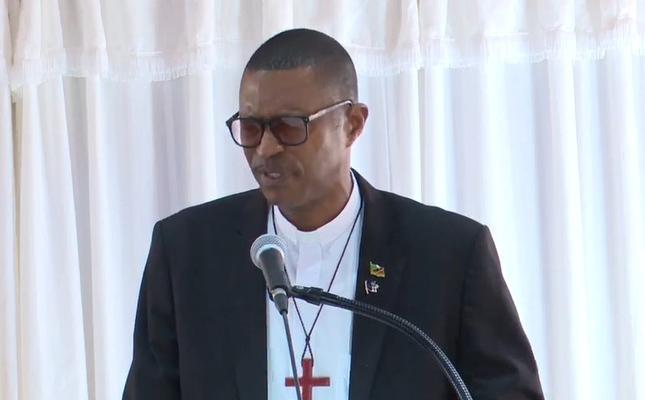
    BASSETERRE, St. Kitts – The 2026 Legal Year commenced with a powerful appeal for judicial integrity as Pastor Derek Brown delivered a stirring address during Monday’s ceremonial church service, emphasizing three fundamental pillars: fairness, equality, and clarity within the justice system.

    Speaking before legal professionals and congregants, Brown articulated the critical necessity of administering justice without prejudice or external influence. He anchored his message in this year’s judicial theme: “The Eastern Caribbean Supreme Court: Justice that Endures, Anchored in Independence, Strengthened through Trust,” interpreting it as a direct commitment to equitable treatment for all citizens.

    “A judicial framework must instill universal confidence that justice will be served impartially,” Brown stated. “An institution anchored in independence operates without compromise or interference—it is fundamentally unbiased. When strengthened through public trust, it becomes a transparent system worthy of societal reliance.”

    The pastor further highlighted the urgent need for clarity in legal proceedings, particularly within what he characterized as an increasingly confusing global landscape dominated by distorted information. He expressed deep concern over the proliferation of ‘alternative facts,’ noting that repeated falsehoods often gain unwarranted legitimacy.

    “In our rapidly evolving world, truth itself faces unprecedented challenges,” Brown observed. “What was once universally right cannot suddenly become wrong. The justice system must serve as an enduring bulwark against such distortions—independent, influential, and truly worthy of public trust.”

    Additionally, Brown cautioned against tolerating minor offenses, warning that overlooked violations can escalate into severe societal problems. Using illustrative examples during his sermon, he advocated for comprehensive accountability across all levels of law enforcement and civic society.

  • houtexport dossier 7: Directeur LVV Ramkisoensing ontheven; RvM keurt besluit goed

    houtexport dossier 7: Directeur LVV Ramkisoensing ontheven; RvM keurt besluit goed

    The Surinamese Council of Ministers has officially relieved Anand Ramkisoensing of his duties as Director of Agricultural Research, Marketing and Processing (LOAV) at the Ministry of Agriculture, Livestock and Fisheries. The decision, formalized through an official resolution, takes immediate effect from the date of issuance.

    According to government documents, Ramkisoensing has been placed on temporary assignment to the Agriculture Minister while retaining his full salary and benefits in accordance with civil service regulations. The dismissal follows comprehensive evaluations revealing significant failures in achieving key policy objectives and operational targets under his leadership.

    Official statements cite persistent deficiencies in management approach, interdepartmental collaboration, and goal attainment within the LOAV directorate. Additionally, investigators raised concerns about documents signed by Ramkisoensing that potentially enabled fraudulent activities, though no specific allegations have been formally proven.

    The director’s extended medical leave period reportedly contributed to operational disruptions within the research division. Government authorities determined that leadership change was necessary to ensure continuity of critical agricultural research programs and ongoing investigations.

    In a parallel development, Ramkisoensing has been appointed as First-Class Advisor to the Agriculture Minister through consultation with the Ministry of Home Affairs. This position maintains his existing employment status while removing him from operational responsibilities. He remains obligated to cooperate with ministerial investigations and return all government property.

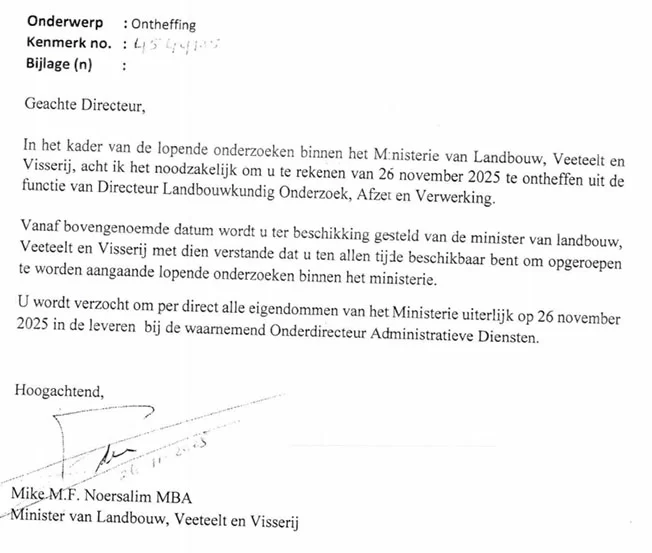
    The November 26, 2025 notification letter formally informed Ramkisoensing of these administrative changes and his ongoing responsibilities to assist with internal investigations.