作者: admin

  • Manamoto: first training initiative for motorcyclists

    Manamoto: first training initiative for motorcyclists

    SANTO DOMINGO – In a targeted effort to cut down on preventable traffic collisions and build a culture of responsible two-wheeled travel, the National Action Table with Motorcyclists (Manamoto) has launched its first-ever specialized road safety training program for motorcyclists, gathering riders and local stakeholders at the Boca Chica mayor’s chapter room earlier this month.

    Against a backdrop of persistently high traffic accident rates across the Dominican Republic, where motorcyclists rank as one of the most at-risk groups on public roads, the training session centered on core public safety priorities: improving rider education, embedding respect for traffic regulations, and curbing high-risk riding behaviors. The initiative is backed by the Dominican Road Mobility Foundation (Movido), an organization leading the push for collaborative, community-centered road safety reform across the nation.

    Miguel Jiménez, president of Movido, opened the event by emphasizing shared accountability for improving road outcomes, pushing back against the idea that road safety is solely the responsibility of government regulators. “Rather than placing the blame on the authorities, who in some ways have their share of responsibility, there is a large share of responsibility that we as citizens have, and that is why, by working together, we will find solutions,” Jiménez said. He added that the work is rooted in social impact, not political gain: “I don’t have a political discourse, I have a social discourse, through which we will all say: I am committed.”

    Three specialist speakers led targeted educational sessions covering distinct critical safety topics for attendees. Dr. Frank Reyes led a discussion on the underrecognized dangers of driving under the influence of medication, highlighting the heightened risks of unregulated self-medication and the lethal combination of prescription or over-the-counter drugs with alcohol. Popular motorcycle safety advocate Claudio en Moto focused on foundational practical riding habits, stressing the non-negotiable need for correctly fitted protective gear, proper riding posture, and consistent defensive driving techniques that help riders anticipate and avoid hazards. Juan José Mella Mota, Mobility Coordinator at Seguros SURA, rounded out the sessions by walking attendees through step-by-step protocols for responding safely and appropriately immediately after a traffic collision, a skill that can reduce secondary injuries and speed up emergency response.

    Throughout the program, Manamoto’s core mission has remained consistent: to drive widespread awareness of three non-negotiable road safety rules – correct use of all required protective gear, full adherence to traffic signage and regulations, and consistently prudent, attentive riding. Multiple local and national government officials joined the event to signal institutional support for the initiative, including Boca Chica mayor Ramón Candelaria, Joel Gneco Gross, director of Transit and Road Safety at the National Institute of Traffic (Intrant), Santo Enriquez García, regional East director for the General Directorate of Road Safety and Traffic (Digesett), and Franklin Glass, president of the Dominican Chamber of Insurers and Reinsurers (Cadoar).

    In an interview with Miguel Franjul, director of local media outlet Listín Diario, event organizers outlined their long-term expansion plans: the program will roll out to additional provinces across the Dominican Republic in coming months, with the ultimate goal of reaching thousands of motorcyclists and embedding a sustained culture of road safety nationwide. Local officials including Boca Chica mayor Víctor Ramírez have also publicly voiced their support for the community-focused initiative, framing it as a critical intervention to reduce preventable deaths and injuries on Dominican roads.

  • 70% of minor crimes in the National District are linked to drug use

    70% of minor crimes in the National District are linked to drug use

    SANTO DOMINGO — A newly released feasibility study has uncovered a critical connection linking problematic substance abuse to the majority of low-level criminal cases processed in the Dominican Republic’s National District, opening the door to sweeping reforms of the nation’s justice system through a new restorative therapeutic justice pilot program. The findings were shared by Magistrate Kenya Romero, coordinator of the jurisdiction’s Courts of Instruction, during a progress presentation at the 2026 Judicial Power Conference, where legal innovators from across the globe gathered to discuss modernization of criminal justice frameworks.

    Romero spoke on the conference panel titled “Treatment Under Possible Judicial Supervision,” outlining how the new pilot model seeks to upend centuries of traditional adversarial justice practices that have long defined criminal case processing. Rather than forcing prosecutors and defendants into an oppositional standoff that centers punishment over root-cause resolution, the new framework adopts a collaborative approach that integrates court-supervised monitoring of defendants’ substance use recovery into the legal process.

    Under the program’s guidelines, only defendants meeting rigorous legal and health screening criteria — those facing minor charges and confirmed to have narcotic dependence — are selected to participate in the alternative track. Romero explained that this targeted approach clears a massive backlog of thousands of stalled minor infraction cases by prioritizing public health intervention over traditional prosecution, creating a more efficient system that addresses the underlying drivers of repeated low-level crime.

    “The goal is to bring a more human-centered perspective to legal conflict resolution,” Romero emphasized. “A judge still upholds the rule of law, but we recognize that many defendants face systemic risk factors and live with a chronic, treatable health condition. This model strengthens the judicial role by integrating medical and public health tools, rather than asking courts to punish people for conditions that can be treated.”

    The conference drew insights from international peers already implementing similar models, including Carmen Otero, administrative judge of Bayamón, Puerto Rico, who explained that therapeutic justice has been enshrined as a constitutional state policy on the island. Otero shared economic data that makes a compelling case for the shift: Puerto Rico spends roughly $343 million annually on prison confinement for non-violent drug offenders, while prevention and court-supervised treatment programs deliver far better rehabilitation outcomes at a fraction of the cost.

    “Unlike the traditional adversarial process that pits all parties against one another, the therapeutic approach aligns everyone on the same team, working toward the shared goal of the defendant’s long-term recovery,” Otero noted.

    Attending judges across the regional delegation reached a broad consensus: the future of effective criminal justice requires addressing the root causes of crime, rather than only responding to and punishing its harmful outcomes.

    The discussions on therapeutic justice are a core component of the Dominican Republic’s national Criminal Process Optimization Plan, the central policy focus of this year’s Judicial Power Conference. The three-day event has drawn more than 6,000 total participants, 68 international exhibitors, and legal representatives from 25 countries, cementing the Dominican Republic’s position as a regional benchmark for forward-thinking legal innovation in the Americas.

  • ABLP St. John’s Rural East Branch Condemns Removal of Maria Browne Campaign Signs

    ABLP St. John’s Rural East Branch Condemns Removal of Maria Browne Campaign Signs

    A local chapter of the Antigua and Barbuda Labour Party (ABLP) has publicly denounced a disturbing act of electoral sabotage targeting the campaign materials of a sitting party politician, marking an ugly turn ahead of the island nation’s democratic political activity. The St. John’s Rural East Branch of the ABLP confirmed that the incident involved a small group of young men who traveled through the constituency in a white Toyota Vitz. Wearing the party’s signature red ABLP-branded shirts to obscure their true intentions, the group defaced and removed campaign signs and posters belonging to Hon. Maria Browne, an elected representative for the area. Party officials with the local branch emphasized that this behavior has no place in Antigua and Barbuda’s democratic framework. They labeled the actions as both ethically unacceptable and legally unlawful, noting that the vandalism directly contradicts the core values that the ABLP has long promoted for political competition: fairness, mutual respect, and integrity across all campaign activity. The branch stressed that every political actor, regardless of which party they align with, has a fundamental right to engage in public political expression. That right, officials added, must always be exercised within the bounds of the law and with respect for opposing candidates and their supporters. Following the discovery of the vandalism, the St. John’s Rural East Branch formally filed a report with local law enforcement. Authorities have since launched a formal investigation into the incident, and party representatives confirmed that they are fully cooperating with police to identify all individuals involved in the act. The branch made clear that once the responsible parties are found, they will be held fully accountable for their actions under the law. In addition to calling for accountability, the local chapter issued a public appeal to all residents and political actors across Antigua and Barbuda. The branch urged every person to approach the political process with responsibility and respect, reiterating that aggressive, illegal tactics that undermine democratic activity will not be tolerated in the country.

  • Brandstofprijzen voorlopig bevroren; regering volgt impact Midden-Oosten nauwlettend

    Brandstofprijzen voorlopig bevroren; regering volgt impact Midden-Oosten nauwlettend

    Against a backdrop of growing global economic uncertainty triggered by the ongoing conflict in the Middle East, the government of Suriname has announced a temporary fuel price cap to lock in current rates and protect domestic consumers from sudden volatile price swings.

    The decision, finalized following coordinated consultations between key stakeholders, the Ministry of Finance and Planning, and Staatsolie, Suriname’s state-owned oil company, fixes diesel prices at 53.27 Surinamese dollars and regular unleaded gasoline at 48.32 Surinamese dollars for the immediate future.

    Policy makers framed the measure as a proactive buffer designed to shield households and businesses from the unpredictable market shifts that often accompany regional geopolitical tensions in major energy-producing areas. The core priority of the intervention, officials emphasized, is to minimize the economic spillover that would disproportionately impact everyday citizens, while maintaining a careful balance between public expenditure and available state revenue.

    Suriname’s authorities have committed to continuous close monitoring of international market dynamics and the evolving situation in the Middle East, with regular evaluations of how global developments are impacting the domestic economy. Any future adjustments to the current fuel price policy will be communicated to the public in a timely manner to ensure full transparency and keep all segments of society informed of changing conditions.

  • PM says free university education to commence in September, earlier than expected

    PM says free university education to commence in September, earlier than expected

    In a surprise policy announcement made moments ago, Prime Minister Gaston Browne has confirmed that the Caribbean nation of Antigua and Barbuda will introduce fully funded free university education for its citizens starting as early as September 2026, bringing forward a long-promised reform that was originally tied to campus expansion work.

    The free tertiary education program, which will be hosted at the University of the West Indies Five Islands Campus, was initially scheduled to launch only after the institution completed its planned campus enlargement projects. But during a recent interview with local radio outlet Pointe FM, Browne revealed that updated conversations with the country’s Financial Secretary have cleared the way for an earlier rollout of the signature policy.

    Under the new program, eligible Antiguan and Barbudan students will have the opportunity to earn multiple undergraduate and graduate degrees entirely free of charge while studying locally. This includes the popular and high-demand law degree, opening up accessible pathways for students seeking to enter the legal profession without the burden of crippling tuition debt.

    Beyond the immediate rollout of free university education, Browne also dropped a hint that the governing party is preparing more sweeping education reforms. Plans to expand free access to education across all levels of schooling will be outlined in greater detail in the party’s upcoming electoral manifesto, which is scheduled for official launch next week.

    As this policy development is still unfolding, additional details about program eligibility, implementation logistics and broader education initiatives are expected to be released in the coming days.

  • CRICKET WEST INDIES: West Indies Championship round 2 preview

    CRICKET WEST INDIES: West Indies Championship round 2 preview

    As the West Indies Championship heads into its second round of matches, Trinidad & Tobago Red Force holds a razor-thin 0.6-point advantage over second-placed Jamaica Scorpions after a thrilling opening round of the regional cricket competition. Chasing their first title in two decades, Red Force delivered a dominant statement in their opening fixture, crushing Leeward Islands Hurricanes by an innings and 271 runs at Coolidge Cricket Ground to pocket 22.6 total points, six of which came from bonus points. Just behind Red Force on the leaderboard, Jamaica Scorpions sit at 22 points after a dramatic final-day run chase against Barbados Pride, while defending champions Guyana Harpy Eagles round out the top three with 21.4 points.

    Red Force has opted to keep its full squad unchanged for its upcoming second-round clash, but captain Joshua Da Silva is pushing his side to lift their intensity and sharpen their edge heading into the match at Sir Vivian Richards Stadium. Da Silva noted areas for improvement following the opening win, pointing out dropped catches that need to be addressed in the field. While he expressed satisfaction with the early performance of the team’s opening batters, who have bounced back from inconsistent opening partnership struggles last year, Da Silva called on the pair to extend their good form into the next fixture.

    For the Leeward Islands Hurricanes, who suffered the lopsided opening round defeat, the squad has made two adjustments: Kofi James and Carlon Bowen-Tuckett will step in to replace Nathan Edward and Daniel Doram respectively. Head coach Steve Liburd says his side’s sole focus right now is bouncing back to secure a win and keep their playoff hopes alive. “It is a three-match series, and we are looking to bounce back and win the game. On reflection we had very good conversations with the players in our different groups about finding different ways we can come back into the series,” Liburd explained.

    In Kingston, Jamaica Scorpions are riding high after securing their first victory over Barbados Pride in 10 years, and the side is keen to carry that winning momentum into their home fixture at Sabina Park. Barbados Pride, meanwhile, has shored up its batting order ahead of the rematch, with West Indies Test captain Roston Chase — who has notched 11 centuries at this level of competition — returning to the squad to replace Shian Brathwaite. Barbados head coach Vasbert Drakes acknowledged Jamaica’s standout performance in the last round, where the Scorpions read pitch conditions perfectly to pull off a successful fourth-innings chase, but he says his side has learned from the defeat and is hungry for redemption. “It is a totally different wicket at Sabina Park and totally different environment, and I think everyone will be on a level playing field,” Drakes noted.

    The third second-round fixture sees defending champions Guyana Harpy Eagles face Windward Islands Volcanoes at the historic Antigua Recreation Ground, a venue hosting its first regional cricket match since 2009. The Harpy Eagles, who are chasing a fourth consecutive championship title, have welcomed fast bowler Shamar Joseph back into their squad as they target back-to-back wins to open the tournament. Captain Tevin Imlach says the side’s strong late performance in their opening fixture has given them momentum heading into the match, even though the Antigua Recreation Ground pitch is expected to be flatter than their previous venue. Imlach emphasized the need for batters to step up and for the fielding unit to cut down on missed chances after several dropped catches in the opening game.

    Windward Islands Volcanoes have made one squad change for the clash, with Johann Jeremiah replacing Teddy Bishop. Head coach Kenroy Peters acknowledged that Guyana enters the fixture as the favored side, having dominated the regional competition in recent years, but he pointed out that his side had strong patches in their opening defeat that they can build on. “We all know Guyana might be the better the team in this format but despite losing, we still had periods where we did well, but we failed to capitalize and maintain pressure for longer periods,” Peters said. “This time around we are looking to correct areas where we are dominating to stay on top, and if things are not going our way, we need to be patient and have better execution while sticking to our plans.”

    All three second-round matches are scheduled to get underway at 10 a.m. local time at their respective venues.

  • Mottley calls for democratic renewal, truth and fairness in Spain

    Mottley calls for democratic renewal, truth and fairness in Spain

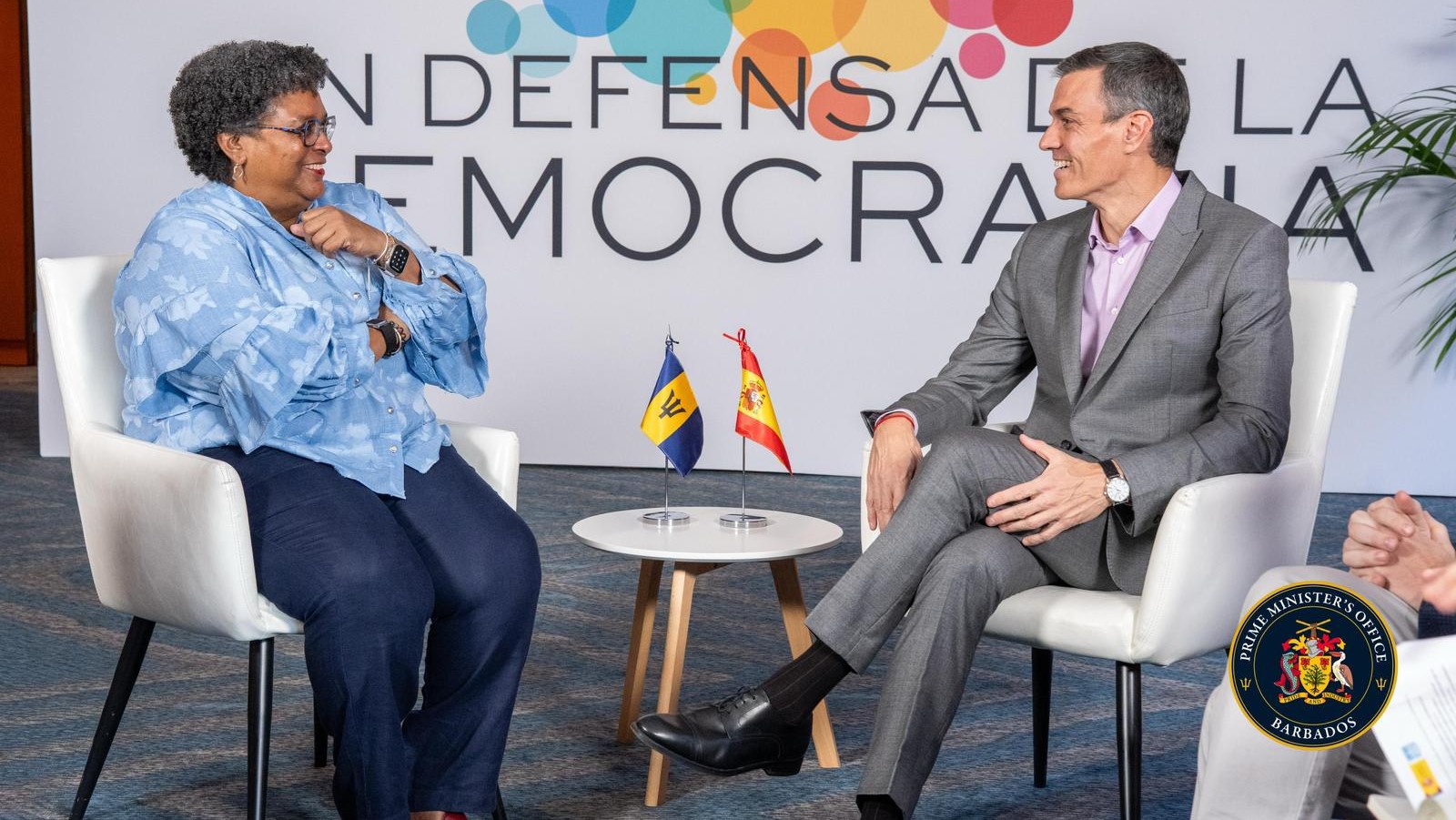
    Leaders from across the globe gathered in Barcelona for the IV Meeting in Defence of Democracy, with Barbados Prime Minister Mia Mottley at the forefront of calls to translate commitments to democratic governance into tangible action. The high-level summit closed with a landmark joint declaration that reaffirmed the global community’s core commitment to upholding democracy, universal human rights, and a rules-based international order, while outlining a concrete action plan focused on multilateral reform, information integrity, democratic digital governance, and inclusive global development.

    Against a backdrop of rising geopolitical tension, widening economic inequality, growing societal polarization, and the rampant spread of disinformation, Mottley positioned Barbados as a leading voice for small nations demanding that democratic values be defended through action, not just rhetoric. Her address centered on three interconnected critical priorities that shape the future of democratic governance globally: upholding the rules-based international system, countering the rise of extremism fueled by systemic inequality and exclusion, and defending truth amid a growing crisis of disinformation.

    “For small states like Barbados, a rules-based order is essential to our ability to exist and succeed,” Mottley emphasized. She further warned that unaddressed systemic inequality poses an existential threat to democratic foundations, noting, “When democracy does not deliver for people, and when inequality becomes extreme, it erodes faith in the system itself and creates space for extremism.”

    Many of Mottley’s key priorities were integrated directly into the final Barcelona declaration. The document reaffirmed that respect for international law and multilateral cooperation remain the bedrock of global peace, sustainable development, and human dignity. Participating leaders committed to building a renewed, more effective, inclusive, and representative multilateral system, including comprehensive reform of the United Nations, particularly the UN Security Council.

    Of special significance to Barbados and other similarly positioned nations, the declaration recognized the urgent need for a reformed multilateral framework that addresses the unique vulnerabilities of Small Island Developing States (SIDS) and advances a global development financing structure better aligned to the needs of marginalized nations and their citizens.

    A core pillar of Mottley’s intervention was the concept of informational sovereignty, which she framed as fundamental to democratic function. “Without facts there is no truth, without truth there is no trust, and without trust there is no shared reality,” she stated, arguing that democracies have a non-negotiable obligation to protect the public’s right to accurate information. This emphasis was reflected in the final declaration: participating nations pledged to strengthen cross-border cooperation on transparency, accountability, and democratic governance in the digital space; launched a new Digital Democracy Roundtable initiative; and committed to supporting algorithmic transparency, information integrity, independent pluralistic media, sustainable journalism, and national digital sovereignty.

    Mottley pushed attending leaders to move beyond broad symbolic statements and unite around shared, values-driven actionable goals. “If we are serious about the Sustainable Development Goals, we have to be serious about allowing countries to access the means to achieve them. The reform of the international financial system is central to that effort,” she said. She went on to argue for a “more comprehensive, fairer and more democratic system” that guarantees all people access to basic necessities including food and clean water, and addresses the systemic inequities that push vulnerable nations further to the margins during global economic crises.

    The summit’s final declaration echoed these concerns, acknowledging that persistent systemic inequality creates fertile conditions for extremism and democratic backsliding, reaffirming the importance of fair progressive taxation, and recognizing that climate change acts as a key amplifier of global inequality. Most notably, the meeting framed itself as a decisive turning point, shifting the initiative from collective acknowledgment of shared challenges to concrete implementation. The group will reconvene in New York this coming September on the sidelines of the United Nations General Assembly to review progress.

    Beyond the plenary discussions, Mottley held bilateral talks with Spanish Prime Minister Pedro Sanchez focused on advancing practical cooperation priorities for Barbados and other small island states. The two leaders covered a wide range of topics, including migration policy cooperation, climate resilience, renewable energy transition, methane reduction policy, data governance, international competitiveness, strategic autonomy, and the removal of persistent systemic economic barriers that disproportionately harm small states.

    Key topics on the bilateral agenda included a potential technical study visit for Barbadian officials to learn from Spain’s migration policy experience, the framing of climate resilience as a core national defense priority for small island nations, advancing renewable energy transition while maintaining energy security in a hurricane-prone region, strengthening global methane regulations, sustainable green data center governance, and the strategic importance of digital and communications sovereignty for small states.

    The leaders also addressed the disproportionate harm caused by unfair international financial listings, specifically discussing Barbados’ long-running request to be removed from Spain’s national blacklist of financial jurisdictions. Mottley noted that Barbados has already met all required compliance standards set by the Organisation for Economic Co-operation and Development (OECD), and Sanchez confirmed that Spain would immediately move forward with updating the list and removing Barbados from the designation.

  • Gasoline, diesel, and kerosene hit $17 for April 2026

    Gasoline, diesel, and kerosene hit $17 for April 2026

    Starting Saturday, April 18, 2026, consumers across Grenada, including its island dependencies Carriacou and Petite Martinique, will face substantially higher retail prices for most major petroleum products, according to an official price adjustment announcement.

    The new pricing structure brings uniform $17.00 Eastern Caribbean dollar (IG) per gallon pricing for three core liquid fuels, a shift that brings sharp increases from previous rates. Gasoline, which previously retailed for $15.18 per IG, will rise by $1.82 to hit the new unified rate. Diesel sees a more moderate increase of $0.89 per IG, climbing from its former $16.11 price to match the $17.00 benchmark. Kerosene bears the steepest hike among liquid fuels, jumping by $3.90 per IG from $13.10 to reach the $17.00 new price point.

    For liquefied petroleum gas (LPG), more commonly known to local households as cooking gas, pricing changes vary by cylinder size and geographic location. Across both the main island of Grenada and the smaller islands of Carriacou and Petite Martinique, the popular 20-pound household cooking gas cylinder will retain its current price, holding steady at $40.00 in Grenada and $49.00 in the smaller island dependencies. However, larger commercial and bulk LPG purchases will see notable increases. In Grenada, 100-pound LPG cylinders will rise from $296.60 to $350.00, a $53.40 increase, while bulk LPG will climb $0.55 per pound from $3.05 to $3.60. In Carriacou and Petite Martinique, 100-pound cylinders increase by $43.40 from $319.60 to $363.00, with bulk LPG following the same $0.55 per pound hike to $3.60 that applies to the main island.

    This official price adjustment, linked to Grenada’s finance ministry, will impact household budgets, transportation costs, and small business operating expenses across the country. Media outlet NOW Grenada notes that it holds no responsibility for contributor content related to this announcement, and encourages reporting of any abusive content related to the fuel price adjustment.

  • Iran fully closes Strait of Hormuz over US blockade and fires on ships

    Iran fully closes Strait of Hormuz over US blockade and fires on ships

    Tensions around the strategically vital Strait of Hormuz reignited dramatically on Saturday, as Iran backed away from its recent partial reopening of the waterway and launched attacks on passing commercial vessels. The escalation comes in direct retaliation for the United States’ ongoing maritime blockade of Iranian ports, a core pressure tactic in the eight-week conflict between the two nations.

    In an official statement Saturday, Iran’s Revolutionary Guard Navy announced that the strait will remain fully closed to commercial traffic until the U.S. blockade is permanently lifted. The force issued a stark warning to global shipping: “no vessel should make any movement from its anchorage in the Persian Gulf and the Sea of Oman, and approaching the Strait of Hormuz will be considered as cooperation with the enemy” — a designation that puts any errant vessel at risk of being targeted.

    The United Kingdom’s United Kingdom Maritime Trade Operations center confirmed the attacks, reporting that Revolutionary Guard gunboats fired on a tanker, while an unknown projectile struck a container ship, damaging cargo containers on board. India’s foreign ministry has since escalated the diplomatic fallout, summoning Iran’s ambassador to New Delhi to protest the incident: two of the vessels hit were flying the Indian flag, a particularly provocative move after Iran had recently allowed multiple India-bound ships to pass through the strait unimpeded.

    This latest escalation comes at a precarious moment for regional diplomacy: a fragile temporary ceasefire is set to expire this coming Wednesday. Iranian officials confirmed that Tehran has received a new set of negotiating proposals from Washington, with Pakistani mediators currently working to arrange a new round of direct talks between the two adversaries.

    Just days before Saturday’s attacks, Iran’s joint military command had announced that control of the strait had “returned to its previous state … under strict management and control of the armed forces,” signaling a partial easing of restrictions that had raised hopes for de-escalation.

    For Iran, controlling access to the Strait of Hormuz — through which roughly 20% of the world’s daily oil supplies transit — remains its most impactful leverage in the conflict. The current conflict began on February 28, when the U.S. and Israel launched military operations amid stalled negotiations over Iran’s nuclear program. Closing the strait puts immediate pressure on the global economy, inflicting political strain on Western leaders while the U.S. naval blockade aims to cripple Iran’s already fragile economy.

    Iran’s newly installed supreme leader, Ayatollah Mojtaba Khamenei, delivered a defiant address Saturday, asserting that Iran’s navy stands “ready to inflict bitter defeats on its enemies.” Khamenei, who assumed the role following his father’s death in Israel’s opening offensive of the war, has not been seen in public since he took office.

  • Teachers Given Formula to Calculate Final Retroactive Pay for 2018–2023 Period

    Teachers Given Formula to Calculate Final Retroactive Pay for 2018–2023 Period

    Public sector teachers across Antigua and Barbuda who are eligible for long-awaited final retroactive payments from the 2018 to 2023 collective bargaining contract period now have step-by-step guidance to calculate their outstanding owed amounts, released this week by the Executive of the Antigua and Barbuda Union of Teachers (ABUT).

    The guidance is split into two distinct frameworks based on a teacher’s start date within the contract period, to ensure every eligible educator can accurately verify their entitlement. For educators hired between January 1, 2019 and December 31, 2023, the calculation follows a four-step process. First, multiply the teacher’s substantive salary (as recorded on January 1, 2019) by 0.05, then multiply that total by 12 to account for the full 2019 calendar year. Second, calculate the 2020–2023 component by multiplying the teacher’s substantive salary as of January 1, 2020 by 0.092, then multiply that by the total number of months the teacher worked between 2020 and 2023. Third, add the results of the first two calculations to get a subtotal, then sum up the value of all extra monthly salary payments received in 2022, 2024, and 2025. The final retroactive amount owed equals the subtotal minus this sum of previously received extra payments.

    To illustrate this first framework, ABUT provided a sample calculation for a hypothetical Teacher A, who was hired in January 2019 and remained employed beyond the end of 2023. With a 2019 starting substantive salary of $2,754, 48 months worked between 2020 and 2023, and extra payments totaling $9,154 across 2022, 2024, and 2025, the final retroactive payout comes out to $4,660.

    For educators hired between January 1, 2020 and December 31, 2023, a simplified framework applies. Teachers in this group calculate their base amount by multiplying their January 1, 2020 substantive salary by 0.092, then by the total number of months worked between 2020 and 2023. They then subtract the sum of their extra 2022, 2024, and 2025 salary payments from this base to get their final owed amount, with results rounded to the nearest whole dollar. ABUT’s sample for this group, Teacher B, also hired with a $2,754 salary and 48 months of work, ends up with a final retroactive payment of $3,008 after rounding.

    ABUT’s leadership emphasizes that this public guidance is designed to promote full transparency around the retroactive payment process, allowing every eligible teacher to independently confirm their expected payout rather than relying solely on government calculations. The union has advised both members and non-members who identify any discrepancies between their own calculation and the payment issued by the government to report inconsistencies to either the Accounts Department at the Ministry of Education or the Treasury Department for review.

    In closing the announcement, ABUT President Casroy Charles reaffirmed the union executive’s ongoing commitment to keeping all teaching staff updated on any new developments related to the retroactive payment process. The organization says it will continue working to ensure every educator receives the full and fair compensation they are entitled to under the 2018–2023 collective agreement.