
The Foundation for Labor Mobilization and Development (SAO) has inaugurated a cultural-historical meeting space on its premises in Geyersvlijt, Suriname. The centerpiece of this new community hub is a miniature wooden house, ‘SAO Oso Tori Oso,’ crafted by students from the Construction and Mechanical Woodworking Vocational School. The house, previously managed by the cultural organization NAKS, was officially dedicated during a festive ceremony. This initiative is part of a newly designed plaza intended to serve as a central gathering spot for local residents, students, and visitors. The space showcases traditional Surinamese artifacts (fosten sani), offering a glimpse into the nation’s cultural heritage. The project was realized in collaboration with the foundation Under the Blue Surface and funded with support from the Netherlands. Deputy Minister Raj Jadnananding (Health, Welfare, and Labor) and SAO Director Joyce Lapar presided over the opening ceremony, as reported by the Suriname Communication Service. During the event, ten senior residents were honored for their contributions to the community, receiving gift packages and snacks courtesy of the Lions Club Parwani. ‘This building is a piece of our history,’ remarked one of the honorees. The SAO, which will celebrate its 45th anniversary in 2026, provides vocational training for youth, adults, and seniors. Lapar emphasized that the new meeting space aims to foster community connections and spark interest in educational opportunities. The venue can accommodate gatherings of up to thirty people and will host workshops and themed events, including a Mental Health Day on October 22. ‘With knowledge, you build not just a house but also yourself,’ Lapar stated, urging the public to take advantage of SAO’s retraining and upskilling programs.
作者: admin
-

PM Says Government Will Repair Its Own Derelict Buildings
Prime Minister Gaston Browne has unveiled a significant initiative aimed at urban renewal and beautification across Antigua. During a parliamentary debate on the Tax Administration and Procedure (Amendment) Bill 2025, Browne emphasized the government’s commitment to restoring its own derelict buildings as part of a broader effort to enhance community aesthetics and enforce property upkeep standards. The Prime Minister stated that the Cabinet had unanimously agreed to prioritize the repair and repurposing of government-owned properties in poor condition, setting a precedent for private property owners to follow. Browne argued that the government must ‘lead by example’ in maintaining public spaces and infrastructure. The initiative is part of a comprehensive urban renewal drive that also addresses abandoned lots, derelict houses, and unkempt government facilities. The goal is to foster cleaner, safer, and more livable neighborhoods while ensuring accountability among both public and private property owners. Browne defended the property tax amendment, which grants authorities enhanced powers to tackle chronic neglect and dereliction, dismissing opposition claims that the bill is overly harsh. He clarified that the legislation targets long-term defaulters and abandoned properties, not ordinary homeowners. This move underscores the government’s dedication to improving the nation’s physical landscape and promoting compliance with property maintenance regulations.
-

Belgian court approves Mehul Choksi extradition to India
In a significant legal development, a court in Antwerp, Belgium, has approved the extradition of Mehul Choksi, a fugitive diamond trader, to India. This decision comes nearly five months after Choksi’s arrest in Belgium in connection with the ₹13,000-crore Punjab National Bank (PNB) loan fraud case. The 64-year-old businessman now has a 15-day window to appeal the ruling before Belgium’s Supreme Court. The Indian government has provided assurances regarding the detention conditions Choksi would face if extradited, including his placement in Mumbai’s Arthur Road Jail. Choksi, along with his nephew Nirav Modi, is accused of orchestrating a massive fraud between 2014 and 2017 by using fraudulent Letters of Undertaking to secure overseas credit. The alleged scam resulted in losses exceeding ₹13,500 crore for PNB, with Choksi’s share estimated at ₹6,000 crore. After fleeing India in 2018, Choksi obtained citizenship in Antigua and Barbuda through its investment program before relocating to Belgium in 2024, reportedly for medical treatment. India’s extradition treaty with Belgium, established in 1901, facilitates the transfer of fugitives charged with crimes punishable in both jurisdictions. Choksi’s legal team has raised concerns about his health and the conditions of Indian prisons, arguing that he would not receive due process in India. The case continues to draw significant attention as it moves closer to a potential resolution.
-

Trinidad and Tobago reserves position as CARICOM reaffirms Caribbean as Zone of Peace
The Heads of Government of the Caribbean Community (CARICOM), with the exception of Trinidad and Tobago, have unanimously reaffirmed their dedication to preserving the Caribbean as a Zone of Peace. This declaration comes amidst heightened US military presence in the region, including the deployment of eight warships, a nuclear-powered submarine, and fighter jets, as well as a request to Grenada for the installation of radar and other equipment. Trinidad and Tobago, however, has reserved its position on the matters discussed during the recent meeting.
-

CARICOM Reaffirms Caribbean as a “Zone of Peace” Amid Security Concerns
In a significant move to address escalating security concerns, the Caribbean Community (CARICOM) has reaffirmed its commitment to maintaining the Caribbean as a ‘Zone of Peace.’ This declaration came during a recent meeting of the Heads of Government, where leaders expressed growing unease over increased military and security activities in the region. While Trinidad and Tobago reserved its position, the majority of CARICOM members emphasized the importance of dialogue and peaceful conflict resolution. The regional body also highlighted its ongoing efforts to combat narcotrafficking and the illegal trade of small arms, stressing the need for international cooperation and adherence to international law. CARICOM leaders reiterated their unwavering support for the sovereignty, territorial integrity, and safety of Caribbean nations and their people. Although the statement did not explicitly name any specific country or external actor, it comes amid heightened U.S.-led operations and renewed debates about foreign intervention and border disputes. This reaffirmation aligns with the principles of the 1979 Havana Declaration, which advocated for a Caribbean free from military confrontation and external interference.
-

Matthew: Derelict Properties Are ‘Havens for Criminals and Rodents’
In a passionate address during Thursday’s parliamentary debate on the Tax Administration and Procedure (Amendment) Bill 2025, St. John’s Rural South MP Daryll Matthew highlighted the urgent need to tackle abandoned and decaying buildings across the island. Describing these structures as ‘havens for criminals and rodents,’ Matthew emphasized their detrimental impact on public health and community safety. He revealed that a recent survey in the Lower Ottos area of his constituency identified 151 abandoned properties, many of which are overrun with vegetation, vermin, and criminal activity. ‘These properties have become havens for criminals and hotels for rodents,’ Matthew stated. ‘We have an opportunity to turn what is now decay into development — to turn a nuisance into something nice.’ The MP argued that the new legislation provides the government with the necessary tools to address derelict properties, which have long been eyesores and public health hazards. He proposed that properties acquired through the process could be converted into green spaces, playgrounds, or housing lots, particularly for residents living near the abandoned sites. Matthew also suggested the introduction of an escrow system to protect the proceeds of property sales in cases where an owner or heir later reappears, and recommended waiving stamp duty for buyers who purchase derelict lots through public auction to encourage redevelopment. ‘This is a chance to improve the quality of life for everyone,’ Matthew concluded. ‘We have been elected to solve problems, not allow them to rot in our neighborhoods.’ The Tax Administration and Procedure (Amendment) Bill 2025 passed later that day with the government’s majority support, marking a significant step toward community revitalization and public safety.
-
VIDEO: Bowen Calls Property Tax Bill ‘Draconian,’ Urges Safeguards for Homeowners
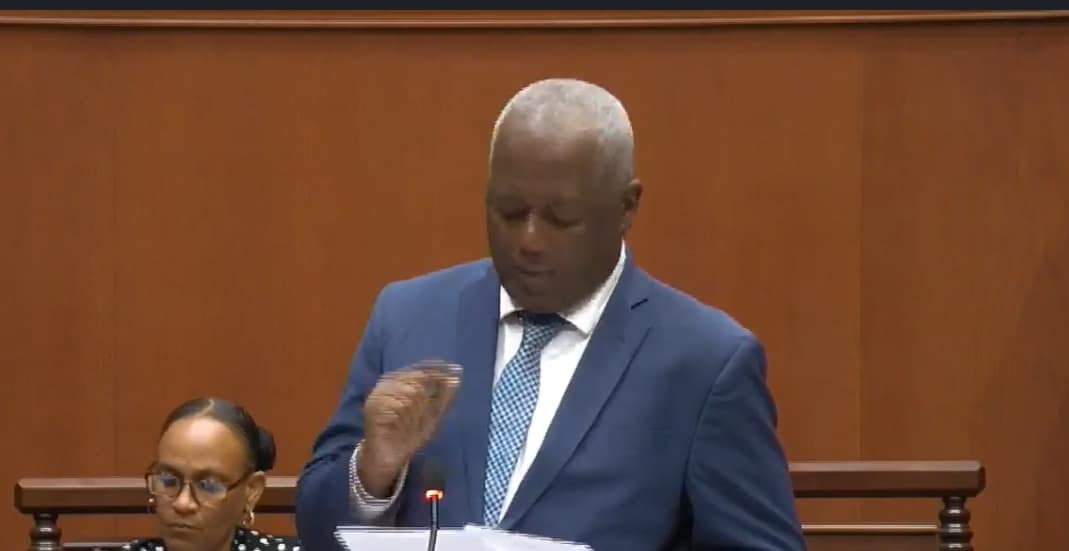
In a heated parliamentary debate on Thursday, Opposition MP Sherfield Bowen vehemently criticized the Tax Administration and Procedure (Amendment) Bill 2025, labeling it as ‘draconian’ for granting the government excessive powers to seize and sell private property over unpaid taxes. Representing St. Philip’s South, Bowen argued that the bill, ostensibly designed to address derelict and abandoned properties, could unfairly penalize homeowners who fall behind on tax payments, even by a single installment. He emphasized that the legislation lacks a crucial precondition: the property must be officially declared derelict or abandoned before any sale is considered. Bowen proposed several amendments to ensure fairness, including a mandatory five-year period of government-maintained property cleaning and maintenance, with costs charged to the land, before any sale is pursued. He also objected to the bill’s provision allowing tax collection after a mere 30-day notice, deeming it unreasonable and advocating for a more extended grace period of at least one year. Additionally, Bowen called for multiple written notices and personal service to homeowners before enforcement actions are taken. Despite his impassioned arguments and calls for stronger homeowner protections, the bill passed later that day with government support.
-

President roept op tot nationale verbondenheid bij Diváliviering in Saramacca
On Friday, President Jennifer Simons inaugurated the Diváli celebrations in the Saramacca district by lighting a symbolic dia at the district commissioner’s office in Groningen. The ceremony was attended by prominent figures, including Parliamentary Chairman Ashwin Adhin, Minister Lalinie Gopal, District Commissioner Aniel Ramautar, Assembly Member Jayant Lalbiharie (NDP), and Indian Ambassador Subhash Gupta. Diváli, the Festival of Lights, is globally recognized as a celebration of light triumphing over darkness. In her address, President Simons urged society to translate this symbolism into social unity. ‘Although Suriname observes multiple light festivals, there is one source: divine light. Let us be a light for one another. Our nation needs direction, connection, and inner strength,’ she emphasized. The dia was jointly lit by President Simons, Chairman Adhin, and Commissioner Ramautar. Speakers unanimously highlighted the importance of reflection, love, and community spirit during times of societal challenges. Commissioner Ramautar described the flame as ‘a symbol of hope and collective willpower,’ while Ambassador Gupta called for spiritual purification and the renewal of moral values. The National Diváli Manifestation will take place tonight at Independence Square.
-
Traffic management for the Oistins We Gatherin’ jump
The National Cultural Foundation, in partnership with ‘We Gathering’ Christ Church, is set to host a vibrant Nighttime Concert and Street Party along Oistins Main Road in Christ Church on Saturday, October 18. To accommodate the event, significant traffic adjustments will be implemented starting at 5:40 pm and lasting until the event concludes. Key road closures will be in effect from 5:40 pm to 10:30 pm, specifically on Oistins Main Road from its intersection with Oistins Hill to the junctions of Keizer Hill and Thornbury Hill. Exemptions will be granted to Transport Board Buses, Public Service Vehicles, and individuals conducting business at the fish market, though exiting vehicles must turn right onto Oistins Road. Motorists traveling east along Oistins from Maxwell Road are required to turn left at Oistins Hill, right onto Church Hill, and proceed to Thornbury Road. Those heading west along Keizer Hill must turn right at Thornbury Hill and Oistins Road, then left onto Church Hill, continuing to Canevale Road. Parking restrictions will be enforced on Oistins Road, Oistins Hill, Church Hill Road, and Thornbury Road, with exceptions only for passenger pick-up or drop-off. Violations of these rules may result in a $500 BDS fine or up to three months of imprisonment. Emergency vehicles and those operated by the Barbados Police Service, Barbados Defence Force, and Barbados Fire Service are exempt. Police officers will be stationed to manage traffic, and the Barbados Police Service has expressed gratitude for the public’s cooperation and understanding, apologizing for any inconvenience caused.
-

Domestic Violence in Belize: Recognising the Red Flags Before It’s Too Late
Domestic violence remains a pressing issue in Belize, with alarming statistics revealing 1,453 reported cases as of August 2025. Among these, over 1,000 involved intimate partner violence, with 1,089 victims identified as women. Young adults aged 25 to 29 were the most affected, highlighting the vulnerability of this demographic to abusive relationships. Sheena Gentle, First Vice President of Haven House, a prominent organization dedicated to supporting survivors and advocating for systemic change, is urging individuals to recognize the early signs of abuse. Haven House has been actively working to improve the handling of domestic violence cases in courts, enhance survivor support, and ensure perpetrator accountability. Gentle outlined five critical red flags indicative of abusive relationships. The first is excessive control, where a partner monitors your movements and demands constant updates. The second is isolation, where a partner criticizes or severs your connections with family and friends. Jealousy and possessiveness, the third sign, involve frequent accusations and overreactions to harmless interactions. Emotional manipulation, including gaslighting, is the fourth red flag, where a partner undermines your confidence by distorting your thoughts and feelings. The final sign is love bombing, where a partner overwhelms you with affection initially, only to later withdraw it and exert pressure. Gentle emphasized that these are just a few of the many warning signs in unhealthy relationships. She advised individuals to trust their instincts and seek support if something feels off. For those in need of assistance, resources are available through Haven House, the National Women’s Commission, and the Gender-Based Violence Unit.