作者: admin

  • France locks down 1,700 on cruise ship after 90-y-o dies; officials say no hantavirus link

    France locks down 1,700 on cruise ship after 90-y-o dies; officials say no hantavirus link

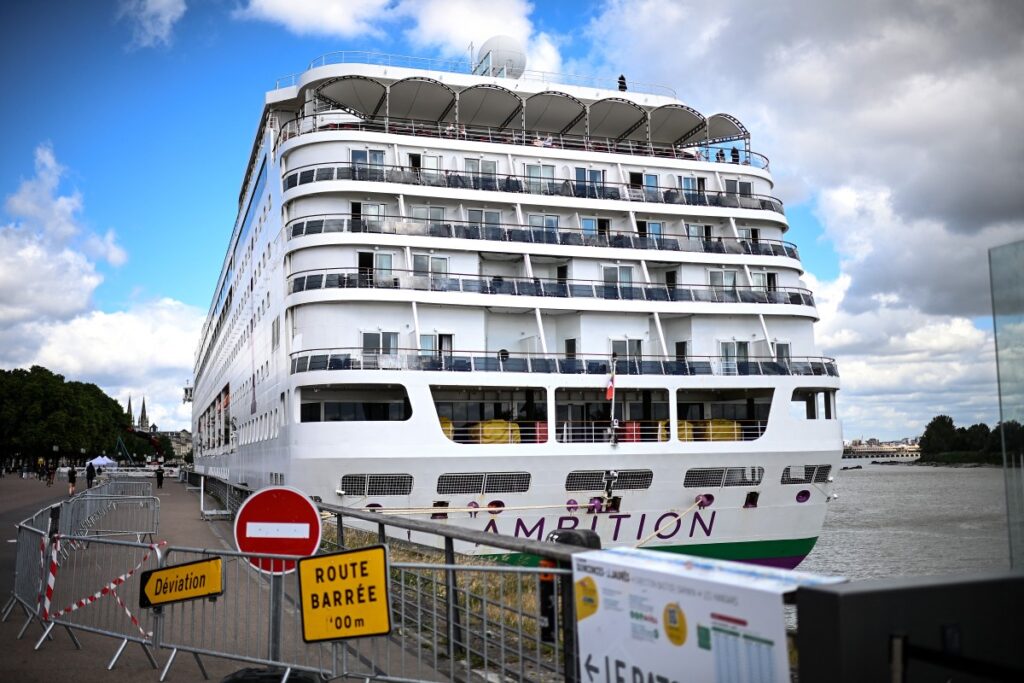
    In the southwestern French port of Bordeaux, local authorities have ordered more than 1,700 people including passengers and crew to remain on board a British cruise ship Wednesday, following the death of an elderly passenger and a reported outbreak of gastrointestinal illness, regional health officials confirmed. Despite early concerns that the incident could be connected to a separate hantavirus outbreak linked to another cruise vessel, officials have moved quickly to dismiss that connection.

    The vessel in question is the Ambition, operated by UK-based Ambassador Cruise Line, which docked in Bordeaux Tuesday morning. Of the ship’s 1,233 passengers, the vast majority hold British or Irish citizenship, while the 514-person crew is made up almost entirely of Indian nationals. Dozens of people on board have reported symptoms of stomach illness, with officials updating that figure to roughly 50 symptomatic people as of Wednesday.

    The 90-year-old passenger who passed away had died before the ship docked in Brest, a port in France’s northwestern Brittany region, where symptoms reached their peak among passengers and crew on Monday. The Ambition began its current voyage on May 6, departing from the Shetland Islands off the northern coast of Scotland, and made stops in Belfast, Northern Ireland and Liverpool, England before reaching its scheduled stop in Bordeaux, where it was meant to depart for Spain next.

    Health officials clarified that the outbreak has no connection to the recent hantavirus outbreak on the Dutch cruise ship MV Hondius, which departed from Argentina and has been linked to three passenger deaths. Initial laboratory testing has already ruled out norovirus – a highly contagious strain of viral gastroenteritis that causes severe vomiting and diarrhea – as the cause of the illness. Secondary testing is still ongoing, and officials have confirmed that food poisoning remains a plausible cause that has not been eliminated from the investigation.

    An AFP reporter on the ground in Bordeaux Wednesday reported no visible enhanced security measures around the docked vessel. Passengers were observed moving freely on deck, with many capturing photos of the city’s waterfront skyline, with no signs of immediate public safety cordons in place around the port.

  • Vin Diesel drives ‘Fast and Furious’ tribute in Cannes

    Vin Diesel drives ‘Fast and Furious’ tribute in Cannes

    CANNES, France — The Croisette is getting a rare injection of Hollywood star power this week, as the core cast of *The Fast and the Furious* gather at the Cannes Film Festival to celebrate the iconic franchise’s silver anniversary. Lead actors Vin Diesel and Michelle Rodriguez are headlining the long-awaited cast reunion, set to precede a special midnight screening of the 2001 original street-racing thriller on Wednesday.

    Joining the two leads at the festival were co-star Jordana Brewster and Meadow Walker, the daughter of the franchise’s late beloved actor Paul Walker, who tragically lost his life in a 2013 car accident. The group stepped out together for photos early Wednesday, drawing crowds of fans and press to the French Riviera venue that is traditionally known for art house and independent cinema.

    This year’s Cannes iteration stands out for a striking absence: all of the major U.S. film studios and top global streaming platforms have opted not to premiere any new blockbusters at the event, a break from longstanding industry tradition. Industry giants including Universal Pictures (the current owner of the *Fast & Furious* franchise), The Walt Disney Company, and Sony Pictures, alongside streaming leaders Netflix and Amazon, all sat out this year’s festival lineup for major new releases.

    Three core factors have driven the major players’ decision to skip Cannes this cycle. First, ongoing industry-wide cost-cutting initiatives across Hollywood have pushed studios to scale back on the extravagant, big-budget premieres that the festival demands. Second, studios have increasingly shifted their launch strategy toward controlled, social media-focused rollouts that give them more direct control over messaging, rather than the traditional festival publicity model. Finally, many studios remain wary of the risk that harsh critical reception from Cannes’ notoriously tough reviewers can tank a blockbuster’s box office performance before it even hits wide release.

    What began as a small-scale action film about underground street racing 25 years ago has grown into one of the most successful media franchises in global cinema history. Industry data shows that the entire *Fast & Furious* film series has already grossed more than $7 billion worldwide across its 10 released installments, with an 11th theatrical entry currently in development. Just this week, Diesel made a major announcement about the franchise’s future: the property will soon expand beyond the big screen, with Universal developing a *Fast & Furious* television series to bring the franchise’s high-octane storytelling to the small screen.

  • U.S. approves deportation of Haitian national Dimitri Vorbe to the Dominican Republic

    U.S. approves deportation of Haitian national Dimitri Vorbe to the Dominican Republic

    In Miami, federal U.S. authorities have given formal approval for the deportation of Haitian citizen Dimitri Albert Edouard Vorbe to the neighboring Dominican Republic, following his arrest by U.S. Immigration and Customs Enforcement (ICE) agents earlier this year. The detainment centers on claims that Vorbe represents a potential threat to the United States’ foreign policy objectives, a charge that has put the case under intense public and legal scrutiny.

    This proceeding comes at a pivotal moment: the U.S. and the Dominican Republic recently signed a new bilateral migration accord that permits the temporary cross-border transfer of third-country nationals between the two nations. However, Dominican government officials have publicly reiterated that Haitian citizens are explicitly excluded from the terms of this agreement, creating a layer of legal and diplomatic uncertainty around the planned deportation.

    Court documents from the federal judicial system lay out Vorbe’s legal response to his detainment. In early 2025, he filed a habeas corpus petition challenging the legality of his detention, arguing that ICE violated his fundamental due process rights under U.S. law. At the time of his arrest, Vorbe was in the process of seeking lawful permanent resident status via a family-based immigration petition filed on his behalf by his son, who is a natural-born U.S. citizen. He also held active Temporary Protected Status (TPS), a federal designation that provides temporary legal protection from deportation for Haitian nationals who meet eligibility criteria, a status he had maintained for years prior to his arrest.

    ICE officers took Vorbe into custody at his private residence in Miami in September 2025, and he has since been held at the Krome Processing Center, South Florida’s largest and busiest immigration detention facility, as he navigated his legal challenge.

    Legal analysts and immigration policy advocates note that this deportation decision opens a new chapter in ongoing national and regional debates over U.S. immigration strategy, as well as collaborative migration management efforts across the Caribbean. The case brings into sharp relief the tensions between bilateral security agreements, immigration enforcement, and the legal rights of migrants seeking protected status in the United States, and it is expected to inform future negotiations between the U.S., the Dominican Republic, and other Caribbean nations on migration policy.

  • Dominicans advised to stay hydrated as heat and rain persist

    Dominicans advised to stay hydrated as heat and rain persist

    Residents across the Dominican Republic are bracing for another day of mixed weather conditions this Wednesday, as a low-pressure trough combined with moisture carried by southeasterly winds continues to dominate the country’s climate patterns. The system is projected to trigger scattered rain showers across multiple provinces, paired with isolated thunderstorms that have the potential to bring sudden strong wind gusts to affected areas.

    Early morning precipitation will be concentrated primarily along the country’s southern Caribbean coastline and across its northeastern regions, according to meteorological projections. As the day progresses into the afternoon hours and early evening, rainfall intensity is expected to ramp up significantly. The hardest-hit regions during this period will likely be the agriculturally important Cibao region, the rugged Central Mountain Range that splits the country, and scattered sections of the Dominican northwest.

    Despite the incoming storm activity, temperatures across the nation will stay unseasonably hot through the day. Forecasters predict maximum temperatures will hover between 31 degrees Celsius (88 degrees Fahrenheit) and 35 degrees Celsius (95 degrees Fahrenheit), creating humid, sweltering conditions for much of the population. In response to the combined risks of heat and scattered storms, local public safety officials have issued public guidance to help residents stay safe: they recommend maintaining consistent hydration to avoid heat-related illness, opting for loose, lightweight clothing to stay cool, and cutting back on extended periods of direct sun exposure during the hottest peak hours of the day.

  • Luis Abinader arrives in Panama to promote investment at World Free Zones Congress

    Luis Abinader arrives in Panama to promote investment at World Free Zones Congress

    The Dominican Republic’s head of state, President Luis Abinader, has touched down in Panama to take part in the high-profile World Free Zones Congress, a key global gathering focused on advancing cross-border economic collaboration and special trade zone development. As a featured guest of the event, Abinader is set to deliver the opening ceremony’s keynote address, where he will lay out the Dominican Republic’s strategic vision for attracting international capital and highlight untapped opportunities for global businesses.

    Central to his trip is a packed schedule of targeted strategic meetings designed to draw new foreign investment into the Dominican Republic, with a specific focus on three high-growth sectors: logistics, advanced manufacturing, and the development of specialized free trade zones.

    Beyond the congress agenda, Abinader has planned formal bilateral talks with his Panamanian counterpart, President José Raúl Mulino, as well as a meeting with Mohammed Al Zarooni, president of the World Free Zones Organization. Discussions between the two national leaders will center on identifying new avenues to deepen bilateral cooperation and expand the scope of economic and trade relations between the Dominican Republic and Panama.

    Abinader’s engagement also includes separate sessions with senior industry leaders and government officials: he will meet with top executives from global logistics firm DP World, Panama’s Minister of Industry and Commerce Julio Moltó, and Martín Pedersen, president of the International Free Zones Authority. A key milestone expected during the visit is the signing of a memorandum of understanding between the Dominican delegation and the World Free Zones Organization, a pact that will formalize cooperation frameworks and facilitate the exchange of industry best practices for sustainable free zone development.

    Accompanying President Abinader on the official visit are three senior Dominican officials: Minister Eduardo Sanz Lovatón, Biviana Riveiro, and Dominican Ambassador Roberto Salcedo, who will support the delegation’s engagement across all scheduled events and initiatives.

  • Voters face missing names despite short election lines

    Voters face missing names despite short election lines

    On general election day across the country, voting operations in most electoral districts unfolded far more smoothly than pre-election forecasts had warned, though persistent issues with voter roll inaccuracies have validated longstanding opposition concerns about the integrity of the electoral registry ahead of the vote. A field survey conducted by The Tribune across polling stations nationwide found that most voters waited less than an hour to cast their ballots, with many completing the process in just a handful of minutes.

    The majority of polling locations opened on schedule, voting lines moved at a consistent pace, and numerous voters commended the overall administrative organization of the election. That said, scattered issues including mismatches in the voter register, insufficient ballot supplies, unexpected delays, and accessibility challenges were reported throughout voting day.

    The most common grievance centered on voters whose names were missing from their local voting register, voters incorrectly assigned to constituencies they did not reside in, and approved voter transfers that were never updated in the official registry.

    At Yellow Elder Primary School, a polling location serving the St Barnabas constituency, Michael Halkitis, candidate for the Progressive Liberal Party (PLP), noted that multiple voters who had applied for transfers found their changes had never been finalized. “Some of them just voted in the constituency where they appeared because the transfer was not finalised, so you had some of them, but by and large, a very smooth process,” Halkitis told The Tribune. He added that voter turnout was consistent through the morning, with the earlier advanced polling likely reducing election day turnout numbers. When asked why affected voters rarely opted to file protest ballots, he explained that most avoid the option out of a belief that protest ballots are never officially counted.

    Parallel issues emerged in the Golden Isles constituency, where Free National Movement (FNM) candidate Brian Brown documented cases of voters who held valid voter ID cards but could not find their names on the register at the Anatol Rodgers High School polling station. Brown confirmed that several of these impacted voters were ultimately forced to cast protest ballots.

    Complaints about the flawed voter register also spread rapidly across social media platforms. Local voter Shadai Toote shared a live video detailing her experience: she had submitted a transfer request from St Barnabas to Fort Charlotte back in March, but was ultimately incorrectly assigned to Bains and Grants Town — a constituency where she has never lived. “It’s like appalling to me,” Toote said. “I can’t begin to fathom that we’ve had four plus years to get prepared for something like this, and they still dropped the ball, so I’m being advised that I can’t vote in the constituency I’m in because I’m not on any of their registries.”

    Similar reports came from Abaco, where multiple voters opted to forgo voting entirely after discovering they had been assigned to the wrong constituency. Jobeth Coleby-Davis, PLP candidate for the Elizabeth constituency, confirmed her campaign team had received multiple complaints about incorrect constituency assignments. “They’ve been noticing it. And I think when those incidents come up, they speak with the returning officer, the presiding officer, to see how they would allow it to move ahead,” she said.

    Heather Hunt, FNM candidate for Elizabeth, shared one voter’s experience: the voter’s card correctly listed Elizabeth as their constituency, but their name appeared on the register for a different district. “They were sent to another constituency because that’s where the name appears on the register, and they had already tow the line and everything for almost half an hour,” Hunt said. “So that frustration we’re hearing, but you know, that person just is determined to, you know, exercise their right to vote, and so they just decided that they’re going to take that drive and go to the other constituency where their name is.”

    One of the most significant disruptions arose in Long Island, where FNM candidate Andre Rollins reported that Polling Division Nine, the island’s largest voting district, received 60 fewer ballots than the number of registered voters assigned to the location. “The fact that it’s the largest polling division means that it is curious that the Parliamentary Registration Department would send much fewer number of ballots than the number of people who are on the register,” Rollins said. “We have 360 plus persons on the register here on polling division number nine. However, they included only 300 white paper ballots in polling division nine ballot box when they send it from New Providence here to Long Island.”

    Rollins noted that legal guidance provided to the FNM suggested the polling station should not have opened at all, as the shortage put eligible voters at risk of being disenfranchised. The issue was ultimately resolved by reallocating surplus ballots from three smaller nearby polling divisions — 25 extra ballots were pulled from each of Divisions Three, Four and Eight, bringing Division Nine’s total ballot count up to 375.

    Ballot shortages were also reported on New Providence. In Fort Charlotte’s Polling Division One, voting was delayed for nearly 45 minutes after the station exhausted its initial ballot supply and had to wait for additional stock to be delivered.

    Not all voting experiences were marred by issues, however. At Jordan Prince-Williams Baptist School, Bamboo Town resident Darren Sinclaire described his voting experience as efficient and well-organized, noting that he and his elderly mother completed the entire process in roughly eight minutes. When asked if he felt anxious after hearing widespread warnings about voter register errors ahead of election day, Sinclaire said: “Yeah, I was, because I heard a lot of errors on the register and stuff like that, so I wondered if there would be any error on our parts, but everything went pretty smooth.”

    In Fort Charlotte, voter Nadia Benaby arrived at the CC Sweeting Senior High School polling station at 8:45 a.m. and finished voting by 9:15 a.m. She called the experience the smoothest voting process she had participated in across six general elections. At the same polling location, though, FNM candidate Travis Robinson highlighted concerns including late delivery of ballots.

    Voters across multiple other constituencies, including Freetown, Centerville, Garden Hills and Carmichael, reported average wait times of 20 minutes or less, reflecting that the majority of voting operations ran according to plan.

  • COI plays major election spoiler as Bain falls short in Pinewood

    COI plays major election spoiler as Bain falls short in Pinewood

    In yesterday’s Bahamian general election, the upstart Coalition of Independents (COI) left a lasting mark on the country’s political landscape even though it failed to secure a single parliamentary seat. The minor third party proved it can no longer be ignored by the nation’s two dominant political forces — the ruling Progressive Liberal Party (PLP) and opposition Free National Movement (FNM) — after siphoning off thousands of protest votes that would likely have bolstered the FNM’s bid to unseat incumbents, most notably across the key island of New Providence.

    COI’s strongest showing of the cycle came in the Pinewood constituency, where party leader Lincoln Bain came astonishingly close to ousting sitting PLP representative Myles Laroda. Early vote projections that placed Bain in the lead sent social media platforms into a frenzy, as observers watched a minor party candidate mount a historic challenge to a major party incumbent. When all ballots were finally counted, Laroda retained his seat by a narrow margin of 314 votes, earning 1,446 ballots to Bain’s 1,132. FNM candidate Denarii Rolle finished a distant third behind Bain — marking the first time in history that a COI candidate outpolled a major party nominee in a constituency race.

    For Bain personally, the 2024 result represents a dramatic improvement over his 2021 general election performance in Pinewood, where he earned just 579 votes, or roughly 17% of the total vote share. The party’s growing traction was visible across other constituencies as well. In Englerston, COI candidate Faith Percentie also outperformed FNM nominee Heather McDonald, even as long-serving PLP incumbent Glenys Hanna-Martin held onto the seat for a sixth consecutive term. Across multiple races, COI candidates crossed the 10% vote threshold required to retain their candidate deposits — a key metric that proves the party built a tangible, sustained base of support rather than just appearing on the ballot. That bloc is overwhelmingly made up of Bahamian voters who hold deep frustration with the country’s two established major parties.

    Long before polls opened, FNM Leader and Opposition Leader Michael Pintard warned that COI and independent candidates would split the anti-incumbent opposition vote, handing an advantage to the ruling PLP. After conceding his party’s poor election showing, Pintard reaffirmed that assessment, noting “a vote for the COI or a vote for an independent, it’s a vote for the PLP. So, we understand that clearly.”

    COI’s rapid rise in Bahamian politics has been fueled by a hardline platform focused on immigration reform and widespread public distrust of the traditional political establishment. Over the past five years, the party has consistently captured more public attention and momentum than the official opposition FNM, a shift that upended the country’s traditional two-party dynamic.

    Following the release of final election results, Bain pushed back against former Prime Minister Hubert Ingraham’s longstanding claim that election results in The Bahamas cannot be stolen. Bain alleged that Laroda’s final vote total “jumped” unexpectedly during the vote tabulation process, contradicting earlier on-the-ground trends that pointed to a Bain victory in Pinewood. He specifically raised questions about the handling of advanced poll ballots, claiming election officials failed to maintain proper chain of accountability while counting votes.

    Despite challenging the legitimacy of the Pinewood outcome, Bain urged his supporters to remain optimistic, framing political change as a long-term project that requires sustained organizing and sacrifice. “Nothing worth having is easy,” he told supporters. “The fight has just begun.” He called on COI backers to deepen their involvement in future electoral cycles, urging them to serve as poll observers and participate in recounts to strengthen the party’s electoral oversight. “You cannot go to war without enough soldiers,” he said. “We shouldn’t have one poll that doesn’t have three people watching.”

    Bain framed his current dispute over electoral procedures as part of a broader, generations-long push for electoral reform in The Bahamas, drawing parallels to past landmark changes won by the two major parties. “The PLP didn’t win until they lobbied for one man, one vote,” he noted. “The FNM had to get the purple finger system going on to stop people from voting several times.” He argued that the current flaws in the country’s electoral process demand the same level of organizing and advocacy to address.

  • Pintard non-committal on leadership after FNM loss

    Pintard non-committal on leadership after FNM loss

    The Bahamas’ general election delivered a devastating blow to the Free National Movement (FNM) on polling day, leaving the long-established political party grappling with significant internal upheaval and growing calls for party leader Michael Pintard to step down from his post.

    In the final seat count, the FNM secured only eight parliamentary seats. While the party managed to flip the Freetown and MICAL constituencies from the ruling Progressive Liberal Party (PLP), it suffered high-profile losses that amplified the scale of its defeat. Notably, the FNM lost the St Barnabas seat; deputy party leader Shanendon Cartwright failed to win re-election in his St James constituency, and party chairman Dr. Duane Sands was defeated in his Bamboo Town race.

    Pintard, who successfully retained his own Marco City seat, offered no clear confirmation that he would stay on as party leader when questioned about his political future shortly after the results were finalized. He stated that he would first hold internal consultations with the party’s senior team in the coming days before any announcement is made.

    “I believe in party conventions,” Pintard told reporters. “I have always respected that process. Over my four and a half years as leader, we have held three conventions, two of which included leadership contests. I am fully committed to following the party’s constitutional process. First and foremost, though, I am committed to talking through our next steps with the party team, and in the next few days we will reach a decision and share it publicly.”

    Pintard’s ambiguous remarks set the stage for what could become a competitive open leadership contest as the FNM begins the slow work of rebuilding after a second consecutive election failure where its policy platform failed to connect with Bahamian voters. The FNM’s winning candidates include J. Leo Ferguson in MICAL, Lincoln Deal in Freetown, Frazette Gibson in Central Grand Bahama, Kwasi Thompson in East Grand Bahama, Dr. Andre Rollins in Long Island, Adrian White in St Anne’s, and Michela Barnett-Ellis in Killarney, alongside Pintard in Marco City.

    Shortly after the results became clear, Pintard called incumbent Prime Minister Philip Davis to congratulate him and the PLP on their election victory, formally conceding defeat. In his public concession address, Pintard paid tribute to the defeated Cartwright, calling him a close friend and brother in the party and praising his years of service to the FNM and Bahamian public.

    The FNM leader emphasized that the Bahamian people had exercised their democratic right to choose their government, and the party fully accepted the outcome of the vote. “The people of the Bahamas have spoken, and we accept their decision,” he said. “That is how democracy works. We put forward our platform, we ask voters for their trust, we count every ballot, and we honor the final result. That has always been the Bahamian way, and tonight we honor that tradition once again.”

    He thanked voters who cast their ballots for FNM candidates, noting that the party had grown its caucus size in Parliament compared to the previous term, adding that official final results would be confirmed the following day. Pintard framed the election loss as a temporary setback, not a rejection of the core values the FNM campaigned on.

    “You believe in a different kind of government,” he said, addressing supporters. “You believed in honest, accountable government that acts fairly in all its dealings, fairly in awarding government contracts. You believed in a Bahamas that works for every one of our people. That belief did not lose tonight. That belief endures, and it will outlast every election that comes.”

    Throughout the campaign, the FNM positioned itself as the standard-bearer for clean, transparent governance, but the 2024 defeat leaves the party grappling with urgent questions about its electoral strategy, leadership direction, and ability to build broad voter support following its 2021 general election loss. Even constituencies political observers had tipped as potential PLP losses, including seats in Abaco, were retained by the incumbent government. The Abaco race drew controversy before voting day, after revelations emerged that the PLP government had distributed more than $200,000 in gift cards funded by the Ministry of Finance to residents under the names of PLP candidates and officials, framed as Hurricane Dorian disaster relief – a move the opposition decried as blatant vote-buying.

    In his address to supporters, Pintard urged all FNM backers not to lose heart, speaking directly to young party members, long-time loyalists, and unsuccessful candidates. He invoked the legacy of former FNM Prime Minister Hubert Ingraham, reminding the crowd that the party’s founding mission to advance government accountability and transparency did not end with Ingraham’s retirement, nor would it end with this election defeat. He confirmed that the FNM would now step into its constitutional role as His Majesty’s Loyal Opposition, where it would hold the new PLP government accountable and carefully scrutinize its legislative and policy agenda.

    When asked whether the Coalition of Independents (COI) and unaffiliated independent candidates split the opposition vote and aided the PLP’s victory, Pintard confirmed that his pre-election warning had been borne out. “It was clear that not just the COI, but independents as well, helped the PLP,” he said. “We made this point repeatedly during the campaign: a vote for COI or a vote for an independent is a vote that ultimately helps the PLP. We see that very clearly now.”

    That comment signals a likely line of internal debate that will emerge as FNM officials conduct their post-election review, with some expected to argue that third-party candidates contributed to the party’s poor performance.

    Pintard closed his remarks by thanking the FNM’s extensive network of campaign workers, volunteers, financial donors, national headquarters staff, all candidates, and their families for their dedication and sacrifice throughout the election cycle. “To my wife and daughter, I want to say a special thank you, but the truth is, every one of our candidates has spouses and loved ones who stood with them,” he said. “To all of you who have stood beside and behind these candidates and workers, we extend a special thank you for the sacrifices you made, the price you paid right alongside them.”

    He also offered a final note of gratitude to the voters of Marco City, who re-elected him to Parliament. “To the people of Marco City who have honored me with the privilege of representing you again, I want to say thank you,” he said. “I will continue to serve you with everything that I have. To every one of you in this room tonight, I recognize every day that I stand on your shoulders, that you have given me the rarest of opportunities to serve our community, and I will do so vigilantly.”

  • Landslide for Brave

    Landslide for Brave

    The Bahamas has witnessed a seismic shift in its long-running political cycle, after Prime Minister Philip “Brave” Davis led the Progressive Liberal Party (PLP) to an unprecedented second consecutive general election victory — a feat not achieved by any ruling party in nearly three decades.

    The outcome of the contest was nothing short of a landslide. Unofficial vote tallies confirmed the PLP secured 32 out of the 41 contested parliamentary seats, a result that nearly mirrored the party’s overwhelming 2021 win. In that election, the PLP took 32 of 39 seats and ousted the Free National Movement (FNM) from power after a single term in office. This year’s resounding win stands as a clear public endorsement of Davis’ first-term administration, and a decisive rejection of the FNM, which failed to convince Bahamian voters that it deserved to reclaim power after just one term as the parliamentary opposition.

    The PLP’s dominance was most pronounced on New Providence, the country’s most populous island, where the party held all but two constituencies: Freetown and Killarney. Before Davis’ historic win, the last party leader to secure back-to-back election victories was former Prime Minister Hubert Ingraham, who led his party to wins in both 1992 and 1997.

    Despite the historic victory, the result comes alongside a notable observation: voter turnout hit an all-time low for general elections in the Bahamas, opening up public debate over whether the PLP’s overwhelming seat share stems from broad popular support, inherent weaknesses in the opposition FNM, widespread voter apathy, or a combination of all three factors. Davis himself acknowledged the lower-than-expected turnout, noting that low participation is never healthy for a democratic society, and emphasized the need for future action to ensure all eligible voters feel their ballot makes a meaningful difference.

    Even with low turnout, the voters who cast ballots delivered an unambiguous result. The PLP ran a short but fiercely aggressive campaign centered on its first-term record, which the party framed around post-pandemic economic recovery, restored international confidence in the Bahamian economy, increased foreign direct investment, expanded economic opportunity for citizens, and a platform of unfinished work that required a second mandate to complete. Throughout the campaign, Davis and PLP candidates repeatedly urged voters to return the party to office to see their agenda through.

    In his victory address to supporters, Davis framed the win as more than just a political victory for his party. “Tonight is a political victory, but this is truly a victory for the whole country,” he said. “For the first time in almost a generation, we have a historic opportunity. Let us make the most of it.” He added, “I will begin our second term as I began the first with a humble spirit and with a heart full of gratitude. Thank you for your trust and faith in me. I will not let you down.”

    Even before unofficial results were finalized, Davis had privately expressed confidence that the PLP would secure its historic consecutive win. PLP insiders noted that reports from on-the-ground poll workers indicated strong enthusiasm among voters who turned out, even as overall participation lagged. As early results began to come in, supporters gathered at PLP headquarters broke into cheers, particularly when early counts showed the party leading in key battleground constituencies including Pinewood and Tall Pines.

    As the night went on, the full scale of the PLP’s victory became clear. Incumbent PLP representatives celebrated at their constituency offices, thousands of supporters flooded Nassau’s Clifford Park, and celebratory motorcades crossed New Providence. Despite intermittent rain, crowds danced in the streets and honked car horns in celebration across the island.

    Davis used his victory speech to reach out to opposition supporters, calling for national unity and emphasizing that he would serve all Bahamians regardless of their vote. “To the Bahamians who voted today but did not vote for us, I want you to know I’ve listened to you. I’ve heard you. I want you to know that I will continue to work hard for all Bahamians,” he said. He pledged to deliver on every campaign promise with unwavering commitment, saying, “I will deliver the party’s promises with every bone in my body and every beat in my heart.”

    Davis emphasized that the election result sent an unambiguous message about the direction Bahamian voters want for their country. “You voted because you believe that together we can make some of the big changes that would fulfil our missions we share for our Bahamas,” he said. “We all want a country that has more opportunities, a country where safety and prosperity belong to all Bahamians. You want a country in which all of you and your children and grandchildren will thrive.”

    The PLP’s renewed mandate comes as the Bahamas continues to grapple with pressing domestic challenges, including a high cost of living, strained public healthcare systems, and persistent inflation. Davis first took office in 2021 amid similarly severe economic headwinds, including mounting national debt, stagnant growth caused by the COVID-19 pandemic, and ongoing recovery efforts from the devastating Hurricane Dorian that struck the country in 2019. For his second term, Davis has campaigned on a broad policy agenda that includes expanded worker protections, stricter immigration enforcement, a new migrant health insurance scheme, integration of artificial intelligence into public services, expanded vocational training opportunities for workers, expanded housing support, and a range of other social and economic programs.

  • Storms spark parametric push

    Storms spark parametric push

    For years, parametric insurance flew under the radar of most Jamaican businesses and insurance brokers. But a string of destructive back-to-back hurricanes in 2024 and 2025 have shifted market attitudes, pushing local brokerage firm Fraser Fontaine & Kong Ltd (FFK) to aggressively expand access to this alternative weather risk coverage, company leaders announced at the recent Jamaica Observer Business Forum.

    FFK’s president and chairman Gerard Fontaine noted that the firm has researched parametric insurance models for more than a decade, moving forward with a tailored local offering only after addressing widespread past dissatisfaction with early iterations of the product. After years of studying successful international implementations and collaborating with risk modeling specialists, the company has designed a version of parametric coverage adapted to the unique needs of Jamaican businesses.

    The urgent push for broader adoption comes in the wake of Hurricanes Beryl in 2024 and Melissa in 2025, which laid bare critical gaps in traditional property insurance that left many local businesses grappling with extended financial strain. Executive Director Martine Fontaine explained that the core difference between the two coverage models lies in how claim payouts are triggered. For traditional insurance, payouts are only issued after lengthy on-site physical damage assessments, adjuster investigations, and forensic reviews. In contrast, parametric insurance pays out as soon as a pre-agreed weather threshold — such as hurricane wind speed or earthquake magnitude — is met, eliminating the need for time-consuming damage inspections.

    Martine shared a firsthand example from Hurricane Melissa, where the trigger condition was satisfied at 8:00 a.m. By 3:00 p.m. the same day, FFK had issued payout declarations to eligible clients, and funds were already wired to clients’ bank accounts by the following Monday. This rapid disbursement addresses one of the most common pain points of traditional insurance, where businesses often wait weeks or even months for payout while already facing post-disaster financial pressure.

    Another critical gap parametric coverage fills is “loss of market” scenarios that are rarely covered by traditional policies. For example, Jamaican hotels frequently lose millions in revenue from booking cancellations and plummeting visitor arrivals after major storms, even if their properties sustain little to no direct physical damage. Because traditional insurance requires proof of physical damage to process a claim, these indirect revenue losses are almost never recoverable. Parametric insurance also covers costs that conventional policies often exclude, including hurricane preparation expenses, forced operational shutdowns, and post-storm business interruptions. Beyond speed and expanded coverage, the simplified claims process is another major advantage: after a trigger event, clients only need to submit a one-page declaration confirming they have experienced financial loss, rather than navigating a complex maze of adjusters, deductibles, and underinsurance disputes that often leave clients feeling the traditional system is designed to deny claims.

    FFK’s custom parametric programs can be tailored to a wide range of local stakeholders, including smallholder farmers, large hotel operators, and any other property owner facing weather-related financial risk. Coverage can extend to tangible recovery costs such as re-landscaping, roof repairs, equipment replacement, and business restart expenses. Company leaders emphasized that almost any asset or revenue stream at risk of weather-related loss can be covered by a customized parametric plan.

    Despite these benefits, FFK executives caution that parametric insurance is not intended to replace traditional property coverage. Payout caps for parametric policies mean they may not fully cover extreme losses from major catastrophic events, so businesses should integrate parametric coverage into a broader, diversified risk management strategy. While consumer inquiries and coverage discussions have risen sharply since the 2024 hurricane season, the product still remains relatively unknown to most businesses in Jamaica’s local market.