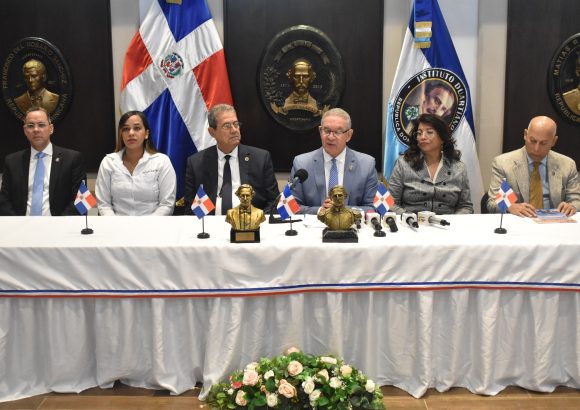
Santo Domingo, Dominican Republic – During a high-level internal leadership gathering at the Duartian Institute, president Wilson Gómez Ramírez laid out stark, evidence-based assessments of Haiti’s unrelenting security and humanitarian collapse, framing the neighboring nation’s spiraling chaos as a persistent, multi-faceted threat to Dominican territorial stability that is imposing unsustainable fiscal strain on state resources.
Gómez Ramírez opened the institute’s situation review by detailing how armed criminal gangs now exercise de facto control over vast swathes of Haitian national territory, with demonstrated advanced operational and technical capabilities that far outpace the capacity of under-resourced local security forces to push back. He went on to condemn the broader global community’s response to the years-long crisis as deeply inadequate relative to its scale, noting there are no tangible, near-term indicators that the cycle of extreme violence will abate or that functional state stability will be restored without coordinated, high-level external intervention.
While acknowledging the limited, on-the-ground contributions of small deployed contingents including Salvadoran military units – some of which are currently engaged in search operations for four missing Salvadoran service members – Gómez Ramírez emphasized that lasting resolution of Haiti’s overlapping security, humanitarian and institutional collapse is impossible without deliberate, scaled engagement from key global and regional stakeholders: the United Nations, Organization of American States, United States, France and Canada. He stressed that any sustainable peace framework must pair immediate security interventions with long-term structural institutional rebuilding, prioritizing the creation of a robust national civil registry, universal access to verified official identification for all Haitian citizens, and a credible, independently administered electoral roll that can restore public trust in state institutions and confer legitimate democratic mandate to governing bodies.
Turning to direct impacts on the Dominican Republic, Gómez Ramírez warned that the Dominican state will be forced to maintain its costly, large-scale deployment of military personnel, heavy equipment and logistical transport along the shared border for the full duration of Haiti’s unresolved crisis. These ongoing unbudgeted operational costs are already placing unprecedented pressure on the national public purse, he noted, with no clear policy or diplomatic roadmap for a solution visible in either the short or medium term.
Against this backdrop, the Duartian Institute formally issued a sweeping set of targeted policy recommendations to Dominican national authorities to mitigate spillover risks. First, it called on the General Directorate of Migration to ramp up deportation operations for all Haitian nationals and other foreign nationals residing in the country without valid legal documentation, framing their unregulated presence as a direct violation of Dominican national immigration law. The institute also urged the Public Prosecutor’s Office to pursue aggressive enforcement action against cross-border networks engaged in human smuggling, illicit goods trafficking and controlled substance smuggling, demanding full seizure of all vehicles used in these illegal operations and calling on the national judiciary to hand down maximum, deterrent-level sentences for individuals convicted of these offenses, which it labeled a core national security threat.
Rejecting widespread calls for a temporary Christmas truce that would pause or scale back border security and migration enforcement operations during the holiday season, the institute insisted that existing border controls must not only be maintained but intensified to avoid eroding months of hard-won progress against illicit cross-border activity. Additional operational recommendations included expanding and upgrading biometric screening infrastructure at all border crossing points, rolling out stricter identity verification protocols at all national hospitals, and launching targeted oversight audits of undocumented labor in high-risk sectors including commercial retail, construction and commercial agriculture. The institute called on the Ministry of Labor to formalize a permanent cross-agency coordination framework with migration authorities to sustain this ongoing workplace monitoring.
To support these expanded enforcement mandates, the Duartian Institute pushed for increased allocated funding for both the Ministry of Defense and the General Directorate of Migration to fully cover their border security operational costs, and urged President Luis Abinader to mobilize the full scope of state intelligence capabilities to identify, disrupt and dismantle transnational corruption networks that profit from undocumented migrant smuggling, illicit goods flows and narcotics trafficking across the shared border. The institute also proposed drafting new legislation aligned with Article 10 of the Dominican Constitution that would reserve priority property ownership rights exclusively for Dominican citizens in high-sensitivity, strategically designated zones along the border. Finally, the organization demanded that national authorities immediately release all public findings from the ongoing investigation into Dominican-origin military equipment that was documented in a recent UN Group of Experts report as having been recovered in Haiti, with full disclosure of all parties deemed responsible for facilitating the unauthorized transfer of the material across the border.
Duartian Institute warns Haiti crisis keeps Dominican Republic at high threat level