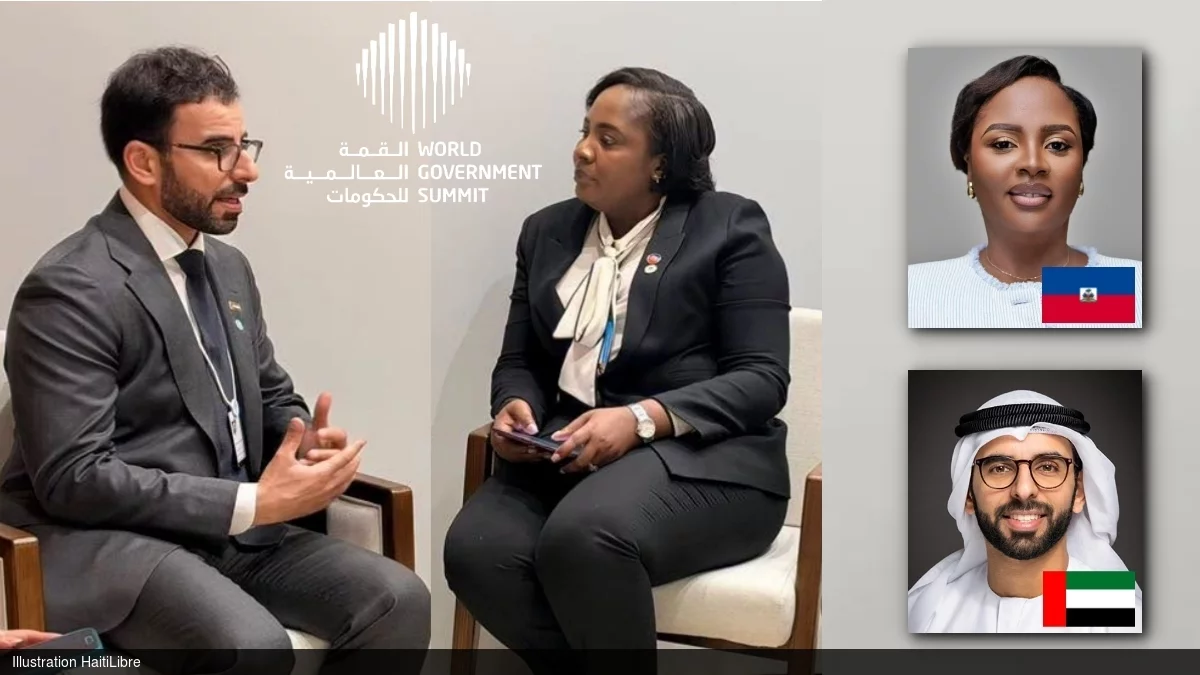
On November 21, 2026, on the margins of the 2026 World Governments Summit – Latin America and the Caribbean (WGS-LAC) Dialogue, Haiti’s Minister of Planning and External Cooperation Sandra Paulemon convened a high-stakes bilateral discussion with Mohamed AlSharhan, Director General of the UAE-based World Governments Summit organization, which operates under the auspices of the UAE Prime Minister’s Office.
Opening the dialogue, Paulemon extended formal gratitude to the UAE for its years of sustained collaborative support for Haiti, before making a clear call to move past symbolic memoranda of understanding and non-binding statements of intent. She laid out a framework for future cooperation centered exclusively on rigorously vetted, structural projects that meet three core criteria: technical workability, long-term financial sustainability, and full oversight via transparent, publicly accountable governance and monitoring systems to eliminate waste and ensure deliverables reach vulnerable Haitian communities.
The Haitian minister mapped out six high-priority sectors for targeted UAE investment and partnership: scaled deployment of solar power paired with grid-compatible energy storage to address the country’s chronic electricity shortages, construction of climate-resilient public infrastructure that can withstand frequent tropical storms and seismic activity, universal expansion of safe drinking water and community sanitation networks, optimization of fragmented domestic and regional supply chains to reduce food and essential goods costs, mass rollout of affordable modular housing to address the national housing deficit, and digital transformation of public administration to cut bureaucratic red tape and improve government service delivery.
Paulemon also walked AlSharhan through the core architecture of Haiti’s upcoming 2026–2030 National Program for Stabilization and Economic, Social, and Territorial Recovery (PNSREST), a landmark national strategy her ministry is finalizing with technical advisory support from the United Nations country team in Haiti. Built on eight interconnected pillars, the PNSREST breaks traditional silos by merging immediate humanitarian response, long-term peacebuilding interventions, and inclusive economic development planning into a single integrated roadmap. The two sides explored structured resource mobilization pathways for the multi-billion-dollar program, with Paulemon formally inviting the UAE to consider direct targeted financial contributions to PNSREST implementation.
The conversation also covered expanded Haitian engagement with the broader World Governments Summit global platform, with Pauleman noting that Haiti’s line sector ministries are eager to take part in the summit’s working groups, global knowledge exchanges, and cross-country partnership matching initiatives to access global best practices.
Paulemon additionally underscored the Haitian government’s deep appreciation for the UAE’s recent $10 million emergency humanitarian aid disbursement, a solidarity gesture that has delivered critical food, medical supplies, and temporary shelter to communities impacted by recent unrest and natural disasters. She concluded the meeting by reaffirming Haiti’s vision for a upgraded, mutually beneficial bilateral partnership with the UAE, rooted in productive private and public sector investments, structured skills transfer programs for local Haitian workforces, and durable, community-led initiatives that will drive long-term national recovery rather than short-term, patchwork relief.