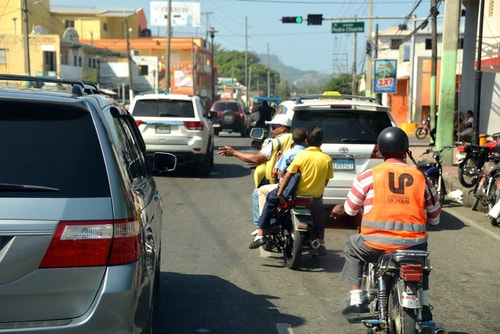
After more than a decade of navigating roads across the Dominican Republic, from smooth multi-lane intercity highways to rutted mountain tracks that barely meet the definition of a paved thoroughfare, long-term resident and seasoned driver Clayton Gush has amassed thousands of miles of firsthand experience, including a handful of minor collisions that shaped his no-nonsense approach to road safety. His core guiding rule for every new driver behind the wheel in the country may sound startling at first: operate your vehicle under the assumption that every other road user is actively trying to harm you.
Gush is quick to clarify this is not a jab at local Dominican drivers, nor a claim that reckless behavior is tied to nationality. He notes that expats and first-time tourist visitors often drive just as carelessly, if not more so, as they adjust to unfamiliar road norms. The mantra is simply a memorable framing for rigorous, proactive defensive driving: prioritizing anticipation of potential hazards rather than only reacting to events as they unfold in front of you. He has spent years instilling this framework, and a set of accompanying actionable principles, in his two daughters as they learned to drive locally, drawing both on universal safety best practices and hard lessons earned on Dominican tarmac.
First, never accelerate blindly the second a traffic light turns green. Pause for a full second, scan both left and right cross-traffic, and confirm the intersection is fully clear before proceeding. It is extremely common for drivers to squeeze through intersections long after their light has shifted to red, and even a completely justified collision will leave you facing costly damage and potential injury. Gush also emphasizes strict adherence to stopping at red lights even on seemingly empty roads, both to follow local traffic law and set a positive example for other road users. A green light only grants you permission to move forward — it never guarantees a hazard-free path.
His second core practice, which he dubs “driving like a lone wolf,” centers on intentionally creating a buffer of open space around your vehicle whenever possible. If you are tailgating another car, ease off the accelerator to extend your following distance. If a driver behind you is riding your bumper, wait for a safe stretch of road to pull over and let them pass. If you find yourself surrounded by a cluster of vehicles moving at mismatched speeds, adjust your position to avoid getting boxed in on all sides. This does not mean reckless speeding or crawling along so slowly that you become a road hazard yourself: the goal is to maintain maximum maneuvering room to respond instantly to unexpected events.
He also stresses unwavering vigilance around blind spots, given that motorcycles are a ubiquitous, affordable primary mode of daily transport for millions across the country. These small, agile two-wheelers can easily slip into gaps beside your vehicle between mirror checks, so before every turn, lane change, or curb pull-out, activate your signal well in advance, scan your mirrors, physically turn to check your blind spot, and confirm the space is clear a second time. That extra two seconds of attention can save a motorcyclist’s life.
Drivers should also develop a precise sense of exactly where their four tires sit on the road surface. Many local drivers drift close to the center line, but Gush advises leaving extra room between your vehicle and oncoming traffic on narrow rural roads, while avoiding straying too far toward the shoulder where you may encounter unmarked drainage ditches, deep potholes, jaywalking pedestrians, or parked motorcycles. Always scan far ahead at the full stretch of road in front of you, rather than only fixating on the bumper of the car directly ahead.
Excessive speed is one of the greatest avoidable risks on Dominican roads. Reaction time drops sharply the faster you travel, and the force of any collision rises exponentially with increased velocity. Local road conditions can shift in an instant: a motorcycle can pull out from an unmarked side street, a pedestrian can step out from behind a parked vehicle, or a deep hidden pothole can appear in the shadow of a roadside tree. Travel at a speed calibrated to match current road conditions, traffic density, and visibility — shaving five minutes off your travel time is never worth a potentially catastrophic crash.
Gush also notes that the Dominican Republic’s harsh climate, with intense year-round heat, high humidity, and rough uneven road surfaces, puts unusual strain on vehicle components. Car batteries degrade far faster in high temperatures, so schedule regular testing to avoid being stranded with a dead battery in a remote area. Tires also wear rapidly from rough pavement, sharp scattered debris, and extreme heat, but the country’s widespread affordable neighborhood tire repair shops (known locally as gomerías) make maintenance accessible, from well-regarded local spots like David Tire in Sosúa to small independent roadside vendors. While new tires are always the safest option, properly inspected used tires with intact tread and no structural damage are a far better temporary alternative than driving on dangerously bald, worn rubber, especially during the wet rainy season when hydroplaning risks spike.
A dual-facing dashcam that records both front and rear road activity is another high-value investment. Footage from a working dashcam can resolve disputes after collisions or traffic stops, eliminating conflicting he-said-she-said accounts to clarify exactly what transpired. Always confirm the device has a functional memory card, accurate date and time settings, and is actively recording before you start every drive.
All drivers should also familiarize themselves with Dominican Republic’s national traffic regulations under Law 63-17, which requires valid local or converted foreign driver’s licenses, active motor vehicle insurance, up-to-date vehicle registration documents, and a current annual marbete road tax sticker. Foreign visitors should confirm their home country license is valid for short-term use, while long-term expats can access a formal license conversion process through the national transit authority INTRANT. Gush also advises reviewing your insurance policy to confirm the minimum legally required coverage is sufficient to protect you in the event of a serious accident. Universal baseline safety rules still apply everywhere: always wear your seatbelt, never use a mobile phone while driving, and never operate a vehicle under the influence of alcohol or other impairing substances.
Finally, leave all road rage at home. Driving norms in the Dominican Republic will differ from what many visitors and expats are accustomed to in their home countries, and it is easy to feel frustrated by unfamiliar traffic patterns. But shouting, making threatening gestures, or attempting to chase down or “teach a lesson” to another driver can escalate into extremely dangerous, unpredictable outcomes. Even if you have the legal right of way, being technically correct is never worth risking serious injury. Let aggressive drivers pass, create extra space, and continue on your route calmly.
Gush acknowledges that even decades of defensive driving practice cannot eliminate all collision risk, and he has been involved in incidents through no fault of his own over the years. But he also notes that Dominican roads are full of small, uncelebrated acts of kindness: strangers stopping to help push a broken-down car off the pavement, drivers pausing to let families cross busy streets, and communities stepping in to assist after minor crashes. The country’s scenic coastal routes and winding mountain roads offer unparalleled freedom to explore its natural beauty, but they demand full, constant attention from every person behind the wheel. At the end of the day, no driver can control the behavior of everyone else on the road — they can only control their own choices. Driving is a shared responsibility that impacts the safety of every person nearby, and the core goal of every trip should be to arrive home safe and unharmed.
Driving in the Dominican Republic