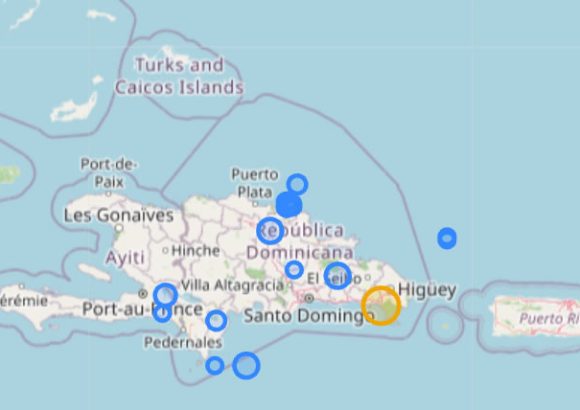
Santo Domingo, Dominican Republic – The National Seismology Center under the prestigious Autonomous University of Santo Domingo (UASD) has confirmed that two nearly overlapping moderate seismic events rattled the coastal Caribbean region on the morning of Saturday, November 21, unfolding within a single second of each other shortly after 11 a.m. local time. According to the center’s official seismic monitoring logs, the first tremor, registering a 4.6 magnitude on the Richter scale, was detected at 11:00:11 a.m., centered 14.3 kilometers due east of Catalina Island, at a relatively deep subsurface depth of 105.6 kilometers. Barely one second later, a 4.7 magnitude earthquake was recorded by the university’s nationwide sensor network, occurring at a depth of 111.4 kilometers. The significant depth of both seismic events likely softened the intensity of shaking felt by coastal and island communities on the Dominican Republic’s southeastern shoreline. As of the latest public update released by the UASD Seismology Center, officials have not received any verified reports of structural damage to residential or public infrastructure, nor any notifications of personal injuries linked to the twin tremors. Local emergency management agencies are continuing to conduct routine spot checks in high-risk coastal zones to confirm no unreported harm has occurred, while the seismology center has advised residents to maintain standard earthquake preparedness protocols as a precaution. This latest seismic activity falls within the expected range of low-to-moderate tremors common to the Caribbean’s active tectonic plate boundary, a region well-documented for regular geological shifts due to the interaction of the North American and Caribbean tectonic plates. Readers can follow DominicanScope for ongoing real-time updates on local seismic activity and related public safety announcements.
Two earthquakes measuring 4.7 and 4.6 recorded near La Romana, Dominican Republic