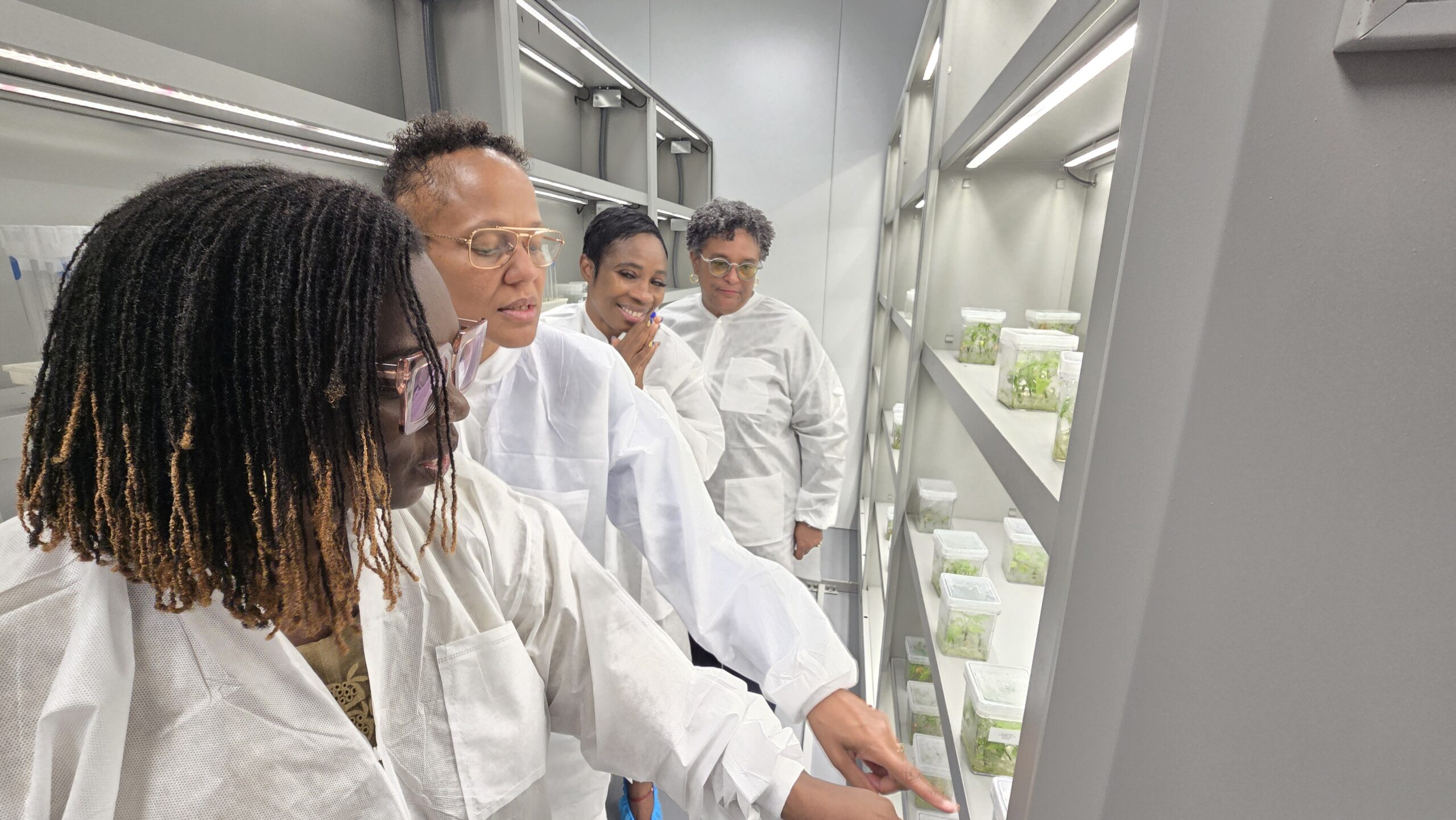
On a Friday ceremony at the Home Agricultural Station in St Philip, Barbados’ Ministry of Agriculture, Food and Nutritional Security officially inaugurated its state-of-the-art Plant Tissue Culture Laboratory, a transformative agricultural facility set to deliver a minimum of 500,000 high-quality plantlets annually – more than 12 times the 40,000-unit output of its 32-year-old predecessor. The original 1994 lab was initially built to support the local cut-flower industry, prioritizing anthuriums and orchids, before gradually shifting its focus to disease-free propagation of staple food crops including 30+ varieties of sweet potato and cassava over decades of operation. Persistent contamination issues stemming from outdated cooling systems prompted the ministry to seek funding for a replacement commercial air-conditioning unit in 2023, a review that ultimately led officials to conclude the aging facility could never meet the country’s fast-growing agricultural production targets, spurring the decision to construct the purpose-built new lab. Presiding over the launch, Prime Minister Mia Mottley framed the investment as a cornerstone of Barbados’ multi-pronged national strategy to advance food sovereignty, mitigate climate-related food supply disruptions, and reduce public health burdens linked to overconsumption of processed imported foods. Mottley emphasized that scaling up domestic production of nutrient-dense root crops and fresh vegetables would cut household reliance on costly vitamin supplements and packaged processed goods, addressing two overlapping national crises: rising diet-related public health challenges and growing vulnerability to global food chain shocks. Equipped with industry-leading micropropagation technology, the new lab generates genetically uniform, disease-free, climate-resilient plantlets suited to a far broader portfolio of crops, directly supporting the ministry’s 15-crop escalation program designed to accelerate local food production, as well as national agricultural export expansion goals. The facility will also extend its technical services to serve neighboring Caribbean nations, aligning with regional collective efforts to strengthen cross-border food security frameworks. Director of the Plant Tissue Culture Laboratory Dr Sophia Marshall hailed the opening as a historic milestone, noting that rising extreme weather patterns, emerging crop pest threats, and growing consumer demand for consistent high-yield harvests had rendered traditional agricultural propagation methods insufficient to meet national needs. Agriculture Minister Dr Shantal Munro-Knight highlighted that local farming stakeholders were actively included in the inauguration event to ensure the research and innovation roadmap for the new lab is co-designed with the communities it is intended to support, stressing that regional collaboration is essential to deliver meaningful agricultural transformation across the Caribbean. In a bid to nurture the next generation of Barbadian agricultural science talent, Prime Minister Mottley announced two targeted youth engagement initiatives: a personally funded essay competition for students from St Cyprian’s Boys’ School, where the top prize is a new tablet device and submissions are due by the end of January, and a separate project-based food security competition for Foundation School students that will reward the top three entries for work tied to the new laboratory’s mandate. Mottley directly appealed to the young students in attendance to pursue careers in agricultural science, expressing hope that several would go on to become leading food and agricultural sector scientists for the nation. Closing her address to the lab’s incoming operational staff, Mottley urged all team members to view their work as a core national mission, noting that the facility’s success holds the key to a critical course correction for Barbados as it navigates overlapping threats of climate crisis, food supply volatility, and public health challenges. The government also confirmed that two additional specialized facilities – a veterinary laboratory and a general analytical laboratory – are slated for development in the upcoming fiscal year to further expand the country’s agricultural and food safety infrastructure.