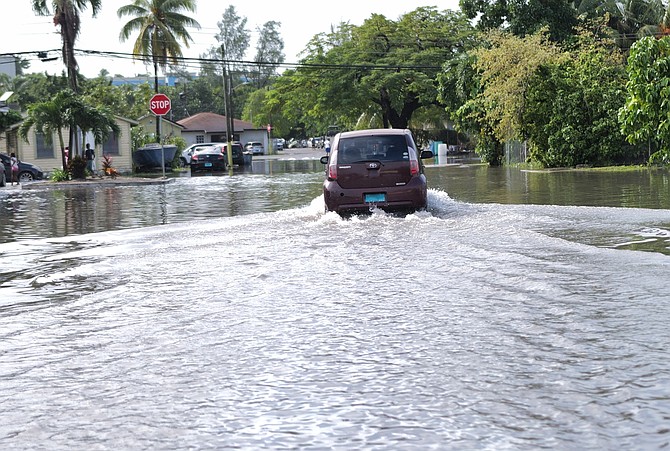
Torrential, unseasonal downpours swept across New Providence island in the Bahamas yesterday, triggering widespread flash flooding that submerged residential yards, disrupted public services, displaced vulnerable residents, and inflicted costly property damage, even as local officials acknowledged long-promised flood mitigation equipment for one of the island’s most chronically waterlogged communities had only just cleared customs and arrived on local shores.
Shocking on-the-ground footage and user-shared photographs documented the scale of the disaster: murky brown floodwaters climbed as high as the hoods of mid-sized passenger vehicles, entire cars were partially submerged along major thoroughfares, and multiple service stations were forced to suspend operations after rising water overwhelmed their premises. Dozens of households in historically flood-prone neighborhoods reported standing water seeping into ground-floor living spaces within hours of the rain’s peak.
The Ministry of Education, Science and Technology made the unprecedented call to shutter all public K-12 schools across the island for the day, while the University of The Bahamas shifted all in-person classes to remote delivery, closing its Oakes Field main campus, Grosvenor Close Centre, Harry C Moore Library and on-site Chapter One Bookstore to avoid endangering staff and students navigating submerged access roads.
For Georgette Gardiner, a Fox Hill resident on Romer Street, the crisis unfolded the moment she woke to find her entire yard submerged. Panic set in immediately as she realized her 71-year-old mother and 91-year-old father were still asleep inside the home, trapped by rising water. The family has lost all their ground-floor furniture to flood damage on three separate occasions, and during 2019’s Hurricane Dorian, standing water inside their home reached knee height. While yesterday’s waters did not breach the home’s interior, passing motorists navigating the street sent constant waves of floodwater spilling over the low yard perimeter, forcing Gardiner to wade through nearly calf-deep water just to reach her car, which was nearly encircled by the flood. Her elderly mother, wearing plastic bags wrapped around her shoes to keep them dry, stood shivering in the rain to open the heavy driveway gate for her, sobbing openly out of fear that the water would soon creep into the family home. The elderly couple remained stranded indoors for the entire rest of the morning: their low-clearance sedan could not be opened without floodwater pouring into the cabin, and Gardiner’s 91-year-old father missed a long-scheduled critical eye care appointment. Gardiner said she broke down in tears mid-commute to work, overwhelmed by anxiety that her elderly parents could suffer a fall or medical emergency while trapped, and prayed fervently that the heavy rain would not continue through the night to worsen the crisis.
Over in Pinewood Gardens, a community so chronically plagued by flooding that residents have previously relied on kayaks and small sailboats to traverse submerged streets during storm events, 25-year local resident Jason Clarke woke to find ankle-deep standing water pooling inside his Claudia Street home. Because the neighborhood’s homes are connected to a shared sewer pump system, flooding triggers immediate sewage backflow: residents cannot flush toilets, run bathtubs, or use any water-related fixtures without raw waste spilling back up into their home plumbing. “You can’t bathe. You can’t flush the toilet. You can’t do nothing at all,” Clarke explained. He purchased his seventh brand-new refrigerator last December after six previous units were destroyed by successive flood events, only to find the new appliance also damaged by this week’s standing water. Over decades, floodwaters have ruined dozens of beds, sofas, and household belongings, and Clarke estimates his family has spent more than $20,000 replacing damaged items, repairing water-damaged structural elements, and remediating toxic mould growth after each flood. “When the water starts coming, everyone has to rush to lift their shoes, their furniture, everything up off the floor. It’s just absolute chaos,” he said, adding that he is “sick and tired” of empty government promises of flood relief that never materialize, and demanded that local officials finally “do something concrete” to resolve the crisis.
Back in July, the Bahamian government announced a $2.6 million pilot project to install four specialized lift drainage stations across Pinewood Gardens, with Works and Family Island Affairs Minister Clay Sweeting stating at the time that all equipment had been ordered and was scheduled to arrive in the country within three to four weeks. The lift stations are designed to automatically pump excess stormwater into deep, purpose-built disposal wells when heavy rain overwhelms the area’s outdated, overstretched natural drainage system, with officials projecting the full 12-month construction timeline would begin immediately after the equipment arrived. “The lift stations are finally in the country. Work was supposed to start this week, but due to the unprecedented heavy rainfall, the contractor was not able to mobilize to begin site work,” Sweeting confirmed yesterday, noting that crews are now scheduled to break ground on the long-delayed project next week. He added that the Ministry of Works had been coordinating emergency response plans with the national Disaster Risk Management Authority for 48 hours prior to the storm, after observing catastrophic flash floods hit South Florida, where some areas received nearly 12 inches of rain in a two-day window. Acting chief engineer Francis Clarke confirmed that the Ministry of Works had 12 heavy-duty water pumps on standby across the island, with nine dedicated response teams patrolling nine separate zones around the clock through the night to clear blocked drains and pump out standing water. Crews were dispatched first to priority flood hotspots in Pinewood Gardens and Cox Street, with two additional pumps being redeployed to Bernard Road in Fox Hill, and the ministry committed to prioritizing all urgent resident complaints submitted through its public 24-hour hotline.
Cristobal Gomez, general manager of local tile business Nassau Tile and property manager for multiple downtown Nassau parcels, blasted the government for decades of deliberate neglect of the downtown drainage network. “The government’s utter negligence in maintaining the downtown drainage system has had a devastating, long-lasting negative impact on local downtown businesses. It is absolutely deplorable,” he said. Gomez noted that Prime Minister Philip “Brave” Davis drove through Dowdeswell Street back in 2024, and gave explicit public assurances that the road would be fully repaved and the failing drainage system completely repaired. “Well, it is November 2026, two full years later, and no tangible, meaningful work has been done to fix the downtown flooding issues at all,” he pointed out, adding that the government had mailed out annual real property tax bills for downtown properties just this past Sunday, the exact same week that dozens of local businesses were swamped by flood damage. “We are being given zero tax relief from the government, even though their failure to maintain critical public infrastructure is the direct cause of all our losses,” he said.
Rudolph Taylor, president of the Bahamas Unified Bus Drivers Union, reported that multiple union members suffered catastrophic damage to their public transit bus engines after driving through floodwaters that were far deeper than expected due to hidden, water-filled potholes in high-traffic corridors including Pinewood Gardens, East Street South and Bay Street. “The repair costs are going to be massive for these drivers: just replacing a water-damaged crankshaft alone costs $2,800,” he explained, noting that the affected roadways were built at improperly low elevations and lack any functional supplementary drainage, but that bus drivers remained on their routes all day to serve commuters. “Sun or rain, we are out there working to get people where they need to go,” Taylor said.
Don Williams, chairman of the Bahamas Chamber of Commerce and Employers’ Confederation, noted that most local businesses avoided full shutdowns, but had to implement flexible scheduling policies as many employees struggled to navigate submerged roads to reach their workplaces. “Even without a massive, record-breaking rain event, Dowdeswell Street floods every single time there is a moderate downpour,” he noted, adding that he had granted flexible work arrangements to two of his own employees, one based in Coral Harbour and one from the island’s eastern districts, who were trapped by flooded highway segments, as well as all chamber administrative staff. A handful of local businesses even operated at near-full capacity: Donnalee Miller, operations manager at Empire Fitness in Seagrapes Shopping Plaza, arrived at the gym shortly before 5 a.m. to find the entire parking lot submerged, but the facility remained busy, with many regular patrons parking on the sidewalk to access the building. The gym shared a lighthearted social media post showing the flooded parking lot, thanking all staff for making it to their shifts safely. At Lorene’s retail shop in Palmdale, manager Asha Miller reported the immediate neighborhood escaped severe flooding, and shoppers continued to arrive throughout the day, even if their commutes took far longer than usual. “People are determined to get the items they need, and if they want something, they will find a way to get here,” she said.
In Perpall Tract, a community that saw dozens of residents stranded for days after Tropical Storm Imelda cut off all access to the neighborhood last year, local resident Andrea Moxey said yesterday’s flood event was far more manageable, even as standing water pooled across every residential street. During Imelda, floodwaters reached two feet high outside her condominium, leaving her trapped inside for 48 hours with her mother and four-year-old son. Moxey added that she remains deeply concerned about how the community will cope once construction breaks ground on the proposed $268 million specialty hospital planned for Perpall Tract, a project that local residents have long publicly opposed over well-documented fears that the development will permanently worsen chronic flooding in the area. The Bahamas Department of Meteorology had issued a public advisory days prior warning of an elevated island-wide flash flood risk, noting that a combination of slow-moving atmospheric troughing and abundant tropical moisture would continue to fuel heavy, prolonged showers, severe thunderstorms, and sudden flash flood events across all Bahamian islands for the coming 72 hours.