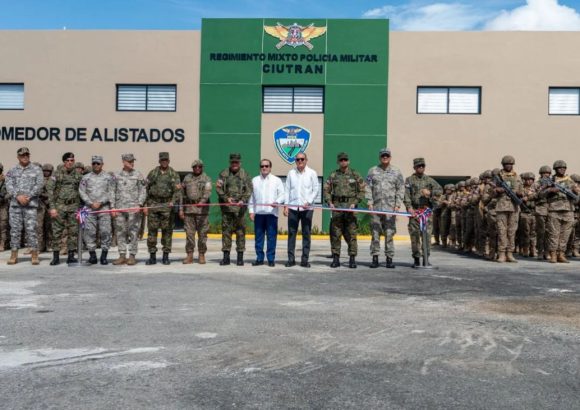
Santo Domingo, Dominican Republic – The Dominican Republic’s Ministry of Defense has officially unveiled purpose-built new operational facilities and formally rebranded the long-running Ciudad Tranquila (widely known by its Spanish acronym Ciutran) initiative as a fully structured Mixed Military Police Regiment, a landmark institutional upgrade that significantly expands the Dominican Armed Forces’ operational capacity to backstop the National Police in nationwide public safety and citizen security deployments.
The official inauguration ceremony was presided over by Presidency Minister José Ignacio Paliza, who attended the event as the official representative of sitting President Luis Abinader, alongside Defense Minister Lieutenant General Carlos Antonio Fernández Onofre and a cohort of senior national security officials, local municipal leaders and armed forces command staff.
Unlike its previous iteration as an ad-hoc temporary task force, the newly designated regiment operates as a permanent, specialized tiered unit mandated to carry out a full spectrum of public safety support missions: proactive community preventive patrols, large-scale crowd management and civil disturbance response, targeted urban security operations, round-the-clock protection for critical national infrastructure sites, and a range of additional deployments to reinforce civilian government agencies during high-demand security scenarios.
Defense Minister Fernández Onofre contextualized the unit’s two-decade institutional legacy, noting that Ciutran was first launched in 2006 as a nimble interagency military task force that spent nearly 19 years refining cross-institutional collaborative operations alongside civilian law enforcement. Its formal elevation to a permanent regiment was codified via official Resolution No. 09-2025, issued in December 2025, which formalized a clear, hierarchical command structure, delineated dedicated specialized sub-units for distinct mission profiles, and embedded the regiment as a core permanent component of the Dominican national security architecture.
A centerpiece of the modernization rollout is the brand-new 2,011-square-meter purpose-built base facility, completed in a 12-month construction timeline, with on-site accommodation and operational support infrastructure capable of housing up to 350 active service members. The purpose-designed complex includes full-service troop dining halls, a commercial-grade industrial kitchen, climate-controlled cold storage for supplies and rations, a multi-use training and assembly auditorium, dedicated administrative workspaces, and a suite of auxiliary amenities built to streamline on-site troop accommodation, ongoing skills training, and rapid mobilization for field operations.
Alongside the new facilities, the regiment has received a full fleet of upgraded operational hardware: 10 heavy-duty patrol trucks, four armored personnel carriers, a fleet of tactical motorcycles, IWI ARAD 5.56-caliber assault rifles, Negev light machine guns, tactical shotguns, and a suite of other mission-specific specialized gear. All new official uniforms issued to the regiment’s service members were manufactured domestically by the Dominican Military Industry, supporting local defense manufacturing supply chains.
The multi-phase modernization framework also includes a structured specialized training pipeline for all regiment personnel, with curated courses hosted in partnership with the Colombian Military Police Academy that cover core military police operational protocols, human rights compliance standards, and evidence-based frameworks for the proportional, lawful use of force during public safety deployments.
Government officials emphasized that the full Ciutran relaunch is strategically designed to break down long-standing coordination silos between disparate national security institutions, and deliver a far better resourced, highly trained dedicated military support unit that can seamlessly collaborate with civilian law enforcement during any crisis or large-scale public event that demands a synchronized, coordinated multi-agency response. The initiative forms a key pillar of the Abinader administration’s multi-year public safety enhancement agenda targeted at reducing crime rates and boosting community-wide perceptions of safety across Dominican national territory.