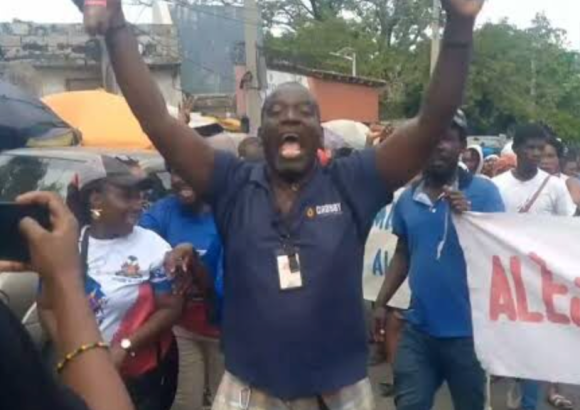
Thousands of Haitian civilians flooded the streets of Port-au-Prince on Tuesday to stage public rallies voicing full-throated support for Salvadoran President Nayib Bukele’s decision to deploy military personnel to Haiti to push back against violent armed gangs that have terrorized local communities for years. Protesters carried national Haitian flags, raised clenched fists in solidarity, and chanted demands for expanded deployment of drone surveillance and other advanced technological tools to retake neighborhoods currently under total gang control.
Bukele dispatched roughly 2,500 Salvadoran service members to Haitian territory last month, a move triggered by a brazen attack that left four Salvadoran aviation personnel unaccounted for; the four men remain missing as of press time. Since the deployment landed, armed clashes between criminal gangs, local Haitian security forces, and the newly arrived Salvadoran troops have escalated sharply across gang-dominated swathes of the capital. Independent security analysts have repeatedly flagged a critical gap in the current intervention framework: no clear, actionable long-term roadmap to sustain public stability after all international military forces eventually withdraw from the country.
A new public report released the same day by the International Crisis Group (ICG) underscored this systemic risk, noting that Haiti urgently requires a unified national security strategy designed to align the operations of local police units, national military forces, and all international security partners under a single coordinated framework. The global conflict prevention organization emphasized that while foreign military deployments can temporarily disrupt gang operations and erode their operational capacity, no external intervention will permanently dismantle armed criminal networks unless paired with targeted investments to rebuild Haiti’s chronically weakened state institutions.
At present, Haiti’s fragmented security landscape includes overlapping, often uncoordinated groups: the under-resourced national police, the newly reactivated Haitian military, a UN-authorized multinational security support mission, informal armed civilian vigilante groups, private security contractors, and the recently deployed Salvadoran troops. The ICG report noted that the lack of a single overarching governing strategy has created a chaotic operational environment where disparate police units operate under conflicting sets of guidelines, many of which are dictated unilaterally by their respective foreign funding donors rather than aligned with Haitian national security priorities.
The ICG also laid out long-documented structural flaws plaguing the Haitian National Police, including severe understaffing, insufficient operational training, poverty-level salaries for frontline officers, and a promotion system that rarely prioritizes demonstrated merit. The organization issued formal policy recommendations calling for immediate upgrades to officer compensation and work facilities, targeted specialized tactical training for gang counteroperations, and full implementation of a transparent, performance-based promotion framework to rebuild the force’s credibility and effectiveness.
The report also analyzed the rising use of aerial assets including attack helicopters and explosive-armed drones in ongoing counter-gang operations. While these technologies initially delivered a psychological shock that undermined the confidence of senior gang leaders, the ICG confirmed that their operational impact has steadily faded over time, and they have not driven any meaningful shift in the territorial control gangs maintain across large swathes of Port-au-Prince and rural Haiti. The organization further noted that an immediate blanket ban on explosive drone use would be entirely unfeasible under current security conditions, but stressed that all parties involved in counter-gang operations must prioritize strict safeguards to prevent avoidable civilian casualties. The ICG’s data shows that more than 20,000 Haitian residents have been killed in gang-related violence over the last five years.
Even amid widespread expert concerns over the lack of long-term planning, Bukele’s intervention has earned significant popular support among segments of the Haitian public, who view the Salvadoran deployment as a far more robust, action-oriented response than the series of slow, under-resourced international missions that preceded it. Cliford Vital, a Port-au-Prince resident who joined Tuesday’s demonstrations, shared that the arrival of Salvadoran troops had already shifted the long-standing “balance of fear” that had left local residents terrified of gang retaliation for years, giving ordinary citizens a new sense of safety.
Haiti’s Minister of Justice Patrick Pélissier traveled to El Salvador earlier this week to attend a regional international security conference, where he is scheduled to hold closed-door bilateral meetings with senior Salvadoran government officials to discuss ongoing security cooperation. Salvadoran Vice President Félix Ulloa confirmed that the full text of the bilateral security agreement governing the troop deployment will remain confidential and not be released to the public. Senior Salvadoran officials have repeatedly stated that all deployed troops will return home immediately once the four missing Salvadoran aviation technicians are located and safely repatriated. Salvadoran Security Minister Gustavo Villatoro added that the broader, longer-term objective of the intervention is to support Haitian authorities in building fully functional, independent state institutions and establishing sustainable rule of law across the country.