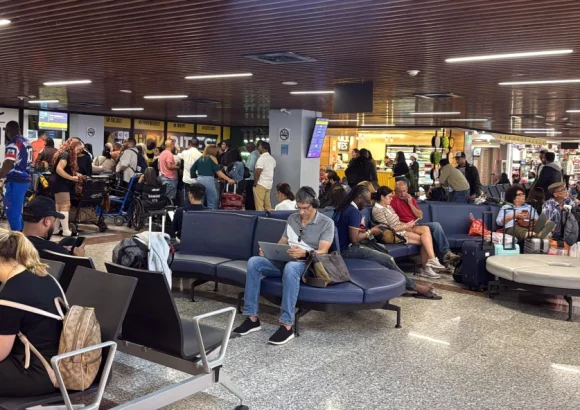
Hundreds of passengers passing through Dr. José Francisco Peña Gómez Las Américas International Airport in the Dominican Republic found themselves stuck in extended, unplanned layovers this week after all inbound and outbound commercial flights connecting to the United States were abruptly suspended, throwing carefully laid travel schedules into total disarray. For many of the stranded travelers, the sudden operational freeze erased pre-planned arrangements to return to homes, workplaces, and family gatherings across U.S. territories, leaving them with no clear timeline for when they would be able to resume their journeys. Passengers waiting in crowded airport terminals shared a mix of frustration, lingering uncertainty, and cautious optimism as they navigated the chaos of last-minute schedule shifts and limited official updates. Many of those booked on U.S.-bound routes reported their departure times were pushed back repeatedly over the course of hours, with no concrete guarantees of takeoff. One Dominican traveler, Lisa Corporán, detailed her own cascading schedule disruptions in remarks to local outlet *Hoy*, noting her flight bound for Boston that was originally slated for a 5:30 p.m. departure was first pushed to 6 p.m., then 8 p.m., then 9 p.m., before being rescheduled for 4 a.m. the following day. “It’s obvious this disruption will ripple out and cause cascading delays for days, but what support are the airlines and airport administration providing for all the foreign and local passengers stuck here?” Corporán questioned. The nationwide U.S. flight pause that triggered the cross-border travel chaos was addressed publicly by U.S. Homeland Security Secretary Markwayne Mullin during a press briefing at the White House, where he moved quickly to dispel widespread public fears that the shutdown was tied to an active terrorist threat. Mullin clarified that the full suspension of takeoff operations across U.S. airports was rooted in an unplanned telecommunications system failure, not a security incident, and emphasized that the public had no cause for heightened alarm over public safety. “There is no reason for anyone to feel fear, or to worry about the safety of their loved ones who are traveling. This is not a repeat of the 9/11 attacks,” Mullin told assembled reporters. He acknowledged that many members of the public immediately drew parallels to the 2001 terror attacks, which marked the only prior instance of a full nationwide U.S. flight ground stop, but stressed that the two events were entirely unrelated in cause and risk profile. As airport staff in the Dominican Republic worked to coordinate with U.S. aviation authorities and airline operators to outline a path to resume regular transborder services, many stranded passengers held out hope that full flight operations would be restored in short order to let them reach their final destinations without further extended delays. This on-the-ground report is part of DominicanScope’s coverage of local breaking news events across the country.
Passengers stranded in the Dominican Republic express their discomfort after the suspension of flights in the U.S.