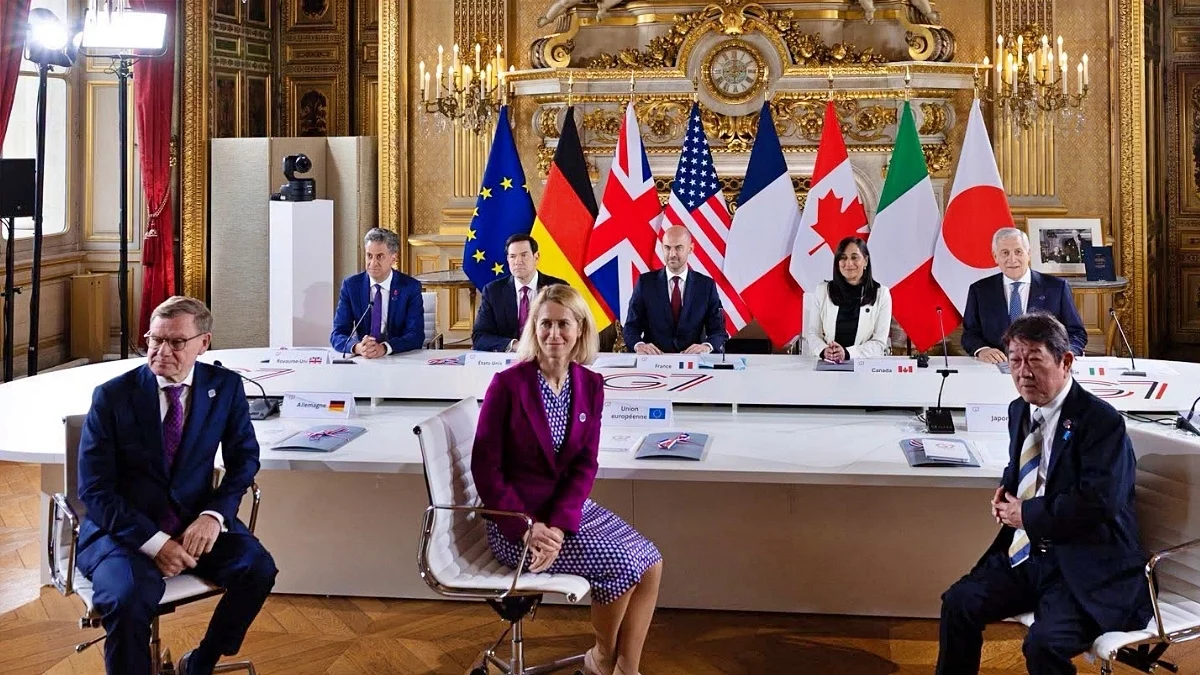
Meeting under France’s 2026 G7 presidency in Paris on November 9 and 10, top diplomatic representatives from the Group of Seven leading economies released a unified joint statement laying out a comprehensive roadmap to address Haiti’s cascading security, political and humanitarian crises. The gathering brought together Germany’s Federal Foreign Office head Johann Wadephul, Canada’s Foreign Affairs Minister Anita Anand, U.S. Secretary of State Marco Rubio, France’s Minister for Europe and Foreign Affairs Jean-Noël Barrot, Italy’s Deputy Prime Minister and Foreign Affairs chief Antonio Tajani, Japan’s Foreign Minister Toshimitsu Motegi, and the United Kingdom’s Foreign, Commonwealth and Development Affairs Secretary Ed Miliband.
The bloc formally endorsed the extension of the Gang Suppression Force (GSF) mandate through the end of March 2027, a move designed to bolster local Haitian security forces’ ongoing operations to dismantle armed criminal networks and restore nationwide public order. G7 ministers also voiced explicit support for the renewal of the United Nations targeted sanctions regime, which is structured to impose tangible consequences on individuals and organizations that undermine Haiti’s fragile peace, security and institutional stability. The collective communiqué calls on the broader global community to direct additional resources toward professionalizing the Haitian National Police and the reconstituted Armed Forces of Haiti, advancing rule of law reforms, and ending the longstanding culture of impunity that has allowed cycles of violence to persist. All security actors operating on Haitian soil were explicitly urged to center the safety and protection of civilian populations as their non-negotiable top priority during every operational deployment.
Turning to Haiti’s stalled democratic transition, the G7 envoys acknowledged the recent official postponement of the country’s first round of long-awaited democratic elections to July 2027, while recognizing incremental progress made by Haiti’s current transitional government and the Provisional Electoral Council to lay administrative groundwork for the vote. The ministers stressed that Haitian authorities bear full responsibility for implementing the national electoral decree in a fully impartial, transparent manner to safeguard the integrity and public credibility of the entire electoral process, and called for tangible, verifiable steps to rebuild public trust in the vote leading to a legitimate, democratically elected governing body. The statement also flagged the bloc’s significant concern over the inclusion of sanctioned individuals in ongoing political processes, noting that such participation erodes core accountability principles and further erodes Haitian citizens’ already fragile confidence in state institutions. The G7 reaffirmed that the Haitian people hold the inalienable right to chart their own national future through inclusive democratic processes and elected leaders who govern with full integrity in service of the broader public good.
Addressing the nation’s deepening humanitarian emergency, the G7 ministers highlighted their persistent alarm over rampant community violence and widespread documented reports of human rights abuses across Haiti. They issued a global call for nations to scale up financial donations to the dedicated United Nations trust fund supporting the UN-mandated hybrid security mission, warning that the operation’s ability to deliver on its mandate depends entirely on sustained, predictable multilateral funding. The bloc also urged expanded delivery of life-saving humanitarian aid to meet the urgent needs of vulnerable Haitian populations grappling with overlapping crises. Finally, the G7 outlined plans to partner with international financial institutions and multilateral stakeholders to lay structured foundations for long-term Haitian economic recovery, welcoming a recently signed pact between the World Bank and Haitian government that establishes a shared framework to track locally led reform progress and strengthen accountability for development outcomes. The group committed to coordinating closely with a wide cross-section of Haitian civil society, government and global partners to eliminate redundant efforts and maximize the collective impact of all international support initiatives.